
Balsa Glider Competition
Students act as if they are engineers designing gliders, aiming to improve the flight distance and time in the air. First, they determine the controls—the average distance traveled and time aloft for their basic model balsa wood gliders. Then they modify the wings, testing and reworking their altered designs to achieve improvements in distance and time. Using a design procedure whereby one variable is changed and all the others are kept constant, they determine how each modification affects the flight. They make measurements and analyze the class data. This activity brings together students' knowledge of engineering and airplanes, applying what they have previously learned about lift, weight, thrust and drag to glider models, as well as their understanding of the control surfaces—elevator, rudder and aileron—that control pitch, yaw, and roll, respectively.
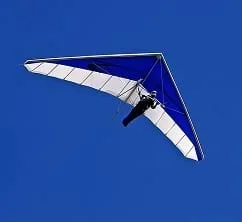 Copyright ElectronicRU (open clip art) https://openclipart.org/detail/27127/glider-picture-by-electronicru
When working with models, engineers test, make changes, test again, make more changes, and so on until they have a successful design. It is important that engineers use the engineering design process in their testing, so they know what to change about the aircraft to fix any problems. Using this process, engineers make improvements and work out the "bugs" so they end up with well-designed aircraft. Also, by using small-size airplane models, the process is less expensive than testing on full-size airplanes.
After this activity, students should be able to:
- Describe the steps of the engineering design process
- Compare a glider model with actual glider flight.
- Use variables to conduct an experiment.
- Use glider models to solve a problem and communicate their results.
- 6.1.2.b Fluently add, subtract, multiply, and divide multidigit decimals using standard algorithms for each operation.
Grade 6
Do you agree with this alignment? - 6.3.1.d.ii.1 Report the number of observations.
Grade 6
Do you agree with this alignment? - 6.1.2.a Fluently divide multi-digit numbers using standard algorithms.
Grade 6
Do you agree with this alignment? - 6.3.1.d.ii.2 Describe the nature of the attribute under investigation, including how it was measured and its units of measurement.
Grade 6
Do you agree with this alignment?
- Use mathematical expressions to describe the movement of an object
Grade 8
Do you agree with this alignment?
- CCSS.Math.Content.6.NS.B.2 Fluently divide multi-digit numbers using the standard algorithm.
Grade 6
Do you agree with this alignment? - CCSS.Math.Content.6.SP.B.5 Summarize numerical data sets in relation to their context, such as by:
Grade 6
Do you agree with this alignment? - CCSS.Math.Content.6.SP.B.5a Reporting the number of observations.
Grade 6
Do you agree with this alignment? - CCSS.Math.Content.6.SP.B.5b Describing the nature of the attribute under investigation, including how it was measured and its units of measurement.
Grade 6
Do you agree with this alignment? - CCSS.Math.Content.6.SP.B.5c Giving quantitative measures of center (median and/or mean) and variability (interquartile range and/or mean absolute deviation), as well as describing any overall pattern and any striking deviations from the overall pattern with reference to the context in which the data were gathered.
Grade 6
Do you agree with this alignment? - CCSS.Math.Content.6.SP.B.5d Relating the choice of measures of center and variability to the shape of the data distribution and the context in which the data were gathered.
Grade 6
Do you agree with this alignment?
- STEL-7P Illustrate the benefits and opportunities associated with different approaches to design.
Grades 6-8
Do you agree with this alignment? - STEL-7Q Apply the technology and engineering design process.
Grades 6-8
Do you agree with this alignment?
- MS-ETS1-2 Evaluate competing design solutions using a systematic process to determine how well they meet the criteria and constraints of the problem.
Grades 6-8
This resource focuses on the following Three Dimensional Learning aspects of NGSS:
Science & Engineering Practices- Evaluate competing design solutions based on jointly developed and agreed-upon design criteria.Do you agree with this alignment?
Disciplinary Core Ideas- There are systematic processes for evaluating solutions with respect to how well they meet the criteria and constraints of a problem.Do you agree with this alignment?
Do you agree with this alignment? - Evaluate competing design solutions based on jointly developed and agreed-upon design criteria.
- MS-ETS1-4 Develop a model to generate data for iterative testing and modification of a proposed object, tool, or process such that an optimal design can be achieved.
Grades 6-8
This resource focuses on the following Three Dimensional Learning aspects of NGSS:
Science & Engineering Practices- Develop a model to generate data to test ideas about designed systems, including those representing inputs and outputs.Do you agree with this alignment?
Disciplinary Core Ideas- Models of all kinds are important for testing solutions.Do you agree with this alignment?
- The iterative process of testing the most promising solutions and modifying what is proposed on the basis of the test results leads to greater refinement and ultimately to an optimal solution.Do you agree with this alignment?
Do you agree with this alignment? - Develop a model to generate data to test ideas about designed systems, including those representing inputs and outputs.
Each group needs:
- balsa wood glider kit, one per student; available at hobby and craft stores
- Balsa Glider Competition Worksheet (PDF), one per student
- sandpaper
- glue
- tape
- scissors, coping saw blades, or razor blades
- safety glasses
For the entire class to share:
- stopwatch
- 50-foot cloth measuring tape 50 feet; see if can borrow from the gym teacher or custodian
Building and flying balsa airplane models is an excellent way to learn about airplane construction and flight. Balsa models are not just toys: engineers also create models of their designs before building the real, full-sized craft or product. Building models was an early method used by the pioneers of aviation. Early designers did not just begin by building flying machines and racing about in them—that would have been far too dangerous. These early inventors and engineers—such as the Wright Brothers—began with building model kites and gliders to learn about flight patterns. At a smaller scale, they played with wing shapes and sizes to see how much kites and gliders could carry. They once created a model kite that could carry a 10-year-old boy!
What is the difference between a glider and an airplane? (Listen to student ideas.) A glider is any aircraft that flies without an engine. Gliders can have all the same parts as an airplane, but use the wind—instead of fuel—for power. How many of you have ever made a glider out of balsa wood? (If possible, show an example of the models they will be making or show them what the balsa wood looks and feels like.) What makes balsa a good material for glider model design? (Possible answers: It is very light, easy to cut and alter; and inexpensive.)
Today, we are going to act as if we are engineers who are designing gliders that can either travel a long distance or stay airborne for a long time. To do this, we are going to look at what the normal time (or, control time) of a balsa glider's ability to travel a distance and to stay aloft. From the information we have learned on the four forces of flight (Who can name them? Answer: lift, weight, thrust and drag), we are going to modify the wings of our glider. This is called the independent variable or the variable (part) of the glider that we will be changing as engineers.
(As necessary, review with the class the four forces that act on airplanes—lift, weight, thrust and drag. Also, review the control surfaces—elevator, rudder and aileron—and what they control—pitch, yaw, and roll, respectively.)
Before the Lesson
- Obtain enough balsa wood plane kits so you have one per student, plus a few extras
- Make copies of the Balsa Glider Competition Worksheet (PDF), one per student.
- Make an overhead transparency of the Class Data Blank Table Overhead (PDF).
With the Students
- Organize the class into groups of four students each.
- Determine baseline controls: To begin, have the class establish the controls: the average distance traveled and average time aloft for a basic glider.
- Have each team select a "representative" to assemble one glider to become the "basic" glider used for control testing.
- Have half of the teams complete a distance test with the basic gliders: have team representatives stand in a central location, and throw the gliders. Measure how far each glider traveled and record in the class data table, then average the distances. This is the distance control.
- Repeat this process to find the average time aloft with the other half of the teams and using the stopwatch. Record in the class data table the time aloft for each team and average the times. This is the time control.
- Note: If time allows, have each team representative throw his/her glider one at a time so that all students can observe the flight of the gliders. However, regardless of time, unless several stopwatches and adults are available to record the gliders' time aloft, students will have to do this step one at a time.
- Design: Working in their groups, have team members propose wing shapes that they would like to design to increase either the distance or time aloft of their gliders. Emphasize the benefits of teamwork in engineering: listen to everyone's ideas and make sure everyone participates. To help with this, have each team member use the space provided on the worksheet to draw a wing shape for each (control) variable, and write a sentence or two explaining why s/he decided on that particular shape for each variable. The new wing shapes are the independent variables. Then have team members share their ideas, discuss the pros and cons of each idea and come to agreement (or vote, if necessary) on the two shapes that they would like to try out on their gliders.
- Build: Within the groups, have pairs work together to build the modified gliders.
- At this point, each group of four should have three glider kits left, since one was used to build the "basic" test glider.
- Students may decide to use the final glider kit for parts to supplement the other gliders or save the kit in case any mistakes are made.
- Remind them that mistakes do happen during the engineering process and we can learn from our failures.
- Now, it is time to build!
- Give teams enough time to trial run their designs and rework them as necessary.Test: When ready, have each team test their gliders. Have the student pairs within each team fly their glider three times and record the distance traveled and time aloft for each flight. (These three times are their trials.) The new results are the dependent variables. Have the student pairs average their results.
5. Test: When ready, have each team test their gliders. Have the student pairs within each team fly their glider three times and record the distance traveled and time aloft for each flight. (These three times are their trials.) The new results are the dependent variables. Have the student pairs average their results.
6. Analysis: When all teams have finished their trials, compile all team data into the class data table and examine the results:
- Average all of the class results: Did the changes the teams made to their wing shapes improve the flying distance and time aloft compared to the basic glider?
- Determine the most common (mode) flying time and distance traveled for the class. If there is not a single mode, did most of the planes travel close to the same distance/time?
- Determine the longest distance traveled and time aloft for the entire class. Why do those specific gliders have the best overall results?
Pre-Activity Assessment
Review Discussion: Review with the class the four forces that act on airplanes—lift, weight, thrust, and drag. Also review the control surfaces—elevator, rudder and aileron—and what they control—pitch, yaw and roll, respectively. Show a picture of an airplane or draw one on the board to point out the forces and control surfaces.
Activity-Embedded Assessment
Worksheet/Pairs Check: Have students work individually or in pairs on the Balsa Glider Competition Worksheet (PDF). Have students who work in pairs check each other's answers.
- Have students use the space provided in the worksheet to sketch the wing shape they would like to use.
- Have students record the results of their glider trials on the worksheet chart.
Post-Activity Assessment
Discussion: Lead a discussion on the distance the gliders flew. Start out by asking students if their predictions (on the worksheet) were correct. Then compare which wing designs worked and which ones did not and why.
Figure Drawing/Engineering Design: Have student apply what they learned about which wing designs worked and which ones did not to design new gliders on paper. Have them draw the four forces of flight affecting their glider and how their wing design is developed with those forces in mind.
If students are cutting the balsa with saws or razor blades, set up a cutting station where all of the cutting is performed so that you can keep an eye on any safety risks.
Require students to wear safety glasses when cutting the wood.
Make sure students know how to use the materials and tools. To ensure safety, model the correct use of each tool.
If weather permits, conduct the flights outside and spread out so students are not hit with flying gliders and do not accidentally step on others' gliders.
Drawing Conclusions: Have students record other attributes of their planes such as the weight, the wing area, the use of control surfaces, and the plane length. Have them draw conclusions as to how these variables affect flight attributes, such as flight distance, flight time and aircraft stability.
Graphing: Have students or teams create bar graphs of the shape of the wing vs. distance or time. The x-axis could represent the control airplane, wing shape #1, and wing shape #2. Have them explain the patterns of their graphs to the rest of the class.
Back to the Drawing Board! Have teams circle back to earlier steps of the engineering design process to come up with improvements to their original designs. Have them modify other aspects of the designs such as wing length or have them put control surfaces on the wings. Suggest they use any of the extra balsa wood for parts.
- Up, Up and Away! - Airplanes
- Can You Take the Pressure?
- May the Force Be with You: Lift
- May the Force Be with You: Weight
- May the Force Be with You: Thrust
- May the Force Be with You: Drag
- Take Off with Paper Airplanes
- Airplane Tails & Wings: Are You in Control?
- Airplanes Everywhere: Land, Water, Sky, Oh My!
- Will It Fly?
- Balsa Glider Competition
- Future Flights: Imagine Your Own Flying Machines!
Contributors
Tom Rutkowski; Alex Conner; Geoffrey Hill; Malinda Schaefer Zarske; Janet Yowell
Supporting Program
Integrated Teaching and Learning Program, College of Engineering, University of Colorado Boulder
Acknowledgements
The contents of this digital library curriculum were developed under grants from the Fund for the Improvement of Postsecondary Education (FIPSE), U.S. Department of Education and National Science Foundation (GK-12 grant no. 0338326). However, these contents do not necessarily represent the policies of the Department of Education or National Science Foundation, and you should not assume endorsement by the federal government.
Copyright
2004 by Regents of the University of Colorado