
What a Drag!
Through this activity, students learn how drag affects falling objects. Guided by a worksheet, student teams make a variety of paper shapes (cones, boxes) and experiment to see how size, shape and weight affect the speed with which their paper shapes fall. They collect free-fall timing data and examine the collective class data to draw conclusions about which shapes had less drag as well as the relationship between mass and time (none).
 Drag acts upwards on falling objects.Copyright NASA http://www.nasa.gov/images/content/471976main_jsc2010e110906_lo.jpg
Engineers streamline vehicles and aircraft so the force of drag is reduced. To determine the most streamlined shapes, they perform experiments to measure the amount of drag on those shapes. Usually, engineers use pointed and rounded shapes to minimize drag and maximize vehicle and aircraft efficiency.
After this activity, students should be able to:
- Explain how geometric shape and size affect the amount of form drag on an object through measurement and analysis.
- Predict the relative form drag on any given object based on their observations of the object's size and shape.
- Generate conclusions based on experimental data
- 7.1.2.c Solve real-world and mathematical problems involving the four operations with rational numbers.
Grade 7
Do you agree with this alignment? - 6.3.1.d.i Display numerical data in plots on a number line, including dot plots, histograms, and box plots.
Grade 6
Do you agree with this alignment?
- Use tools to gather, view, analyze, and report results for scientific investigations about the relationships among mass, weight, volume, and density
Grade 6
Do you agree with this alignment?
- CCSS.Math.Content.6.NS.B.2 Fluently divide multi-digit numbers using the standard algorithm.
Grade 6
Do you agree with this alignment? - CCSS.Math.Content.6.NS.B.3 Fluently add, subtract, multiply, and divide multi-digit decimals using the standard algorithm for each operation.
Grade 6
Do you agree with this alignment? - CCSS.Math.Content.6.SP.B.4 Display numerical data in plots on a number line, including dot plots, histograms, and box plots.
Grade 6
Do you agree with this alignment? - CCSS.Math.Content.6.SP.B.5 Summarize numerical data sets in relation to their context, such as by:
Grade 6
Do you agree with this alignment? - CCSS.Math.Content.6.SP.B.5a Reporting the number of observations.
Grade 6
Do you agree with this alignment? - CCSS.Math.Content.6.SP.B.5b Describing the nature of the attribute under investigation, including how it was measured and its units of measurement.
Grade 6
Do you agree with this alignment?
- Some technological problems are best solved through experimentation.
Grades 6-8
Do you agree with this alignment?
- MS-ETS1-2 Evaluate competing design solutions using a systematic process to determine how well they meet the criteria and constraints of the problem.
Grades 6-8
This resource focuses on the following Three Dimensional Learning aspects of NGSS:
Science & Engineering Practices- Evaluate competing design solutions based on jointly developed and agreed-upon design criteria.Do you agree with this alignment?
Disciplinary Core Ideas- There are systematic processes for evaluating solutions with respect to how well they meet the criteria and constraints of a problem.Do you agree with this alignment?
Do you agree with this alignment? - Evaluate competing design solutions based on jointly developed and agreed-upon design criteria.
- MS-PS2-2 Plan an investigation to provide evidence that the change in an object's motion depends on the sum of the forces on the object and the mass of the object.
Grades 6-8
This resource focuses on the following Three Dimensional Learning aspects of NGSS:
Science & Engineering Practices- Plan an investigation individually and collaboratively, and in the design: identify independent and dependent variables and controls, what tools are needed to do the gathering, how measurements will be recorded, and how many data are needed to support a claim.Do you agree with this alignment?
- Science knowledge is based upon logical and conceptual connections between evidence and explanations.Do you agree with this alignment?
Disciplinary Core Ideas- The motion of an object is determined by the sum of the forces acting on it; if the total force on the object is not zero, its motion will change. The greater the mass of the object, the greater the force needed to achieve the same change in motion. For any given object, a larger force causes a larger change in motion.Do you agree with this alignment?
- All positions of objects and the directions of forces and motions must be described in an arbitrarily chosen reference frame and arbitrarily chosen units of size. In order to share information with other people, these choices must also be shared.Do you agree with this alignment?
Crosscutting Concepts- Explanations of stability and change in natural or designed systems can be constructed by examining the changes over time and forces at different scales.Do you agree with this alignment?
Do you agree with this alignment? - Plan an investigation individually and collaboratively, and in the design: identify independent and dependent variables and controls, what tools are needed to do the gathering, how measurements will be recorded, and how many data are needed to support a claim.
Each group needs:
- modeling clay, for wight; alternatively use washers or pennies
- cellophane or masking tape
- 1 pair of scissors
- Drag Shapes Handout (PDF), one per group
- What a Drag! Worksheet (PDF), one per student
- 1 stopwatch or a watch with a second hand
- 1 meter stick for all groups to share
- 1 balance; share among teams as necessary
The type of drag that we are most familiar with is form drag. This is the resistance (or pushing) sensation you feel when you walk into the wind. It is caused by all of the air molecules running into your body. Form drag is dependant on the shape of an object, the cross-sectional area of an object, and the speed of an object. In the case of drag, the cross-sectional area is the area of an object that is facing the direction of its movement. For example, if you hold your hand out of a car's window with your palm down, you do not feel much push from the wind. If you turn your hand right, so that your palm faces the direction the car is moving, the wind will push your hand back much harder. This increase in resistance (push) is due to the increase of the cross sectional area of your hand, not the overall size of your hand.
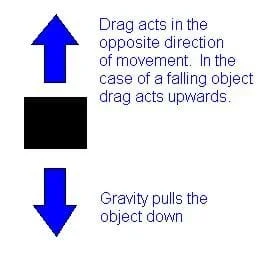 Figure 1. Drag acting on an object.Copyright 2004 Geoffrey Hill, College of Engineering, University of Colorado Boulder
Engineers often consider drag in designing things like airplanes and cars. They try to design these things as streamlined as possible. Streamlined means that the shape of the object, airplane or car can reduce the drag of the object (reduce the force opposing forward motion). This is why airplanes have rounded nose cones and why they pull up their landing gear after liftoff (to remove the wheels from being in the way and creating unnecessary drag). In this activity, we will demonstrate how shape and size affect the drag on something as simple as a piece of paper.
Before the Lesson
- Gather materials.
- Make copies of the Drag Shapes Handout (PDF) (one per group) and What a Drag! Worksheet (PDF) (one per student).
With the Students
- Divide the class into groups of four students each. Hand out the materials, handouts and worksheets.
- Experiment setup: Direct the students in each group cut out the shapes from the handout.
- Construct the cones by taping one side of the pattern to the other to hold the paper in the cone shape.
- Construct the boxes by folding on the solid lines and taping the tabs in place. Leave the boxes with one open side.
- Press a mound of clay (or tape pennies or washers) to the bottom inside of each object. If using clay, use the balance to make sure each shape is the same mass; add or remove clay as necessary.
- Within each group, each object should have the same mass. To demonstrate that mass does not affect drag, have group 1 make all their objects 10 grams, group 2 = 20 grams, etc.
- Experiment and data collection: Select one person to stand on a chair and drop the objects from 2 meters above the floor.
- When the person with the stopwatch says "go," the timing begins and the object is dropped at the same time. When the object hits the floor, the timer stops the watch.
- Conduct three trials (take three measurements) of how long it takes for each object to fall. Be meticulous about dropping the objects from the same height each time.
- Add up the results for each object and divide by the number of trials to get the average for each object.
- Have students record their observations on the worksheet. Which shapes fell faster? What sizes fell faster? What does this tell you about the drag on each of these objects?
- Data analysis and conclusions: Create a class data table on the board starting with data from the group with the large cone of the least mass to the group with the large cone of the greatest mass along with the average times it took those cones to fall.
- As a class, examine all the data. Compare the mass of the different groups' cones to the average amount of time it took to fall for those cones. Does a relationship exist between mass and time? (Answer: Mass does not affect the amount of time it takes an object to reach the ground. Neither drag nor acceleration due to gravity depends on an object's mass.)
Pre-Activity Assessment
Prediction: On a piece of paper or on the board have students predict how long they expect each object to take to hit the ground. Which one do they think will be the fastest? Slowest?
Activity-Embedded Assessment
Worksheet/Pairs Check: Have students work individually or in pairs on the What a Drag! Worksheet (PDF), recording the time it takes for each object to hit the ground, and answering the questinos. Direct students who work in pairs to check each other's answers.
Post-Activity Assessment
Question/Answer: Ask students questions and have them raise their hands to respond. Discuss as a class.
- Which shapes fell faster? (Answer: More streamlined shapes; in this activity, the cone.)
- Which mass fell faster? (Answer: Mass does not affect how fast an object falls.)
- What does that tell us about the drag on each of these objects?
Make sure that students stand on stable chairs or tables so that they do not fall.
It may be useful to drop the objects and just record the time it takes for them to fall past a certain point, like from the top of a desk to the floor. Doing this helps to reduce the error caused by the student starting the stopwatch at a slightly different time than the object is dropped. This way, the timer anticipate when the object will pass the tabletop and start and stop accordingly.
To further reduce error, have groups use the same type of tape on each of their objects.
It helps to practice using the stopwatch before timing the trials.
If students have problems with measuring clay on a scale, or if a scale is not available, use pennies or washers with a pre-determined mass. This ensures that all students are using the same mass.
Use a yardstick to measure the heights in the classroom. Students need to drop their object from the same height as the other groups.
To add height to the drop, have students drop their objects from a slide or other playground apparatus.
Have students repeat the experiment with other shapes. For example, use various balls with similar weights to the other objects; try adding clay to an uncut/unfolded piece of paper.
Challenge students to design and complete an experiment to show what happens if clay is placed in the center of a piece of paper so that it falls flat side down compared to if clay is placed on the side of the paper pulling it down by its edge.
Challenge students to create a shape that goes even slower using one piece of paper and tape.
Have students add streamers to their shapes and see if that increases the time to drop.
For younger students, do not add mass to the shapes. Have the class write their times on the board and discuss as a class. Have the teacher calculate the averages for the class as an example before students do their individual averages on their worksheets. As a class, graph the relationship of large cone weight vs. time to drop.
- Up, Up and Away! - Airplanes
- Can You Take the Pressure?
- May the Force Be with You: Lift
- May the Force Be with You: Weight
- May the Force Be with You: Thrust
- May the Force Be with You: Drag
- What a Drag!
- Take Off with Paper Airplanes
- Airplane Tails & Wings: Are You in Control?
- Airplanes Everywhere: Land, Water, Sky, Oh My!
- Will It Fly?
- Future Flights: Imagine Your Own Flying Machines!
Contributors
Tom Rutkowski; Alex Conner; Geoffrey Hill; Malinda Schaefer Zarske; Janet Yowell
Supporting Program
Integrated Teaching and Learning Program, College of Engineering, University of Colorado Boulder
Acknowledgements
The contents of this digital library curriculum were developed under grants from the Fund for the Improvement of Postsecondary Education (FIPSE), U.S. Department of Education and National Science Foundation (GK-12 grant no. 0338326). However, these contents do not necessarily represent the policies of the Department of Education or National Science Foundation, and you should not assume endorsement by the federal government.
Copyright
2004 by Regents of the University of Colorado