
Airplane Tails & Wings: Are You in Control?
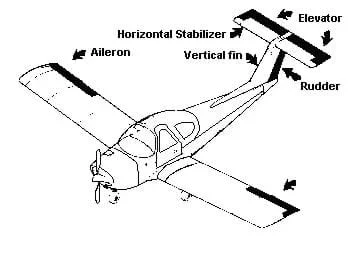 Figure 1. Airplane control surfaces.Copyright NASA http://www.grc.nasa.gov
Students learn about airplane control surfaces on tails and wings, and engineering testing wherein one variable is changed while others are held constant. Through the associated activity, they compare the performance of a single paper airplane design while changing its shape, size and flap positions.
Designing aircraft control systems is more complicated than the control systems for most other transportation vehicles because not only can airplanes move left and right (yaw), but they can also pitch and roll. To master these added dimensions, engineers build ailerons, rudders and elevators to provide adequate airplane steering. Engineers build small-size models of airplanes with these control surfaces and then test them in wind tunnels to find out the capabilities of their designs.
After this lesson, students should be able to:
- Design and construct a model of an airplane.
- Modify the airplane to attempt to improve its flight.
- Relate parts of a paper airplane to parts on a real airplane.
- Explain why testing of models is an important step in the design-build process.
- Use the particle model of matter to illustrate characteristics of different substances
Grade 6
Do you agree with this alignment?
- Students will develop an understanding of and be able to select and use transportation technologies.
Grades K-12
Do you agree with this alignment? - STEL-6D Engage in a research and development process to simulate how inventions and innovations have evolved through systematic tests and refinements.
Grades 6-8
Do you agree with this alignment?
- MS-ETS1-4 Develop a model to generate data for iterative testing and modification of a proposed object, tool, or process such that an optimal design can be achieved.
Grades 6-8
This resource focuses on the following Three Dimensional Learning aspects of NGSS:
Science & Engineering Practices- Develop a model to generate data to test ideas about designed systems, including those representing inputs and outputs.Do you agree with this alignment?
Disciplinary Core Ideas- Models of all kinds are important for testing solutions.Do you agree with this alignment?
- The iterative process of testing the most promising solutions and modifying what is proposed on the basis of the test results leads to greater refinement and ultimately to an optimal solution.Do you agree with this alignment?
Do you agree with this alignment? - Develop a model to generate data to test ideas about designed systems, including those representing inputs and outputs.
Wing Construction
Wing construction is similar for all aircraft types. Early inventors explored and experimented with a variety of materials for airplane wing construction. Most modern aircraft have all metal wings, while many older aircraft had wood and fabric wings.
Most wing structures have two spars, the front spar and the rear spar. The front spar is found near the leading edge while the rear spar is about two-thirds the distance to the trailing edge. Depending on the design of the flight loads, some of the all-metal wings have as many as five spars. The ribs are the parts of a wing that support the covering and provide the airfoil shape. These ribs are called forming ribs, and their primary purpose is to provide shape. Some may have an additional purpose of bearing flight stress, and these are called compression ribs. Figure 2 shows the wing structure.
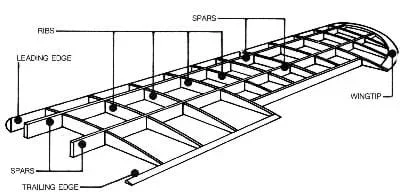 Figure 2. The structure of a wing.Copyright U.S. Centennial of Flight Commission http://www.centennialofflight.gov
Tail Construction
The front, fixed section of the horizontal tail is called the horizontal stabilizer and is used to prevent the airplane from pitching up or down. The rear section is called the elevator and is usually hinged to the horizontal stabilizer. The elevator is a movable airfoil that controls the up-and-down motion of the aircraft's nose. See Figure 1 for a diagram of aircraft control and stability surfaces.
The vertical tail structure is divided into the vertical stabilizer and the rudder. The front section is called the vertical stabilizer and is used to prevent the aircraft from yawing back and forth. The principle behind its operation is much like the principle of a deep keel (the timber at the very bottom of a boat's hull to which the frame is attached) on a sailboat which helps the boat from rolling side to side. In light, in a single-engine aircraft, it also serves to offset the tendency of the aircraft to roll in the opposite direction in which the propeller is rotating.
The rear section of the vertical structure is the rudder. It is a movable airfoil that is used to turn the aircraft. Engineers have to be aware of the construction of the wings when testing their designs. When designing and testing planes, engineers make several test flights with different wings and wing designs. The rudder and tail are also important in the design of most airplanes, almost like the tail of a kite, in that these two components also greatly affect flight capability.
Who has designed and flown a paper airplane? How did it do? Did it go far or do tricks? How can we make our paper airplanes better? What does "better" mean? (Encourage discussions that involve making planes fly further, faster, with better control, etc.)
(Draw a picture of an airplane on the classroom board or make an overhead transparency of Figure 1. Review the various airplane parts that are important to flight: wings, aileron, tail, rudder, elevator, fin, flaps, fuselage, and cockpit.) We refer to the movable parts of the plane's wing or tail as control surfaces, which are parts of the plane that the pilot can control from the cockpit. These airplane parts are going to be important to us today as we design and modify our own paper airplanes to make them go farther.
Engineers are trained to design small-scale models and then test them to make them better. Usually they do this over and over again in order to achieve designs that perform as desired. Students can conduct their own design loop with changing variables in the hands-on activity Better By Design. One important part of this process is keeping track of each design change and its effect on the airplane's performance. Does the airplane go farther when one part of the wings is changed? Or does it fly farther when one part of the tail is modified without the wing modification?
Engineers who design airplanes test their models in a powerful wind tunnel and then carefully record and analyze their results. The wind tunnel enables them to determine if they have designed an airplane that will fly in different conditions and at different speeds. The wind tunnel also helps them to distinguish how small modifications to the plane change the way it flies.
Today, we are going to use a simple paper airplane design, which we will modify, and then test and record how well it flies. Then, we will change certain parts on our planes and record our observations of how each change affects the plane's flight ability.
(After completion of the associated activity, lead a class discussion using the following prompts.) Tell me about the engineering design process. What are the steps? (Answer: Brainstorm, design, build a model, test, redesign, test again, redesign again, etc.
(Refer to a sketch of an airplane drawn or displayed on the classroom board.) Tell me the parts of an airplane that are important to its flight and to controlling its flight.
What did we change on our airplanes to make them fly differently? What changes made some planes fly farther than other changes? (Encourage students to use vocabulary terms to describe the parts of the paper airplanes that they modified. Expect that most students changed and tested the aileron, rudders, flaps, and/or elevators to make their planes fly further and with more control.)
- fuselage
- The central body portion of an airplane that accommodates the crew and passengers or cargo.
- cockpit
- The space in an airplane fuselage for the pilot and the passengers. In some aircraft, it is just the pilot and co-pilot.
- landing gear
- The part of a plane that supports it while on the ground. Located underneath the airplane. Composed of wheels and shocks. Often moved inside the plane while in flight.
- wing
- An airplane part that provides lift and supports most (if not all) of the aircraft weight and contents while in flight.
- propeller
- A rotating blade located on the front of an airplane. The engine turns the propeller, which subsequently pulls the airplane through the air.
- flap
- A movable section of an airplane wing closest to the fuselage. An airplane's flaps are moved in the same direction (down), enhancing the lift of the wing and enabling the airplane to fly more slowly while still creating enough lift to stay in the air.
- aileron
- The outward movable section of an airplane wing that is used to make a turn. An airplane's ailerons move in opposite directions (one up, one down).
- rudder
- The movable vertical section of the tail that controls lateral movement.
- horizontal stabilizer
- The horizontal surface attached to the aft part of the fuselage that is used to balance the airplane.
- elevator
- The movable horizontal section of the tail that causes the nose of the plane to move up and down.
Pre-Lesson Assessment
Brainstorming: Have students generate a number of possible ideas about airplane design. Encourage all ideas and discourage criticism at this stage.
- How can we make planes better? What does "better" mean? (Encourage discussions that involve making planes fly farther, faster, with better control, etc.)
Post-Introduction Assessment
Question/Answer: Ask students questions and have them raise their hands to respond. Write answers on the board.
- For what reason do aerospace engineers use wind tunnels? (Answer: To test their airplane designs to make them fly better.)
- What part of the airplane is the fuselage? (Answer: The central body portion of an airplane, which accommodates the crew and passengers or cargo.)
- Do engineers always test a model of a design before they build the real thing? (Answer: Yes, engineers may test a model many times before getting the design to meet their requirements.)
- What parts of an airplane might you change if your airplane is not flying as far as needed? (Answer: Any part. Accept all answers from a plane's parts that were covered in the introduction diagram. Remind students that they only want to change one part at a time so they can draw logical conclusions.)
Lesson Summary Assessment
Engineering Report: Have students write short reports to their "company" about their new paper airplane models. Requre them to include the following in their reports:
- The name of their model paper airplane.
- How far the paper airplane flies.
- What changes they made to the paper airplane to improve its performance.
- Why the company should consider building their airplane design.
- A picture (drawing) of their airplane.
Pass the Buck: In groups of four, have students brainstorm ideas to design the ultimate paper airplane. First, assign one student in the group to be the recorder. Then have someone toss out an idea. Next, another person in the group provides an idea that builds on the first. Go around the group in this fashion until all students have put in enough ideas to put together a design. When they are done, have them share their idea(s) with the class. (This can also be a fun exercise to do as an entire class!)
Give students the How a Plane is Controlled Handout (PDF) to guide them in learning more about how airplanes are controlled. This handout provides information on control surfaces and helps students modify their paper airplanes to make them move up/down and left/right.
Have students research airplanes on the Internet. They may want to begin with NASA Glenn Research Center's Beginners's Guide to Aeronautics at http://www.grc.nasa.gov/WWW/K-12/airplane/.
Northington, Darryl B. The Evolution of the Small Airplane. http://vestibule13.20m.com/ezine/northington.htm
Levin, David and Hart, Dan. Lift and Drag. Posted September 30, 2010. NOVA, PBS Online by WGBH. http://www.pbs.org/wgbh/nova/xplanes/airborne.html
Stern, David P. Basics of Aviation. Last updated September 22, 2004. (22c) Airplane Flight, Goddard Space Flight Center, NASA. http://www-spof.gsfc.nasa.gov/stargaze/Sflight.htm
- Up, Up and Away! - Airplanes
- Can You Take the Pressure?
- May the Force Be with You: Lift
- May the Force Be with You: Weight
- May the Force Be with You: Thrust
- May the Force Be with You: Drag
- Take Off with Paper Airplanes
- Airplane Tails & Wings: Are You in Control?
- Airplanes Everywhere: Land, Water, Sky, Oh My!
- Will It Fly?
- Future Flights: Imagine Your Own Flying Machines!
Contributors
Tom Rutkowski; Alex Conner; Geoffrey Hill; Malinda Schaefer Zarske; Janet Yowell
Supporting Program
Integrated Teaching and Learning Program, College of Engineering, University of Colorado Boulder
Acknowledgements
The contents of this digital library curriculum were developed under grants from the Fund for the Improvement of Postsecondary Education (FIPSE), U.S. Department of Education and National Science Foundation (GK-12 grant no. 0338326). However, these contents do not necessarily represent the policies of the Department of Education or National Science Foundation, and you should not assume endorsement by the federal government.
Copyright
2004 by Regents of the University of Colorado