
May the Force Be with You: Thrust
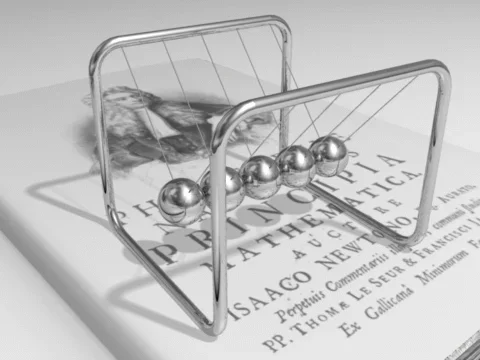 Newton's cradle illustrating Newton's third law of motion.Copyright 2006 DemonDeLuxe (Dominique Toussaint), Wikimedia Commons https://commons.wikimedia.org/wiki/File:Newtons_cradle_animation_book_2.gif
Students study how propellers and jet turbines generate thrust. This lesson focuses on Isaac Newton's third law of motion for every action there is an equal and opposite reaction.
When designing airplanes, engineers apply Newton's third law of motion to determine how to best power the aircraft. The physical law states that for every action there is an equal and opposite reaction. Engineers design systems that create an action that in turn causes the airplane to move forward; this action is called thrust. To create thrust, they may use propellers, jets or rockets, and the heavier the airplane, the more thrust it requires to move.
After this lesson, students should be able to:
- State that thrust is one of the four main forces acting on an airplane.
- Identify that thrust is an example of Newton's third law of motion.
- State Newton's third law of motion and provide real-world examples of the law.
- Explain the difference in how jet engines create thrust compared to propeller engines.
- Predict and evaluate the movement of an object by examining the forces applied to it
Grade 8
Do you agree with this alignment?
- Students will develop an understanding of and be able to select and use transportation technologies.
Grades K-12
Do you agree with this alignment? - Students will develop an understanding of the relationships among technologies and the connections between technology and other fields of study.
Grades K-12
Do you agree with this alignment?
- SEP.11.3 Laws are regularities or mathematical descriptions of natural phenomena.
Grades 6-8
Do you agree with this alignment? - DCI.PS2.A.6-8.1 For any pair of interacting objects, the force exerted by the first object on the second object is equal in strength to the force that the second object exerts on the first, but in the opposite direction (Newton's third law).
Grades 6-8
Do you agree with this alignment? - DCI.PS2.A.6-8.2 The motion of an object is determined by the sum of the forces acting on it; if the total force on the object is not zero, its motion will change. The greater the mass of the object, the greater the force needed to achieve the same change in motion. For any given object, a larger force causes a larger change in motion.
Grades 6-8
Do you agree with this alignment?
What is Thrust?
Imagine you are floating in space holding a huge bowling ball. If you were to throw the bowling ball in one direction, you would move in the opposite direction. The same is true with jets, rockets and propellers, except instead of a bowling ball, they throw air or another gas. This movement of gas (air) is called thrust: the force that causes an airplane to move forwards. Not only does thrust push the airplane forwards, but that movement also allows the wings to create lift. Remember from Airplanes Lesson 2, we learned that lift is created when air moves faster over the top of the wing. Figure 1 illustrates the four forces of flight.
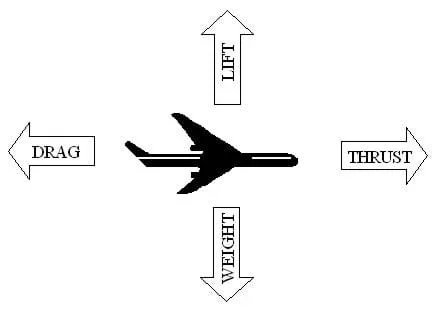 Figure 1. The four forces of flight: lift, weight, thrust and drag.Copyright 2003 Tom Rutkowski, College of Engineering, University of Colorado Boulder
How Is Thrust Created?
Airplane thrust is created by three principle mechanisms: propellers, jet engines and rocket engines. All three engine types take advantage of the physical behaviors described by Newton's third law of motion, which states that for every action, there is an equal and opposite reaction. All airplane engines push air backwards. Newton's third law predicts that an airplane will move forward with an equal and opposite force. This reaction force is known as thrust. Refer to the associated activity Equal & Opposite Thrust in Aircraft: You’re a Pushover! to help illustrate the relationship between thrust and airplane design as explained by Newton's third law.
How Do Propellers Generate Thrust?
Propellers are comprised of multiple, individual blades (of various sizes, depending on the overall size of the propeller), which are each shaped like small wings. Lift is created on one side of the propeller blade as it rotates through the air. This lift then pulls the propeller forwards because it is oriented vertically not horizontally like the wings (which enable movement upwards, or lift). The propeller then pulls on the engine and the rest of the airplane.
How Do Jet Engines Generate Thrust?
Jet engines are much more complex. First, air is pulled into the engine through an inlet and compressor. The compressor pushes the air into a combustion chamber at a high pressure. Then, liquid fuel is continually sprayed into the combustion chamber and burned. This creates exhaust gas, which is at an extremely high temperature and pressure. The (exhaust) gas in the combustion chamber tries to expand as a result of the increase in temperature, creating extreme pressure. This high-pressure gas exits the engine through a turbine and nozzle. It is this high-pressure gas leaving the engine at such a high speed that pushes the engine forwards. This is similar to letting the air out of a balloon. The air molecules are pushed backwards and the balloon is pushed forwards—again, an example of Newton's third law of motion. The action is the air being pushed backwards from the engine; the reaction is the engine being pushed forwards.
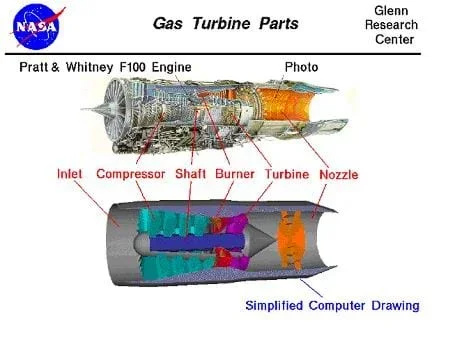 Figure 2. The parts of a jet engine.Copyright Glen Research Center, NASA http://www.grc.nasa.gov/WWW/K-12/airplane/turbparts.html
How Do Rockets Generate Thrust?
A rocket generates thrust in a manner similar to a jet engine. A rocket is composed of either solid fuel in a casing or a combination of liquid fuel and oxidizer that is pumped into the combustion chamber. The fuel burns in the casing and is ejected through the nozzle at a high speed because it has expanded, just as the gas in a jet engine does. A rocket engine is different from a jet engine though in that it does not require outside air and burns more fuel. Even though rockets create a lot of thrust, they are rarely used on airplanes because they usually cannot burn for long periods of time.
What Do Engineers Do?
Engineers are responsible for designing airplanes to fly. However, no simple cookbook recipe exists for airplane construction; it requires tremendous creativity and ingenuity. Did you know that we have no good method to calculate the shape of a propeller blade? Engineers develop the shape of the propellers by experimentation and computer modeling. They must adjust the fuel consumption of an airplane engine so that the engine generates enough thrust but also has enough fuel to travel long distances. Engineers also must calculate how hot the engines will eventually become to make sure that engine parts do not melt or burn.
How does a car move forwards? It moves forwards by pushing backwards on the road. Knowing this, how does an airplane move through the air when no roads exist on which to drive? Why do you think an airplane is able to move forwards? (Answer: Expect students to probably say that the airplane pushes off the air to move, but this is not true. The answer lies in Newton's third law of motion that states that for every action there is an equal and opposite reaction. For example, if you were to stand on a skateboard and throw a bowling ball in one direction, you and the skateboard would move in the opposite direction of the bowling ball. Throwing the bowling ball is the action while the movement of the skateboard is the opposite reaction. This is how an airplane moves, but instead of throwing bowling balls, it "throws" lots of air molecules in the opposite direction of its movement.) Think about a rocket in space. Although a rocket creates thrust—much like a jet engine—nothing is present in space (such as air) for the rocket to push against, yet it still moves when the rockets are fired, just as an airplane can move forwards when its engines are on and propellers are moving.
This idea demonstrates Newton's third law of motion. Car tires push back against the road, which causes the car to move in the opposite direction—forwards. Although airplanes do not push against the air, their movement is still described by Newton's third law of motion. A jet engine and a propeller work together by grabbing air and "throwing" it backwards very quickly. This throwing of the air is the action. The reaction is that the airplane moves in the opposite direction—forwards. A rocket works in the same way, but instead of using air, it uses gasses that it carries inside of it (which means that a rocket works in the atmosphere as well as in space).
So if you throw a bowling ball while standing on a skateboard, why don't you move as far as the bowling ball does? Newton's third law states that the reaction must be equal and opposite. If you do not move as far or as fast as the bowling ball, it does not seem like that is an equal reaction. Part of the reason why you do not move as far as the bowling ball is that the wheels encounter friction, which slows the skateboard. However, the more relevant reason that you do not move as far as the bowling ball is because of your weight: you weigh a lot more than a bowling ball. When Newton's third law says the reaction is equal and opposite to the action, it means that the reaction force is equal and opposite to the action force. Even though the forces acting on the bowling ball and the skateboard are the same, the bowling ball moves farther because it is much lighter. Imagine pushing on a huge boulder. The pushing is a force, and you would have to apply a very large force on the boulder to get it to move. What if you put the same force into a pebble? It would go sailing through the air. The less mass something has, the further/faster it will travel when a constant force is applied to it. This is why you and the skateboard do not move as far as the bowling ball.
Today we will learn about thrust. Thrust is the force that causes an airplane to move forwards because of the movement of air or gas. Not only does thrust push the airplane forwards, but that movement also enables the wings to create lift. (Lift is discussed in the Airplanes unit, Lesson 2.)
Engines are responsible for giving airplanes thrust. Several different types of airplane engines are: propeller, jet, and rocket. Why can't engineers simply build a huge engine so that an airplane can travel twice as fast? (Answer: Remind students of the four forces that act on airplanes: weight, lift, thrust and drag, shown in Figure 1). A huge engine would weigh too much and upset the delicate balance between the four forces. True, a larger engine would create more thrust, but also (too much) more weight. More weight, however, would require more lift, which would require bigger wings.) Finding the power to push an airplane has been a difficult challenge since the first airplanes were built. Engineers continually work on developing engines that are more reliable and give more thrust for their weight. Turbojet and turbofan engines are the most commonly used aircraft engines today, but one can only imagine what the next great innovation in propulsion will be—only time will tell! Maybe you will engineer the next engine to be used in aircraft around the world.
Review the four forces that affect flight and discuss with students how thrust provides the forward force on the airplane. Ask students to explain in their own words the concept of action and reaction. Also, ask students how the mass of an object affects the force needed to move it. (Answer: Expect students to also understand that if one object were twice as large as another object, it would need twice as much force to move it the same amount. Also expect tudents to also understand that two objects pushing off of each other experience the same force.)
- combustion
- A chemical process where a fuel and an oxidizer are reacted producing heat, light and hot gases.
- compressor
- A mechanical component that increases the pressure of a gas flowing through it.
- radial engine
- A gasoline combustion engine where stationary pistons are arranged in a circle around a moving crankshaft.
- rotary engine
- A gasoline combustion engine where moving pistons are arranged in a circle around a stationary crankshaft.
- rotational energy
- The amount of energy possessed by a body as a result of its rotational motion proportional to its mass and radius.
- thrust
- The forward-directed force developed in a jet or rocket engine as a reaction to the high-velocity rearward ejection of exhaust gases or a propeller.
- turbine
- A mechanical component that takes energy from a moving fluid and transforms it into rotational energy.
Pre-Lesson Assessment
Discussion Question/Answer: Solicit, integrate and summarize student responses.
- What are the four forces affecting airplane flight? (Answer: Lift, weight, thrust and drag.)
- What is lift? (Answer: When the air pressure below a wing is greater than the air pressure above the wing, the net upward force is called the lift.)
- What is weight? (Answer: The force with which a body is attracted to Earth or another celestial body, equal to the product of the object's mass and the acceleration of gravity.)
- How does weight affect airplane flight? (Answer: Weight is the force that pulls an airplane back towards the Earth. Weight must be overcome by lift, as discussed in Lesson 2 of the Airplanes unit, in order to achieve flight. The force of lift must be greater than the weight of an airplane for the airplane to climb.)
- What affects airplane weight? (Answer: The materials with which the plane is made.)
- How do you think airplanes move through the air? (Have the students review what they have learned so far about the four forces affecting flight.)
Post-Introduction Assessment
Voting: Ask a true/false question and have students vote by holding thumbs up for true and thumbs down for false. Tally the votes and write the number on the board. Give the right answer.
- True or false: The earliest airplanes were powered by jet engines. (False: Propellers were used on the earliest airplanes.)
- True or false: Rocket engines can produce a lot of thrust but run out of fuel quickly. (True)
- True or false: Not only does thrust push the airplane forward, but that movement also enables the wings to create lift. (True)
- True or false: For every action there is an equal reaction in the same direction. (False: The reaction is in the opposite direction.)
Lesson Summary Assessment
Student-Generated Questions: Have students each come up with one question/answer of their own to ask the rest of the class. Suggest that students think about questions on topics that they have learned in the Airplanes unit so far, such as Bernoulli's principle, Newton's laws of motion, lift, weight and thrust). Be prepared to help some students form questions. Have students take turns asking their questions to the class. Alternative process: Collect the written questions and answers and ask them back to the class in random order.
Assign students to research and learn more about how thrust is generated by different forms of propulsion. A keyword search for "4 forces of flight" and "airplanes" yields many good websites for research. A good website with which to start a search is: http://www.grc.nasa.gov/WWW/K-12/airplane/forces.html.
Guyford, Stever H. and Haggerty, James J. Flight. New York, NY: Time, Inc. 1969.
Four Forces on an Airplane. Glenn Research Center, NASA. Accessed 2004. http://www.grc.nasa.gov/WWW/K-12/airplane/forces.html
What Makes an Airplane Fly - Level 1. Updated March 12, 2004. ALLSTAR Network, Aeronautics Learning Laboratory for Science, Technology and Research, Florida International University, NASA. Accessed 2004. http://www.allstar.fiu.edu/aero/fltmidfly.htm.
- Up, Up and Away! - Airplanes
- Can You Take the Pressure?
- May the Force Be with You: Lift
- May the Force Be with You: Weight
- May the Force Be with You: Thrust
- May the Force Be with You: Drag
- Take Off with Paper Airplanes
- Airplane Tails & Wings: Are You in Control?
- Airplanes Everywhere: Land, Water, Sky, Oh My!
- Will It Fly?
- Future Flights: Imagine Your Own Flying Machines!
Contributors
Tom Rutkowski; Alex Conner; Geoffrey Hill; Malinda Schaefer Zarske; Janet Yowell
Supporting Program
Integrated Teaching and Learning Program, College of Engineering, University of Colorado Boulder
Acknowledgements
The contents of this digital library curriculum were developed under grants from the Fund for the Improvement of Postsecondary Education (FIPSE), U.S. Department of Education and National Science Foundation (GK-12 grant no. 0338326). However, these contents do not necessarily represent the policies of the Department of Education or National Science Foundation, and you should not assume endorsement by the federal government.
Copyright
2004 by Regents of the University of Colorado