
May the Force Be with You: Drag
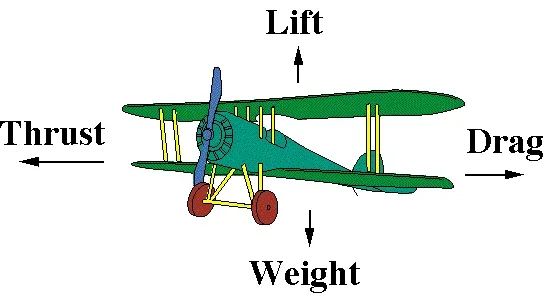 Forces on an aircraft.
Students learn about the drag force on airplanes and are introduced to the concept of conservation of energy and how it relates to drag. They learn the difference between friction drag, form drag and induced drag, and how thrust is involved. They explore the relationship between drag and the shape, speed and size of objects.
When designing airplanes, engineers keep in mind the force of drag and the principle of energy conservation. Since drag slows down airplanes and makes them less efficient (requiring more fuel), engineers aim to design planes that reduce drag. Minimizing the amount of drag acting on aircraft often involves modifying the wing and/or fuselage shapes.
After this lesson, students should be able to:
- Explain that drag is one of the four main forces acting on airplanes.
- Describe how the shape, area and speed of an object affects drag.
- Identify which of the four forces of flight opposes the force of drag (thrust).
- Explain why understanding drag is important to engineers who design airplanes.
- Use tools to gather, view, analyze, and report results for scientific investigations about the relationships among mass, weight, volume, and density
Grade 6
Do you agree with this alignment?
- Students will develop an understanding of and be able to select and use transportation technologies.
Grades K-12
Do you agree with this alignment?
- MS-PS3-5 Construct, use, and present arguments to support the claim that when the kinetic energy of an object changes, energy is transferred to or from the object.
Grades 6-8
This resource focuses on the following Three Dimensional Learning aspects of NGSS:
Science & Engineering Practices- Construct, use, and present oral and written arguments supported by empirical evidence and scientific reasoning to support or refute an explanation or a model for a phenomenon.Do you agree with this alignment?
- Science knowledge is based upon logical and conceptual connections between evidence and explanations.Do you agree with this alignment?
Disciplinary Core Ideas- When the motion energy of an object changes, there is inevitably some other change in energy at the same time.Do you agree with this alignment?
Crosscutting Concepts- Energy may take different forms (e.g. energy in fields, thermal energy, energy of motion).Do you agree with this alignment?
Do you agree with this alignment? - Construct, use, and present oral and written arguments supported by empirical evidence and scientific reasoning to support or refute an explanation or a model for a phenomenon.
What Is Drag?
Drag is a force that acts on an object in the opposite direction than that object is moving. An object must be moving through some kind of fluid for drag to occur. A fluid is a substance in which the particles can move past each other freely. The most obvious fluid is water, but gases, including air, are fluids as well. Students can conduct the worksheet led associated activity What a Drag! to help illustrate this concept by completing several fun experiments.
How Does Drag Slow Airplanes?
Air is the fluid through which airplanes move. When an airplane flies through the air, it runs into air molecules that cause it to slow down. Energy from the moving plane is transferred to the air molecules. In other words, some of the kinetic energy (energy it possesses because of its motion) from the airplane is given to the air molecules, slowing down the airplane and speeding up the surrounding air. The amount of energy lost by the airplane is exactly the amount of energy transferred to the air. This is an example of the first law of thermodynamics that states energy can neither be created nor destroyed. Engineers often refer to the first law of thermodynamics as the conservation of energy principle, which means that energy is always conserved. Energy must go somewhere and in the case of drag, the energy in the movement of an object is transferred into moving the gas in the path of the object (in the case of an airplane, moving the air around it). This transfer of energy results in three types of drag: friction drag, form drag and induced drag.
Friction drag comes from air moving across the surface of the airplane. On a very small scale, the surface of an airplane is rough, like sandpaper. If you run your hand over sandpaper, the sandpaper catches your skin and slows down or stops your hand movement. The same thing happens with an airplane. The "skin" of the airplane catches the air particles next to it and tries to pull the air particles along. This slows the airplane down as air particles speed up.
Form drag is caused by the airplane pushing air molecules to the side so the airplane can pass by them. A streamlined shape (like an airplane wing) has very little form drag (by design!). A non-streamlined shape, like a parachute, has a lot of form drag (by design!).
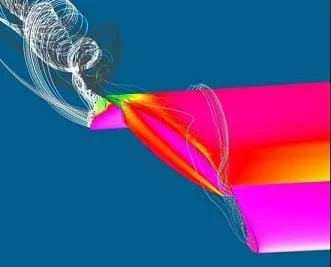 Figure 1. Induced drag at the tip of an airplane wing.Copyright Stuart Rogers, NASA http://people.nas.nasa.gov/~rogers/images/
Induced drag (see Figure 1) is created at the tips of the airplane wings. In order to achieve lift, the wings create a low-pressure region above the wings and a high-pressure region below the wings. At the end of the wing, high-pressure air underneath the wing tries to move around the end of the wing to the low-pressure air on top of the wing. This creates a swirling vortex of air at the wingtip. The energy needed to move the air in the vortex is taken from the movement of the plane, creating induced drag.
What Do Engineers Do about Drag?
THe challengen for engineers is to find creative ways to reduce drag so that airplanes can go faster and fly more efficiently. The less drag an airplane experiences, the less fuel it needs to fly at the same speed. Friction drag increases as the surface area of the wing increases and as the roughness of the wing increases. Form drag increases as the cross-sectional area of the plane increases, and the shape becomes less streamlined. Engineers reduce form and friction drag by making the body of the plane more streamlined, the wings more narrow, or by using new materials and manufacturing processes to make the skin of the plane smoother. Engineers reduce induced drag by making the ends of the wings oval shaped or by adding wing tips that stick up from the end of the wing. Through the efforts of engineers, airplanes are continually changing shape to improve their efficiency and performance (be more aerodynamic).
How would you define drag? (Answer: For our purposes, drag is defined as something that slows you down.) You can feel drag when you walk in a swimming pool. A fisherman feels the drag on his lure as he pulls it through the water. Drag is a force that acts in the opposite direction than an object is moving.
What happens to your arm/hand when you stick it out the window of a moving car? (Answer: The arm/hand gets pushed backwards.) This is because drag is acting on your hand. Now, what can you do to increase the amount of drag on your hand? (Answer: Turn the hand so that the palm is facing into the wind or have the driver speed up.) Drag depends on characteristics such as the size, shape and speed of an object.
Can you think of a situation where drag is a good thing to have occur? (Possible answers: To help cars stop after a drag race, to slow down a plane when it lands on a runway, etc.) An excellent example of drag being a useful force is during skydiving: skydivers rely on drag to slow down their falls so that safe landings take place — hence, the reason for parachutes.
Like any other object that moves through the air, airplanes also experience drag. This is not always beneficial, however, since we want airplanes to move forward very quickly and drag slows planes down. Overcoming drag has always been a primary design challenge for aerospace engineers. Airplanes overcome drag by generating thrust.
Engineers calculate the drag on airplanes by using information about the size, shape and speed of the airplanes. Using this information, they can decide how much thrust is needed to overcome drag and keep the airplane aloft.
(Wrap up the lesson in a class discusion using the following prompts.)
- What are the four forces that affect flight?
- How do they cause airplanes to fall, rise, slow down or speed up?
- How does drag slow down airplanes?
- Will the drag on an object increase if the surface area is increased or the object speeds up? (Answer: Yes to both, the drag increases.)
- How does designing an airplane with less drag affect its speed and efficiency? (Answer: An airplane with less drag can go faster and ismore efficient because more power from the engines is used in pushing the airplane forwards instead of moving the air molecules out of the path of the plane.)
- cross-sectional area
- The projected area of a three-dimensional object onto a two-dimensional plane.
- drag
- The phenomenon of resistance to motion through a fluid.
- fluid
- A continuous, amorphous substance whose molecules move freely past one another and that has the tendency to assume the shape of its container; a liquid or gas.
- gas
- The state of matter distinguished from the solid and liquid states by relatively low density and viscosity, relatively great expansion and contraction with changes in pressure and temperature, the ability to diffuse readily, and the spontaneous tendency to become distributed uniformly throughout any container.
- kinetic energy
- The energy possessed by a body because of its motion, equal to one half the mass of the body times the square of its speed.
- liquid
- The state of matter in which a substance exhibits a characteristic readiness to flow, little or no tendency to disperse, and relatively high incompressibility.
- molecule
- The smallest particle of a substance that retains the chemical and physical properties of the substance and is composed of two or more atoms; a group of like or different atoms held together by chemical forces.
- surface area
- The extent of a two-dimensional surface enclosed within a boundary.
Pre-Lesson Assessment
Discussion Question/Answer Review: Solicit, integrate, and summarize student responses.
- What are the four forces affecting airplane flight? (Answer: Lift, weight, thrust and drag.)
- What is lift? (Answer: When the air pressure below a wing is greater than the air pressure above the wing, there is a net upward force called lift.)
- What is weight? (Answer: The force with which a body is attracted to Earth or another celestial body, equal to the product of the object's mass and the acceleration of gravity.)
- How would you define drag? (Answer: Drag is a force that acts on an object in the direction opposite the direction that the object is moving.)
Post-Introduction Assessment
Voting: Ask a true/false question and have students vote by holding thumbs up for true and thumbs down for false. Count the number of true and false and write the number on the board. Give the right answer.
- True or False: The purpose of engines on an airplane is essentially to overcome the force of drag so that the pilot decides when to land the plane instead of having gravity take over. (True)
- True or False: Drag is always a bad thing. (False: Parachutes need drag to effectively slow a parachuter down in order to avoid injury when landing.)
- True or False: As the speed of an object increases the drag decreases. (False: The drag increases as speed increases.)
- True or False: There is no drag in space. (True: There is no air in space, and therefore, there is no drag.)
Lesson Summary Assessment
Figure Drawing: Have students each sketch an airplane and label the forces of flight on the drawing. As an alternative, draw an airplane on the classroom board and as a class have students generate the placement of arrows to indicate the four forces acting on all airplanes.
Group Flashcards: Have each student on a team creates a flashcard with a question on one side and the answer on the other about something they learned about airplane flight so far. If the team cannot agree on the answers, direct them to consult the teacher. Then pass the flashcards to the next team. Each member of the team reads a flashcard and everyone attempts to answer it. If they are right, they can pass the card on. If they feel they have another correct answer, they write their answer on the back of the flashcard as an alternative. Once all teams have done all the flashcards, as a class discuss and clarify any questions.
Have students research and learn more about how drag affects airplanes, rockets, boats and even people.
Many websites exist on the topic of airplanes and the four forces affecting flight. To find some, do a keyword search for "4 forces of flight" and "airplanes." A good starter website is NASA's Four Forces on an Airplane at http://www.grc.nasa.gov/WWW/K-12/airplane/forces.html.
Campbell, Neil A., Reece, Jane B., and Mitchell, Lawrence G. Biology. Addison Wesley Longman, Inc., 1987.
Guyford, Stever H., Haggerty, James J. Flight (Life Science Library). Time-Life International, 1969.
Four Forces on an Airplane. (diagram and good information) NASA. http://www.grc.nasa.gov/WWW/K-12/airplane/forces.html
What Makes An Airplane Fly - Level 1. Aeronautics, Florida International University. http://www.allstar.fiu.edu/aero/fltmidfly.htm
Jones, Charlotte Foltz. Mistakes That Worked. Doubleday, 1991.
Polymers. World Book Encyclopedia. 2002.
- Up, Up and Away! - Airplanes
- Can You Take the Pressure?
- May the Force Be with You: Lift
- May the Force Be with You: Weight
- May the Force Be with You: Thrust
- May the Force Be with You: Drag
- Take Off with Paper Airplanes
- Airplane Tails & Wings: Are You in Control?
- Airplanes Everywhere: Land, Water, Sky, Oh My!
- Will It Fly?
- Future Flights: Imagine Your Own Flying Machines!
Contributors
Tom Rutkowski; Alex Conner; Geoffrey Hill; Malinda Schaefer Zarske; Janet Yowell
Supporting Program
Integrated Teaching and Learning Program, College of Engineering, University of Colorado Boulder
Acknowledgements
The contents of this digital library curriculum were developed under grants from the Fund for the Improvement of Postsecondary Education (FIPSE), U.S. Department of Education and National Science Foundation (GK-12 grant no. 0338326). However, these contents do not necessarily represent the policies of the Department of Education or National Science Foundation, and you should not assume endorsement by the federal government.
Copyright
2004 by Regents of the University of Colorado