
May the Force Be with You: Lift
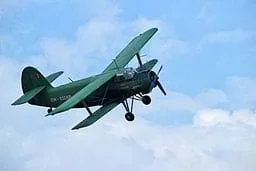 Airplane wings create lift to help keep it in flight.Copyright Wikimedia Commons http://commons.wikimedia.org/wiki/File:Antonov_An-2_in_Vitebsk.jpg
Students revisit Bernoulli's principle (presented in lesson 1 of the Airplanes unit) and learn how engineers use this principle to design airplane wings. Airplane wings create lift by changing the pressure of the air around them. This is the first of four lessons exploring the four key forces in flight: lift, weight, thrust and drag.
With their understanding of Bernoulli's principle, engineers manipulate air pressure to create lift. They design wings so that the air moves faster over the top of the wings than under the wings. Since we know from Bernoulli's principle that faster moving air has less pressure, the air pushes more on the bottom of the wing than on the top of the wing. This difference in pressure causes the wing to rise; engineers call this lift. Before testing their wing designs on real airplanes, engineers experiment with variations in wing shapes in wind tunnels to see how they perform in moving air.
After this lesson, students should be able to:
- Describe how four key forces (lift, weight, thrust, drag) act on airplanes during flight.
- Explain Bernoulli's principle.
- Use Bernoulli's principle to explain what lift means with respect to airplanes.
- Use the particle model of matter to illustrate characteristics of different substances
Grade 6
Do you agree with this alignment? - Explain that the mass of an object does not change, but its weight changes based on the gravitational forces acting upon it
Grade 6
Do you agree with this alignment?
- Students will develop an understanding of the relationships among technologies and the connections between technology and other fields of study.
Grades K-12
Do you agree with this alignment?
- MS-PS2-2 Plan an investigation to provide evidence that the change in an object's motion depends on the sum of the forces on the object and the mass of the object.
Grades 6-8
This resource focuses on the following Three Dimensional Learning aspects of NGSS:
Science & Engineering Practices- Plan an investigation individually and collaboratively, and in the design: identify independent and dependent variables and controls, what tools are needed to do the gathering, how measurements will be recorded, and how many data are needed to support a claim.Do you agree with this alignment?
- Science knowledge is based upon logical and conceptual connections between evidence and explanations.Do you agree with this alignment?
Disciplinary Core Ideas- The motion of an object is determined by the sum of the forces acting on it; if the total force on the object is not zero, its motion will change. The greater the mass of the object, the greater the force needed to achieve the same change in motion. For any given object, a larger force causes a larger change in motion.Do you agree with this alignment?
- All positions of objects and the directions of forces and motions must be described in an arbitrarily chosen reference frame and arbitrarily chosen units of size. In order to share information with other people, these choices must also be shared.Do you agree with this alignment?
Crosscutting Concepts- Explanations of stability and change in natural or designed systems can be constructed by examining the changes over time and forces at different scales.Do you agree with this alignment?
Do you agree with this alignment? - Plan an investigation individually and collaboratively, and in the design: identify independent and dependent variables and controls, what tools are needed to do the gathering, how measurements will be recorded, and how many data are needed to support a claim.
The Four Forces of Flight
The four forces of flight are lift, weight, thrust and drag. Lift and weight are opposing forces, which means they act in opposite directions. Likewise, thrust and drag are opposing forces. All airplanes are subject to these four forces (see Figure 1). Thrust is what moves the aircraft forward and also creates air speed, which we will see later is part of what creates lift. Lift is what pushes the airplane up, while gravity is the force that pulls the airplane down. Drag is a force that acts against thrust and slows the airplane down. When the thrust is greater than the drag, the plane moves forward. When weight is greater than lift, the plane descends.
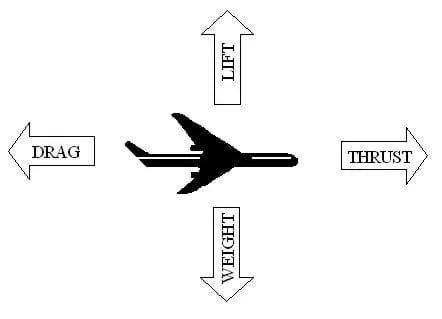 Figure 1. The four forces of flight: lift, weight, thrust and drag.Copyright 2003 Tom Rutkowski, University of Colorado Boulder
How Does Bernoulli's Principle Create Lift?
The wings are the parts of an airplane that create lift. If we look at a wing from the side, as in Figure 2, we can see that it is shaped somewhat like a teardrop, with a thick, rounded front end and a thin, pointed back end. The curve on the top of the wing is longer than the bottom, which means air traveling across the top of the wing has to move faster to keep up with the air moving under the wing. According to Bernoulli's principle, there must be less pressure on the top of the wing than on the bottom of the wing. Refer to the associated activity Windy Tunnel to help students illustrate how the Bernouilli principle relates to winged flight.
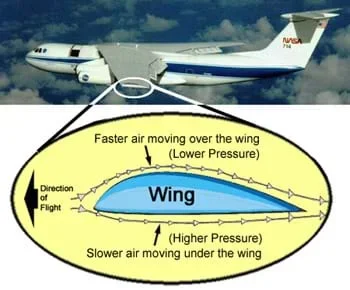 Figure 2. Bernoulli's principle demonstrated on an airplane wing.Copyright NASA (plane photograph) and 2003 Geoffrey Hill, University of Colorado Boulder http://www.nasa.gov/
The result of this difference in air pressure is a net upward force called lift. As illustrated in Figure 3, the air moving under the wing moves slower and exerts more pressure/force on the wing than does the air moving over the wing. Since there is more force under the wing than above it, the net result is that the wing rises up; hence, lift. This principle forms the basis of winged flight.
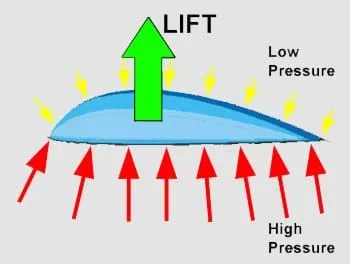 Figure 3. How a wing produces lift.Copyright 2003 Geoffrey Hill, University of Colorado Boulder
Flaps are present on the front and back edges of wings. During takeoff and landing, pilots extend the flaps on the back edge of the wing. The flaps increase the camber (curve) of the wing, which maintains the lift at slower speeds. After takeoff, the pilot retracts the flaps for normal flight. Engineers use wind tunnels and computers to continuously test wing designs to determine their lift.
Start by revisiting with students the Lesson 1 concepts. Make sure they understand that air is around them all the time and that the air has pressure. Ask if they remember how much air pressure is pushing on them. (Answer: 14.7 pounds per square inch at sea level, 12 psi in Denver.)
Next, ask what Bernoulli's principle tells us about air pressure. (Answer: The faster air moves, the lower its pressure.)
Have students brainstorm what Bernoulli's principle might have to do with flight. Get them to realize if is high pressure exists below the airplane and low pressure exists above the airplane, it will move up, which is where the lift force comes from. Then get them to use Bernoulli's principle to determine that somehow the air must be moving faster over the top of the airplane to cause lift.
Draw a simple airplane diagram on the board. Label the four forces of flight (see Lesson Background & Concepts for Teachers and Figure 1). In this lesson we will learn about lift force.
Ask students to explain how Bernoulli's principle relates to lift. (For example, see if they can summarize why the two wings that they saw in the virtual wind tunnel behaved the way they did using knowledge of Bernoulli's principle.)
- lift
- When the air pressure below a wing is greater than the air pressure above the wing, there is a net upward force called the lift.
- angle of attack
- The angle between the wing and direction of flight is called the angle of attack.
- camber
- The camber is the curve in the wing. The higher the camber (curve), the higher the lift created by the wing. Flaps fold down during takeoff and landing to increase the camber so that the airplane can still fly even though it is moving very slow.
Pre-Lesson Assessment
Question/Answer Review: Ask students if they remember Bernoulli's principle from Lesson 1 of the Airplanes unit. Ask for explanations/descriptions to the following:
- Can you remember how much air pressure is pushing on you at all times? (Answer: 14.7 pounds per square inch at sea level; 12 pounds per square inch in Denver.)
- What does Bernoulli's principle tell us about air pressure? (Answer: The faster air moves the lower its pressure.)
- Have students brainstorm what Bernoulli's principle might have to do with flight. Get them to realize if high pressure exists below the airplane and low pressure exists above the airplane, it will move up, which is where the lift force comes from. Then get them to use Bernoulli's principle to determine that somehow the air must be moving faster over the top of the airplane to cause lift.
Post-Introduction Assessment
Voting: Ask a true/false question and have students vote by holding thumbs up for true and thumbs down for false. Tally the number of true and false, and write the number on the board. Give the right answer.
- All airplanes are subject to three forces during flight. (Answer: False, four forces of flight exist: lift, weight, thrust and drag.)
- Bernoulli's principle causes thrust to happen? (Answer: False, lift is the correct force.)
- When weight is greater than lift, an airplane descends? (Answer: True)
Lesson Summary Assessment
Numbered Heads: Have students on each team pick numbers (or number off) so each member has a different number. Ask the students a question (give them a time frame for solving it, if desired). Have the members of each team work together on the answer. Everyone on the team must know the answer. Call a number at random. Students with that number raise their hands to answer the question. If not all students with that number raise their hands, allow the teams to work a little longer. Ask the students:
- What are the four forces of flight? (Answer: Lift, weight, thrust and drag.)
- How does Bernoulli's principle create lift? (Answer: Because the top of a wing is longer than the bottom, and air traveling across the top of the wing moves faster and exerts less pressure than air beneath the wing. The result is a net force up; hence, lift.)
Virtual Wind Tunnel: Wings in a Wind Tunnel II, adapted from: https://www.grc.nasa.gov/WWW/K-12/FoilSim/index.html is a more advanced virtual wind tunnel than in Lesson 1 of the Airplanes unit. Here, students may try out a wider variety of wing shapes that could influence lift. Lift is recorded in pounds. Students should record the greatest lift from a study of a combination of wing shape and attack angle.
Writing Assignment: Have students write short newspaper articles or create a persuasion flyers on which airfoils would be best suited for different purposes. They can discuss which airfoil they thought was best during this computer simulation.
FoilSim Download. NASA. (FoilSim is an interactive simulation software that determines the airflow around various shapes of airfoils.) http://www.grc.nasa.gov/WWW/K-12/FoilSim/index.html
Wings in a Wind Tunnel. The Society of Women Engineers. (The associated activity is adapted from this activity that tests wing design in a wind tunnel.) http://www.swe.org/iac/LP/wind_01.html
- Up, Up and Away! - Airplanes
- Can You Take the Pressure?
- May the Force Be with You: Lift
- May the Force Be with You: Weight
- May the Force Be with You: Thrust
- May the Force Be with You: Drag
- Take Off with Paper Airplanes
- Airplane Tails & Wings: Are You in Control?
- Airplanes Everywhere: Land, Water, Sky, Oh My!
- Will It Fly?
- Future Flights: Imagine Your Own Flying Machines!
Contributors
Tom Rutkowski; Alex Conner; Geoffrey Hill; Malinda Schaefer Zarske; Janet Yowell
Supporting Program
Integrated Teaching and Learning Program, College of Engineering, University of Colorado Boulder
Acknowledgements
The contents of this digital library curriculum were developed under grants from the Fund for the Improvement of Postsecondary Education (FIPSE), U.S. Department of Education and National Science Foundation (GK-12 grant no. 0338326). However, these contents do not necessarily represent the policies of the Department of Education or National Science Foundation, and you should not assume endorsement by the federal government.
Copyright
2004 by Regents of the University of Colorado