
Population Density: How Much Space Do You Have?
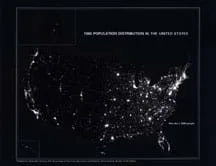 Figure 1: 1990 Population distribution of the U.S. One dot = 7,500 people.Copyright U.S. Bureau of Census, http://www.census.gov/geo/www/mapGallery/ images/density90.jpg.
Students learn about population density within environments and ecosystems. They determine the density of a population and think about why population density and distribution information is useful to engineers for city planning and design as well as for resource allocation.
Population statistics are important parameters that engineers and scientists use to determine the development of open space areas, such as city planning, transportation development, water supply needs for communities and much more. Engineers monitor occupancy density or building occupancy data to plan for safe building emergency evacuations.
After this activity, student should be able to:
- Describe the biosphere and discuss its components.
- Describe how population and population density affect an organism.
- Identify how engineers apply knowledge of population density to the development of space, such as land and building capacity.
- 3.1.3.c.i Fluently multiply and divide within 100, using strategies such as the relationship between multiplication and division or properties of operations.
Grade 3
Do you agree with this alignment? - 3.3.1 Visual displays are used to describe data.
Grade 3
Do you agree with this alignment?
- Use evidence to develop a scientific explanation of what plants and animals need to survive
Grade 4
Do you agree with this alignment? - Use evidence to develop a scientific explanation for similarities and/or differences among different organisms (species)
Grade 4
Do you agree with this alignment?
- CCSS.Math.Content.4.MD.A.3 Apply the area and perimeter formulas for rectangles in real world and mathematical problems.
Grade 4
Do you agree with this alignment? - CCSS.Math.Content.4.OA.A.2 Multiply or divide to solve word problems involving multiplicative comparison, e.g., by using drawings and equations with a symbol for the unknown number to represent the problem, distinguishing multiplicative comparison from additive comparison.
Grade 4
Do you agree with this alignment? - CCSS.Math.Content.5.G.A.2 Represent real world and mathematical problems by graphing points in the first quadrant of the coordinate plane, and interpret coordinate values of points in the context of the situation.
Grade 5
Do you agree with this alignment?
- STEL-5D Determine factors that influence changes in a society's technological systems or infrastructure.
Grades 3-5
Do you agree with this alignment?
- 3-5-ETS1-1 Define a simple design problem reflecting a need or a want that includes specified criteria for success and constraints on materials, time, or cost.
Grades 3-5
This resource focuses on the following Three Dimensional Learning aspects of NGSS:
Science & Engineering Practices- Define a simple design problem that can be solved through the development of an object, tool, process, or system and includes several criteria for success and constraints on materials, time, or cost.Do you agree with this alignment?
Disciplinary Core Ideas- Possible solutions to a problem are limited by available materials and resources (constraints). The success of a designed solution is determined by considering the desired features of a solution (criteria). Different proposals for solutions can be compared on the basis of how well each one meets the specified criteria for success or how well each takes the constraints into account.Do you agree with this alignment?
Crosscutting Concepts- People's needs and wants change over time, as do their demands for new and improved technologies.Do you agree with this alignment?
Do you agree with this alignment? - Define a simple design problem that can be solved through the development of an object, tool, process, or system and includes several criteria for success and constraints on materials, time, or cost.
Each group needs:
- Pencil
- Meter stick (share among teams if supply is limited)
- Population Density Worksheet (PDF)
Basic measuring, multiplication and division skills. A basic understanding of the biosphere and environments (as presented in the associated lesson) is helpful.
Let's review what the biosphere is. It is the part of our planet where life is found, and includes living things like animals and plants, as well as nonliving things, like air, soil, water and sunlight. The Earth's biosphere contains different types of environments and ecosystems, such as tropical rain forests, deserts, grasslands and arctic climates. Can you think of some living and nonliving things that you could find in these different environments? (Possible answers: Rocks, soil, sunlight, water, plants and animals.)
Let's brainstorm on all the types of organisms you might see on a walk in a nearby park. (Write a list that is visible for the entire class, such as on the classroom board or overhead projector.) These organisms share some things. What do they share? They share the same space and air and water and food resources. How does the number or amount of organisms in a space affect each organism? (Possible answers: Results in fewer resources for each organism, including food, space to live, energy, air, etc.)
The sharing of space and resources happens in all environments. For example, what happens if there is only one dog in a house that drinks from a water bowl? What happens to the water if you have three dogs drinking form that same water bowl? That's right; the amount of water per dog is decreased. It may even run out. What might happen to the space in this classroom if the number of students were doubled or tripled? Would that put a strain on any of our resources, such as chairs, desks or paper? Do you think there is a limit to the number of students permitted in a classroom at one time? Why? (For example, for safety in an emergency evacuation, to keep from over heating the room [body heat from so many people], etc.)
The amount of organisms in a particular environment is called its population. Populations are made up of all the members of a species living in the same place at the same time. Population density is the population per unit of land area; for example, persons per square kilometer of land. Population density helps us describe how much space an organism has in that unit of land, which helps us understand how the resources (water, food, etc.) might be divided. Engineers need to know about the population distribution and density to design a community's areas and systems, such as transportation (roads, highways, traffic, parking, bridges), structures (homes, schools, farms, offices, stores), parks and open space, public works infrastructure (power, water, sewers, landfills), and resources (how much water is available for a community to drink and use). During the design and planning phases, safety engineers also review building plans and building safety code requirements to set occupancy limits for safe emergency evacuation.
Who knows what a biodome is? A biodome is a closed structure that contains an environment. Engineers create and study biodomes to better understand how things interact with each other in a specific environment. Biodomes contain both biotic (living) and abiotic (nonliving) factors, just like the biosphere, and are constructed to represent a specific ecosystem or environment, such as a desert or tropical rain forest. A biodome acts as an artificial habitat for the plants and organisms that the engineer decides to place within it. Engineers want to determine the conditions in which a biodome environment is in equilibrium, or in a state in which all the different living and nonliving things exist in a balance, without any disappearing.
Let's consider a biodome of a tropical environment about the size of a shoebox. Could you put a population of 10 medium-sized insects in it? 10,000? What is the number of insects that you think could comfortably survive within it? What might happen if you have too many insects (too large an insect population)? (Possible answers: The insects may eat all of the food or use all of the resources, resulting in insect death.)
Now, let's think about our own classroom — a room that we share with each other and the teacher. What is the population of our class? How much space does each person have in our classroom? What might happen if we try to fit the entire school into our classroom? Well, today we are doing an activity to find out the population density and exactly how much space each person has in your classroom right now.
Before the Activity
- Gather materials and make copies of the Population Density Worksheet (PDF), one per pair of students.
- Take a moment to show students photographs or graphs that illustrate the world's population. See Figure 1 and Figure 2, or look at the U.S. Bureau of Census website at https://www.census.gov/programs-surveys/international-programs.html.
With the Students
- Divide the class into teams of two students each. Assign one student to be the measurer (with the meter stick) and the other to be the recorder (using the worksheet). Tell the students that they are acting as engineers who need to know the population density of the classroom in order to help design safety evacuation procedures.
- Have the students make the following measurements and record them on their worksheets:
- Use a meter stick to measure the length and width of the classroom.
- Multiply the length and width to get the area of the classroom in square meters.
- Count the number of individual people in your classroom (remember to count the teacher[s]).
- Calculate how much space each person has by dividing the number of square meters in the classroom by the number of people.
space = area (length x width) divided by (# of people)
- Predict the amount of space each person would have if your class size doubled. (For example: If the student population is 20 and the classroom size is 200 square meters, then each student would have 10 square meters of space. Repeat the above calculation. If the population density of the example classroom doubled, each person would have only 5 square meters of space.)
- Calculate the population density of the class by dividing the number of people in the classroom by the area to get individuals per unit area. (In our example, the population density is: 20 students/200 square meters = 2 students per 20 square meters = 1/10 = 0.1 students/square meter.)
population density = (# of people) divided by area (length x width)
- Have students practice more population density problems by completing the worksheet table.
- Conclude with a class discussion to review the worksheet and discuss population density trends. How does the population density of the classroom affect the amount of resources (tape, paper, chairs, space, etc.) for each student? (Answer: The amount of resources decreases with an increase in population density.) How might an engineer use the population density of the classroom to design a good safety evacuation procedure for the class in case of a fire drill? (Answer: Engineers would use the information to find the safest number of students to have in the classroom and the best way to get them from the classroom to outside the building quickly.) How many exit doors are there in your classroom? How many exit doors are in your school's auditorium, cafeteria or gymnasium? Why are they different? Tell the students that they will use the knowledge of population density to figure out how organisms and environments interact inside our biodomes.
- abiotic
- Nonliving, for example, sunlight or rocks.
- biodome
- A human-made, closed environment containing plants and animals existing in equilibrium.
- biosphere
- The part of the Earth's atmosphere that is capable of supporting life and includes both living and nonliving things.
- biotic
- Pertaining to life or living organisms.
- engineer
- A person who applies scientific and mathematical principles to creative and practical ends such as the design, manufacture and operation of efficient and economical structures, machines, processes and systems.
- ecosystem
- A functional unit consisting of all the living organisms (plants, animals and microbes) in a given area, and all the nonliving physical and chemical factors of their environment, linked together through nutrient cycling and energy flow. An ecosystem can be of any size — a log, pond, field, forest or the Earth's biosphere — but it always functions as a whole unit.
- environment
- The surroundings in which an organism lives, including air, water, land, natural resources, flora, fauna, humans and their interrelationships. (Examples: Tundra, coniferous forest, deciduous forest, grassland prairie, mountains and rain forest.)
- habitat
- The natural home of a plant or animal.
- population
- The number of persons inhabiting a country, city or any district or area. (ecology) The number of a specific type of organism living in a particular environment.
- population density
- Population per unit of land area; for example, persons per square kilometer of arable land.
Pre-Activity Assessment
Discussion Questions: Solicit, integrate and summarize student responses to these questions:
- How does the number (amount) of individuals in a group affect each individual organism? (For example, how does sharing a classroom with other students affect each of them?)
- In your science classroom, how much space do you think each person has?
Activity Embedded Assessment
Class Definitions: As a class, define the following activity terms on the board: population, population density, space, ecosystem and engineer.
Worksheet: Have students record measurements and follow along with the activity on their Population Density Worksheet. (PDF)After they have finished their worksheets, have them compare answers with their peers. Review their answers to gauge their mastery of the subject.
Post-Activity Assessment
Real-World Population Density Checks:
- Have students list the groups of living things that might be in the environment near where they live.
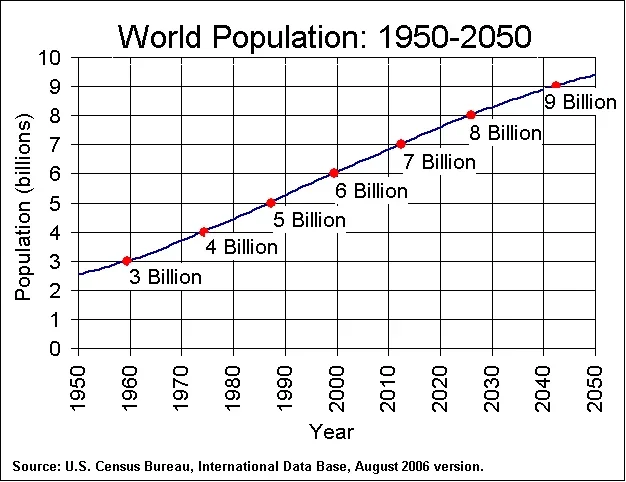 Figure 2: World population growth, 1950-2050.Copyright U.S. Census Bureau, http://www.census.gov/ipc/www/world.html
- Show students a graph of the world's population growth over time (actual and projected) to illustrate how population size changes (see Figure 2).
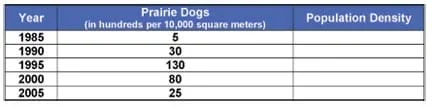 Table 1: Change in prairie dog population over 20 years.Copyright Christopher Valenti, ITL Program, College of Engineering, University of Colorado at Boulder, 2006.
- Write Table 1 on the board. Have students study the data and hypothesize what may have happened to change the population density. (Possible answers: Animal population grew with abundant food, water, shelter and protection from dangers [people, cars, predator animals]. Animals died off if there became too many of them for the limited amount of food, water or shelter. Animals died if they became too crowded and moved closer to dangerous human activity [cars, people, new development of land], or if weather was especially harsh. Animals died when predators found them to be a plentiful source of food.)
- Have students calculate the population density for each year provided in Table 1. It might help students to tell them that 10,000 square meters is roughly the size of two soccer fields.
- If students have already begun constructing biodomes in conjunction with this unit, have them determine the plant and/or insect population density of their biodome.
Homework
Population Density at Home: As a homework assignment, ask students to calculate the population density, the amount of space per person, at their homes or another location of their choice — backyard, park, dining room during a meal, swimming pool, movie theater or other space or event. Have them describe how they performed the calculation. Ask them to explain why an engineer might want to know about the population density in that particular environment.
Help speed along the measuring process by first showing students a good way to measure the classroom with their meter sticks. Then they can get to the rest of the worksheet sooner.
Some students require more help than others in performing the worksheet calculations. They also may need an explanation of the units, how to write them, and what they mean. Take time to discuss the units (meters and square meters), write them on the board and have students provide examples, for example, velocity can be measured in meters per second.
Lead the class in several example population density problems. For example, if a student and his/her sibling were together in their living room with the dimensions of 5 meters by 5 meters, find the population density of the room. Write the problems on the board and label the units for the class to refer to during the activity.
It may be necessary to bring the unit of land into perspective, for example, an acre (~4,047 square meters) is about the size of the playground's soccer field (90 x 45 meters = 4,050 square meters).
Have students approximate other population densities, such as those of their city, county, state or country. What would an engineer do with this information?
Have the class consider how population density and distribution affects different activities. For example, have the students discuss how much food their cafeteria makes each day, how many books are available in the library, how many grocery stores in a town, or how many parking spaces near a sports arena.
Have students make measurements and counts around their school, and calculate population densities, for example, bicycles in the bike rack area, cars in the parking lot, drinking fountains in the school building, people in an school assembly in the auditorium or cafeteria, or trash cans on the school grounds.
- For lower grades, students should be able to complete the activity, but may need a bit more support doing the calculation and in understanding the units.
- For upper grades, remind students to be aware of the units when doing the calculations.
Bush, Mark B. Ecology of a Changing Planet, Second Edition. Saddle River, NJ: Prentice Hall, 2000.
Dictionary.com. Lexico Publishing Group, LLC. Accessed October 9, 2006. (Source of some vocabulary definitions, with some adaptation) http://www.dictionary.com
World Population Trends, World Population Information. Last modified August 24, 2006. Population Division/International Programs Center, U.S. Census Bureau. Accessed October 9, 2006. http://www.census.gov/ipc/www/world.html
Contributors
Christopher Valenti; Malinda Schaefer Zarske; Denise Carlson
Supporting Program
Integrated Teaching and Learning Program, College of Engineering, University of Colorado Boulder
Acknowledgements
The contents of this digital library curriculum were developed under a grant from the Fund for the Improvement of Postsecondary Education (FIPSE), U.S. Department of Education and National Science Foundation GK-12 grant no. 0338326. However, these contents do not necessarily represent the policies of the Department of Education or National Science Foundation, and you should not assume endorsement by the federal government.
Copyright
2006 by Regents of the University of Colorado.