
Biodomes Engineering Design Project: Lessons 2-6
In this multi-day activity, students explore environments, ecosystems, energy flow and organism interactions by creating a scale model biodome through applying the engineering design process. The Procedure section provides activity instructions for Biodomes unit, lessons 2-6, as students work through Parts 1-6 to develop their model biodome. Subjects include energy flow and food chains, basic needs of plants and animals, and the importance of decomposers. Students consider why a solid understanding of one's environment and the interdependence of an ecosystem can inform the choices we make and the way we engineer our own communities. This activity can be conducted as either a very structured or open-ended design.
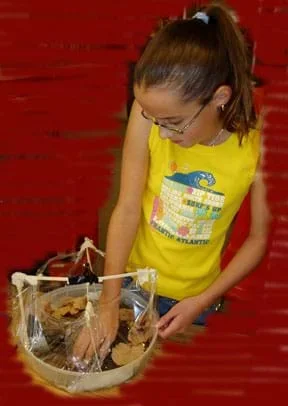 Students create biodiomes using the Engineering Design Process
Every day, engineers adapt existing designs for housing, structures and cities so they work optimally in specific environments and ecosystems. To do this, engineers apply their understanding of the specific environment and biosphere, along with the concept of ecosystems to inform their designs and shape the human-built environment. Engineers employ the cyclical steps of the engineering design process to creatively brainstorm, design, prototype and create our human-made world.
After this activity, students should be able to:
- Define a biodome and name its important features.
- Use the engineering design process to create a model biodome of a particular environment.
- Describe how engineers use their understanding of the biosphere, ecosystems and community interactions to design our human-built environment.
- Create and evaluate models of the flow of nonliving components or resources through an ecosystem
Grade 4
Do you agree with this alignment? - Make a plan to positively impact a local ecosystem
Grade 4
Do you agree with this alignment?
- Students will develop an understanding of the attributes of design.
Grades K-12
Do you agree with this alignment? - Students will develop an understanding of the role of troubleshooting, research and development, invention and innovation, and experimentation in problem solving.
Grades K-12
Do you agree with this alignment? - STEL-7H Illustrate that there are multiple approaches to design.
Grades 3-5
Do you agree with this alignment? - STEL-7I Apply the technology and engineering design process.
Grades 3-5
Do you agree with this alignment?
- 3-5-ETS1-1 Define a simple design problem reflecting a need or a want that includes specified criteria for success and constraints on materials, time, or cost.
Grades 3-5
This resource focuses on the following Three Dimensional Learning aspects of NGSS:
Science & Engineering Practices- Define a simple design problem that can be solved through the development of an object, tool, process, or system and includes several criteria for success and constraints on materials, time, or cost.Do you agree with this alignment?
Disciplinary Core Ideas- Possible solutions to a problem are limited by available materials and resources (constraints). The success of a designed solution is determined by considering the desired features of a solution (criteria). Different proposals for solutions can be compared on the basis of how well each one meets the specified criteria for success or how well each takes the constraints into account.Do you agree with this alignment?
Crosscutting Concepts- People's needs and wants change over time, as do their demands for new and improved technologies.Do you agree with this alignment?
Do you agree with this alignment? - Define a simple design problem that can be solved through the development of an object, tool, process, or system and includes several criteria for success and constraints on materials, time, or cost.
- 5-LS2-1 Develop a model to describe the movement of matter among plants, animals, decomposers, and the environment.
Grade 5
This resource focuses on the following Three Dimensional Learning aspects of NGSS:
Science & Engineering Practices- Develop a model to describe phenomena.Do you agree with this alignment?
- Science explanations describe the mechanisms for natural events.Do you agree with this alignment?
Disciplinary Core Ideas- The food of almost any kind of animal can be traced back to plants. Organisms are related in food webs in which some animals eat plants for food and other animals eat the animals that eat plants. Some organisms, such as fungi and bacteria, break down dead organisms (both plants or plants parts and animals) and therefore operate as "decomposers." Decomposition eventually restores (recycles) some materials back to the soil. Organisms can survive only in environments in which their particular needs are met. A healthy ecosystem is one in which multiple species of different types are each able to meet their needs in a relatively stable web of life. Newly introduced species can damage the balance of an ecosystem.Do you agree with this alignment?
- Matter cycles between the air and soil and among plants, animals, and microbes as these organisms live and die. Organisms obtain gases, and water, from the environment, and release waste matter (gas, liquid, or solid) back into the environment.Do you agree with this alignment?
Crosscutting Concepts- A system can be described in terms of its components and their interactions.Do you agree with this alignment?
Do you agree with this alignment? - Develop a model to describe phenomena.
Each group needs: (Most items are available at hardware or garden center stores.)
- Biodomes Engineering Design Project Workbook: Lessons 2-6 (PDF)
- 2 plastic containers (1- and 2-liter bottles with lids work well, or other inexpensive clear plastic trays, bowls, covers and lids) Well in advance, ask students to bring biodome construction materials from home, or rinse out plastic containers from a recycling bin.
- seeds (provide several types for different climates)
- soil (3-4 cups or .7-.9 l)
- sand (3-4 cups or .7-.9 l)
- supply of miscellaneous materials, such as pebbles, rocks, wire, small paper cups, plastic wrap, string, foil, popsicle sticks, chopsticks, etc.
- If insects are not available outside (due to the weather or other limitations), consider purchasing a small supply of crickets from a pet store.
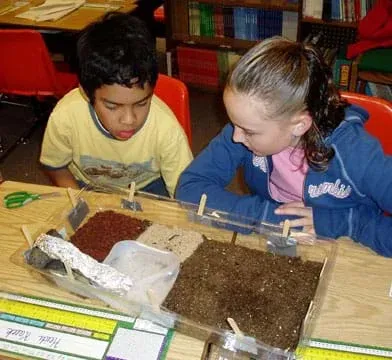 Copyright Jay Shah, ITL Program, College of Engineering, University of Colorado at Boulder, 2005.
For the entire class to share:
- masking tape
- duct tape
- glue (preferred: hot glue sticks with glue guns)
- scissors
- exacto knives (if teacher cuts the plastic bottles)
- butterfly nets and/or jars and paper cups (to catch and hold insects and worms)
- drill (to make a hole in plastic bottle lids)
- water
Some knowledge about environments and ecosystems, as introduced in Lesson 1 of the Biodomes unit.
Let's see what you know about different environments. Can anyone name an example of an environment? (Possible answers: Tropical rain forest, desert, other forest types [such as deciduous or coniferous], grassland prairie and arctic tundra.) All of these environments and ecosystems are part of our biosphere. The biosphere is the part of the Earth's atmosphere that supports life and includes both living (biotic) and nonliving (abiotic) things. It includes all the plants, animals, weather and climate. So, what happens when we have too many organisms in one environment? It may get too crowded! We call the number of organisms in a particular environment its population. Populations are made up of all the members of a species living in the same place at the same time. We learn about population numbers, or population density, to help us understand how much of resources (such as food, water and air) are available for each individual organism in an environment. Engineers need to know about the population density and how it is distributed so they can design areas for cities, parks, roadways, and even water systems so enough is available for a community to drink and use.
If you were able to design an environment, what would it look like? Would it have plants and animals in it? Which ones? How would you decide how many plants and animals you would put in your environment? Would you also live in your environment? How would you get the right amounts of air, water and food for each of your plants and animals? Well, engineers actually design artificial environments that consider all of these things. These environments are called biodomes. A biodome is a model that is designed to represent a particular environment and the community of organisms that live there. Biodomes are used to study ecosystems and attempt to model how living and nonliving things interact in those natural environments. The goal of a biodome is to create an environment that has enough resources for every plant and animal, creating a balance or equilibrium. Engineers come up with all sorts of cool designs using the engineering design process and eventually they settle on one to create.
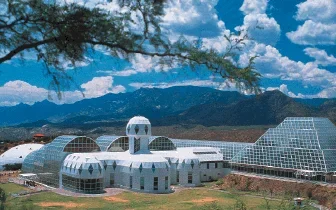 Biosphere 2 in Arizona, USA.Copyright Karen Silva, Environmental Health Perspectives, http://www.ehponline.org/docs/1996/104-4/forum.html.
Who knows something about the engineering design process? It is the set of steps that engineers take when they develop a new or improved product. Can you think of some of the steps an engineer may need to complete when designing something? Well, first they have to have a problem or a need. Then, they brainstorm creative ideas and solutions to that problem or need. Next they select the most promising idea, and draw or communicate the idea to others. Finally, they build a model of the design and evaluate whether or not that design is successful.
Who would like to become and engineer, learn more about environments, and create a biodome? Here is our challenge for this project:
Countries from all over the world have started a new project to create the best biodome yet! This new biodome will represent all the different climates and landscapes on the globe. The organizing committee has asked engineers from all different countries, including you, to help them in the design process. They request that you create a small-scale version – or prototype — of your design. Your design must only include one climate and landscape. When all the designs are done, one of them will be selected as the winner, to be built. So, it is time to put on your engineering hats and start thinking about how to make the best biodome. First thing to do is brainstorm your ideas and then make a drawing. Are you ready?
Before the Activity
- This activity can be conducted as either a very structured or open-ended design. For a more structured lesson, direct the students to build model biodomes as described in Figure 1. Otherwise, provide students with a variety of materials and set them loose to design a biodome structure of their own imagination (see Figure 2).
- Gather materials and make enough copies of the Biodomes Engineering Design Project Workbook: Lessons 2-6 (PDF), one per team (staple the pages together to make workbooks).
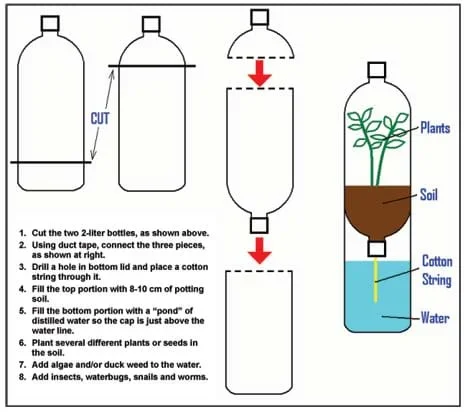 Figure 1. Steps to build a simple model biodome using two, 2-liter plastic bottles.Copyright Geoff Hill, ITL Program, College of Engineering, University of Colorado at Boulder.
With the Students
Part 1: Designing Your Biodome (for Biodomes unit, Lesson 2)
- Divide the class into engineering teams of two to four students each.
- Give each group a Biodomes Engineering Design Project Workbook: Lessons 2-6.
- Have students decide on a name for their engineering design team (and record it on the first page of their workbook).
- Instruct the students to brainstorm ideas on what a biodome would contain for a given environment. (Provide teams with an environment, perhaps the local environment.)
- After the students have brainstormed their ideas and shared a few with the class, have them pick one of their ideas from which they will build their team's model biodome.
- Next, have students draw a picture of their biodome design in the space provided in their workbooks. (Note: For a simple biodome structure, follow the Figure 1 instructions, have students design uniform biodomes, and provide them with a variety of materials, soils and seeds for the interior. For a more open-ended project, instruct the teams to creatively design their own biodome structures and materials [see Figure 2].)
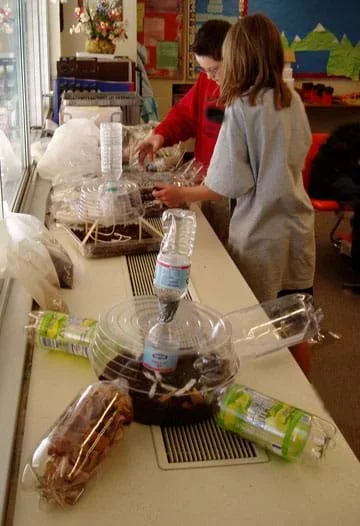 Figure 2. Students are creative in their open-ended model biodome designs.Copyright Jay Shah, ITL Program, College of Engineering, University of Colorado at Boulder, 2005.
Part 2: Building Your Biodome Structure (for Biodomes unit, Lesson 2)
- During this class period, provide each group with the supplies they need to build the structure of their designed biodome.
- Provide time for the students to build their biodome structures. Remind them that they need a tight seal on their biodome, so that it becomes a completely contained mini-environment (use tape or hot glue, preserving the ability to open/close the biodome for future steps).
- Have students answer the questions in Part 2 of the workbook. Remind them that engineers often encounter challenges many times during the engineering design process, before they achieve a finished product.
Part 3: Energy Flow in Your Biodome (for Biodomes unit, Lesson 3)
- Instruct students to sit together with the members of their engineering design teams.
- In their workbooks, have students explain their biodome environment and make a list of the organisms that could be found if their biodome was built on a larger scale.
- Next, have students draw one or more food chains or food webs to show the flow of energy through their biodome environment. Have them consider the relationships of the food sources and consumers in their individual biodomes.
- Have several student teams share their food chains or food webs with the class. Discuss the flow of energy through each of their model biodomes.
- Engage the students in a class discussion about their biodomes. Questions: From where does the energy to sustain your biodomes originally come? (Answer: The sun.) How will you make sure that sunlight gets into your biodome? Where are the air and water sources for your biodomes?
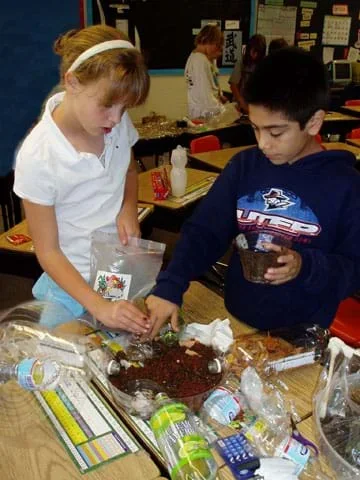 Copyright Jay Shah, ITL Program, College of Engineering, University of Colorado at Boulder, 2005.
Part 4: Plants in Your Biodome (for Biodomes unit, Lesson 4)
- Instruct students to sit together with the members of their engineering design teams.
- Discuss basic plant needs with the students (food, water and energy from the sun).
- Have students place soil, sand, rocks, ponds, or earth features into their biodomes, according to their designs.
- Next, have students plant several seeds in the soil of their biodomes.
- Remind students to record in their workbooks what they are adding to their biodomes.
- Next, have students water their biodome and seal it up tightly.
- Ask students to review their food chain drawings and the plants they placed inside their biodomes. Will these plants support their food chains? If not, what changes will they need to make to their food chains? Tell them that engineers often have to make adjustments to their projects as they learn new information or change their materials (in this case, seeds) from their original design.
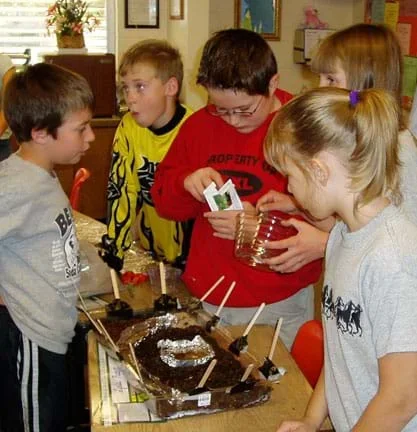 Copyright Jay Shah, ITL Program, College of Engineering, University of Colorado at Boulder, 2005.
Part 5: Animals in Your Biodome (for Biodomes unit, Lesson 5)
- Instruct students to sit together with the members of their engineering design teams.
- In their workbooks, have student record observations of what happened to their biodome since they last added something.
- Inform the students that today they will collect animals from outdoors to place into their biodomes. Before they go outside to collect the animals, they need to plan what kind of animals they can have inside.
- Make a list on the board of possible animals (insects) that the students may find to put in their biodome. (Ideas: grasshoppers, crickets, snails, ants, flies, moths, box elder bugs, June bugs, water bugs. Worms will be added in the decomposition activity, Part 6.) Also make a list of food sources that those animals require.
- Ask the students what kinds of problems they might have in picking which animals to put inside the biodome. Explain that they do not want the animals to be eaten by the other animals in the biodome. If this happens, all the animals would die once their food source is gone. Also explain that engineers are often limited by the materials that are available to them. In this case, the students are limited to the animals they can find outside their classroom, mostly insects.
- After giving instructions on outdoor policies, give the students some time go outside with nets and jars to collect insects for their biodomes.
- Returning to class, ask the students to place their insects/animals into their biodomes and observe what they see.
- Have students add water, if needed, to their biodome and seal it up tightly.
Part 6: Decomposers in Your Biodome (for Biodomes unit, Lesson 6)
- Instruct students to sit together with the members of their engineering design teams.
- In their workbooks, have student record observations of what happened to their biodome since they last added something.
- Inform the students that today they will collect worms from outdoors to place into their biodomes. The worms help to break down animal and plant wastes into more useful soil and nutrients.
- Ask the students what kind of problems they see with putting animals and plants into a biodome. Lead them to realize that it is very difficult for humans to make a safe atmosphere for all the different types of plants and animals and that often some of the plants and animals die in their new locations. While the idea of biodomes is a very popular one, there have not been many successes. Engineers work with biologists and other scientists to try their best to design environments in which the animals can live as if they were in nature.
- After giving instructions on outdoor policies, give the students some time to go outside to with jars or paper cups to collect worms for their biodomes.
- Returning to class, ask the students to place their worms into their biodomes and observe what they see.
- Have students add water, if needed, to their biodome and seal it up tightly.
Part 7: Review & Evaluation (after completion of the model biodomes)
- Instruct students to sit together with the members of their engineering design teams.
- In their workbooks, have student record observations of what happened to their biodome since they last added something.
- Have them answer the review and evaluation questions in their workbooks.
- Exhibit the completed model biodomes, along with the completed team workbooks in the school library, display cases or at parents' night.
- biodome
- A human-made, closed environment containing plants and animals existing in equilibrium.
- brainstorming
- A technique of solving specific problems, stimulating creative thinking and developing new ideas by unrestrained and spontaneous discussion.
- engineer
- A person who applies scientific and mathematical principles to creative and practical ends such as the design, manufacture and operation of efficient and economical structures, machines, processes and systems.
- engineering design process
- The design, build and test loop used by engineers. The steps of the design process include: 1) Define the problem, 2) Come up with ideas (brainstorming), 3) Select the most promising design, 4) Communicate the design, 5) Create and test the design, and 6) Evaluate and revise the design.
- ecosystem
- A functional unit consisting of all the living organisms (plants, animals and microbes) in a given area, and all the nonliving physical and chemical factors of their environment, linked together through nutrient cycling and energy flow. An ecosystem can be of any size — a log, pond, field, forest or the Earth's biosphere — but it always functions as a whole unit.
- model
- (noun) A representation of something, sometimes on a smaller scale. (verb) To simulate, make or construct something to help visualize or learn about something else (as the living human body, a process or an ecosystem) that cannot be directly observed or experimented upon.
- prototype
- A first attempt or early model of a new product or creation. May be revised many times.
Pre-Activity Assessment
Discussion Questions: Solicit, integrate and summarize student responses.
- What is an environment? What types of things does an environment include? Can you think of any artificial environments?
- Are you familiar with the engineering design process? Can you name any steps in the engineering design process?
Activity Embedded Assessment
Workbook: Have students follow along with the activity using the Biodomes Engineering Design Project Workbook: Lessons 2-6 (PDF). Ask the student teams to complete the questions in the workbook after they have finished each part of creating the biodome. After students have finished the workbook questions, have them compare answers with their peers. Review their answers to gauge their mastery of the subject.
Post-Activity Assessment
Re-Engineering: Ask student teams to brainstorm to come up with many ideas on how they could improve their biodomes. Have them sketch the most promising ideas.
Show and Tell: Have student groups show off their biodomes to the rest of the class. Have them explain: 1) how they developed their design, 2) the best part of their design, 3) what could go wrong with it, and 4) what could be fixed or improved in future models. Remind students that engineers go through the design-build-redesign process many times before they are satisfied with a finished product.
Engineering Poster: Using the knowledge they learned in the biodomes lessons and activities, have student engineering teams each create a poster to present their best design for a biodome of a particular environment. Ask them to title their posters with an engineering company name that they invent, such as, Eco Engineering Corporation.
Making Sense: Have students reflect on the science concepts they explored and/or the science and engineering skills they used by completing the Making Sense Assessment (PDF).
- Warn students to be careful when cutting plastic bottles. Or, depending on the ability of the students, cut the plastic bottles in advance of the activity.
- Set up a hot glue gun station that either the teacher or a classroom assistant supervises. Do not hand out hot glue guns unless students are able to use them responsibly and safely.
- Be aware of any student allergies to insects, grasses, etc.
- Warn students not to try to capture potentially dangerous insects, such as bees, wasps or spiders.
- Be sure to monitor students when they are outdoors.
Limit the materials that students are permitted to use to create their biodomes, otherwise, the biodomes tend to become large and resource demanding. This approach mirrors the real world, in which engineers are usually given size, budget and/or resource limitations. One way to limit size is to set a maximum footprint area, such as one square meter or one square foot.
To give the seeds more time to grow, consider swapping the order of Parts 3 and 4, so the seeds are planted earlier in the model biodome development process.
For Part 5, if insects are not available outside (due to the weather or other limitations), consider purchasing a small supply of crickets or snails (often free since they usually have too many) from a pet store, or potato bugs from a science lab. Note that snails and aquarium plants should not go down the drain or into a nearby stream as both are nasty invasive species. Instead, explain to the students that you'll find a home for them, and then either return them to a suitable aquarium elsewhere or destroy them.
Have students conduct research to find out what types of construction methods have been used in real biodomes. See if they can find any details on how these design ideas were reached.
Have students make a bar graph representing the class' biodome diversity.
Have students make a bar chart of the animals and plants they included in their biodomes. Gather all class data and make a class chart as a demonstration. From the data, ask the students how biodome engineers make sure they gather an appropriate sample of plants, animals and decomposers. (Point out that most of students probably gathered the easiest animals and plants to find. What would happen if biodome engineers did this? Would it be a good representation of life?) Then, ask the students to do this for their own biodomes.
Have students research real-world biodomes and find out what animals, birds and fish are inside. How do biodome managers control how the animals come into contact with each other in order to maintain healthy populations of both predators and prey?
- For lower grades, adjust the amount of detail required for the biodome design project. You could have the students create identical plant-only biodomes, using the Figure 1 design, or cover only Parts 1, 2 and 4 of the activity.
- For upper grades, there are numerous ways to scale up this project. Give students more constraints on materials and size, and/or come up with other "customer" requirements. Add a math component by requiring them to draw their designs to scale, or measure and graph the growth of their plants, or survival rate of their animals and decomposers. You could also have students design their biodomes using a computer-aided design software application. Require the student teams to present their projects to the class as if they were a professional engineering firm.
Biosphere 2. Biosphere 2, Tuscon, AZ. Accessed October 26, 2006. http://www.bio2.com/
Dictionary.com. Lexico Publishing Group, LLC. Accessed October 11, 2006. (Source of some vocabulary definitions, with some adaptation) http://www.dictionary.com
- Biodomes
- Environments and Ecosystems
- Biodomes are Engineered Ecosystems: A Mini World
- Biodomes Engineering Design Project: Lessons 2-6
- Go with the Energy Flow
- Got Energy? Spinning a Food Web
- Biodomes Engineering Design Project: Lessons 2-6
- Planting Thoughts
- Plant Cycles: Photosynthesis & Transpiration
- Biodomes Engineering Design Project: Lessons 2-6
- Classification Systems: Animals and Engineering
- Biomimicry: Natural Designs
- Biodomes Engineering Design Project: Lessons 2-6
- Cleaning Up with Decomposers
- Biodomes Engineering Design Project: Lessons 2-6
Contributors
Katherine Beggs; Christopher Valenti; Malinda Schaefer Zarske; Denise Carlson
Supporting Program
Integrated Teaching and Learning Program, College of Engineering, University of Colorado Boulder
Acknowledgements
The contents of this digital library curriculum were developed under a grant from the Fund for the Improvement of Postsecondary Education (FIPSE), U.S. Department of Education and National Science Foundation GK-12 grant no. 0338326. However, these contents do not necessarily represent the policies of the Department of Education or National Science Foundation, and you should not assume endorsement by the federal government.
Copyright
2004 by Regents of the University of Colorado