
Biodomes
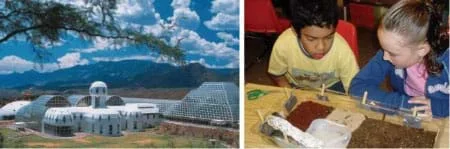 (left) Biosphere 2 in Arizona, USA, (right) students examine the base of their model biodome.
This unit is comprised of a series of six lessons during which students use their growing understanding of various environments and the engineering design process, to design and create their own model biodome ecosystems. The Procedure section of lesson 2's Biodomes Engineering Design Project: Lessons 2-6 activity provides instructions for the Biodomes unit, lessons 2-6, guiding students through Parts 1-6 to develop their models. Biodome components covered include its structure, environment and energy flow, plants, animals and decomposers. This activity can be conducted as either a very structured or open-ended design.
The many facets of biodomes represent a wide range of real-world engineering applications. Engineers design housing, cities and structures for specific environments and ecosystems, using their understanding of the biosphere and ecosystems to shape the human-built environment. Population statistics are important parameters that engineers use to determine the development of open space areas, such as city planning, transportation development, and community water supply needs. Engineers of all disciplines follow the steps of the engineering design process to generate ideas and create prototypes and models. Understanding energy flow and transfer is important for the heat loss/gain of buildings, the fuel to power appliances and tools, meteorological sensors and computer modeling systems. Engineers take advantage of the natural characteristics of plants to improve technologies and make our lives more comfortable, for example, in wastewater treatment processes, air and pollution clean-up, and even solar panels that mimic photosynthesis. Many engineers are directly involved with animals as part of cleaning up chemical spills or restoring habitat. Engineers often use the natural world as inspiration for design, for products such pollution development of antibiotics and healing drugs, as well as the design of sea vessels, airplanes, boats, radar and sonar, medical imaging, and Velcro® - to name a few.
- 3-LS4-3 Construct an argument with evidence that in a particular habitat some organisms can survive well, some survive less well, and some cannot survive at all.
Grade 3
This resource focuses on the following Three Dimensional Learning aspects of NGSS:
Science & Engineering Practices- Use evidence (e.g., observations, patterns) to construct an explanation.Do you agree with this alignment?
Disciplinary Core Ideas- For any particular environment, some kinds of organisms survive well, some survive less well, and some cannot survive at all.Do you agree with this alignment?
Crosscutting Concepts- Cause and effect relationships are routinely identified and used to explain change.Do you agree with this alignment?
- Knowledge of relevant scientific concepts and research findings is important in engineering.Do you agree with this alignment?
Do you agree with this alignment? - Use evidence (e.g., observations, patterns) to construct an explanation.
- 3-LS4-3 Construct an argument with evidence that in a particular habitat some organisms can survive well, some survive less well, and some cannot survive at all.
Grade 3
This resource focuses on the following Three Dimensional Learning aspects of NGSS:
Science & Engineering Practices- Use evidence (e.g., observations, patterns) to construct an explanation.Do you agree with this alignment?
Disciplinary Core Ideas- For any particular environment, some kinds of organisms survive well, some survive less well, and some cannot survive at all.Do you agree with this alignment?
Crosscutting Concepts- Cause and effect relationships are routinely identified and used to explain change.Do you agree with this alignment?
- Knowledge of relevant scientific concepts and research findings is important in engineering.Do you agree with this alignment?
Do you agree with this alignment? - Use evidence (e.g., observations, patterns) to construct an explanation.
- 3-LS4-3 Construct an argument with evidence that in a particular habitat some organisms can survive well, some survive less well, and some cannot survive at all.
Grade 3
This resource focuses on the following Three Dimensional Learning aspects of NGSS:
Science & Engineering Practices- Use evidence (e.g., observations, patterns) to construct an explanation.Do you agree with this alignment?
Disciplinary Core Ideas- For any particular environment, some kinds of organisms survive well, some survive less well, and some cannot survive at all.Do you agree with this alignment?
Crosscutting Concepts- Cause and effect relationships are routinely identified and used to explain change.Do you agree with this alignment?
- Knowledge of relevant scientific concepts and research findings is important in engineering.Do you agree with this alignment?
Do you agree with this alignment? - Use evidence (e.g., observations, patterns) to construct an explanation.
- 3-LS4-3 Construct an argument with evidence that in a particular habitat some organisms can survive well, some survive less well, and some cannot survive at all.
Grade 3
This resource focuses on the following Three Dimensional Learning aspects of NGSS:
Science & Engineering Practices- Use evidence (e.g., observations, patterns) to construct an explanation.Do you agree with this alignment?
Disciplinary Core Ideas- For any particular environment, some kinds of organisms survive well, some survive less well, and some cannot survive at all.Do you agree with this alignment?
Crosscutting Concepts- Cause and effect relationships are routinely identified and used to explain change.Do you agree with this alignment?
- Knowledge of relevant scientific concepts and research findings is important in engineering.Do you agree with this alignment?
Do you agree with this alignment? - Use evidence (e.g., observations, patterns) to construct an explanation.
- 3-LS4-3 Construct an argument with evidence that in a particular habitat some organisms can survive well, some survive less well, and some cannot survive at all.
Grade 3
This resource focuses on the following Three Dimensional Learning aspects of NGSS:
Science & Engineering Practices- Use evidence (e.g., observations, patterns) to construct an explanation.Do you agree with this alignment?
Disciplinary Core Ideas- For any particular environment, some kinds of organisms survive well, some survive less well, and some cannot survive at all.Do you agree with this alignment?
Crosscutting Concepts- Cause and effect relationships are routinely identified and used to explain change.Do you agree with this alignment?
- Knowledge of relevant scientific concepts and research findings is important in engineering.Do you agree with this alignment?
Do you agree with this alignment? - Use evidence (e.g., observations, patterns) to construct an explanation.
- 3-LS4-3 Construct an argument with evidence that in a particular habitat some organisms can survive well, some survive less well, and some cannot survive at all.
Grade 3
This resource focuses on the following Three Dimensional Learning aspects of NGSS:
Science & Engineering Practices- Use evidence (e.g., observations, patterns) to construct an explanation.Do you agree with this alignment?
Disciplinary Core Ideas- For any particular environment, some kinds of organisms survive well, some survive less well, and some cannot survive at all.Do you agree with this alignment?
Crosscutting Concepts- Cause and effect relationships are routinely identified and used to explain change.Do you agree with this alignment?
- Knowledge of relevant scientific concepts and research findings is important in engineering.Do you agree with this alignment?
Do you agree with this alignment? - Use evidence (e.g., observations, patterns) to construct an explanation.
- Day 1: Environments and Ecosystems lesson
- Day 2: Population Density: How Much Space Do You Have? activity
- Day 3: Biodomes are Engineered Ecosystems: A Mini World lesson, Go with the Energy Flow lesson
- Day 4: Got Energy? Spinning a Food Web activity
- Day 5: Planting Thoughts lesson
- Day 6: Plant Cycles: Photosynthesis & Transpiration activity (start on this day, but to be done during three days within a two- or three-week period)
- Day 7: Classification Systems: Animals and Engineering lesson
- Day 8: Biomimicry: Natural Designs activity
- Day 9: Cleaning Up with Decomposers lesson
- Day 10-16: Biodomes Engineering Design Project: Lessons 2-6 activity
Contributors
Christopher Valenti; Malinda Schaefer Zarske; Denise W. Carlson
Supporting Program
Integrated Teaching and Learning Program, College of Engineering, University of Colorado Boulder
Acknowledgements
The contents of this digital library curriculum were developed under grants from the Fund for the Improvement of Postsecondary Education (FIPSE), U.S. Department of Education, and the National Science Foundation (GK-12 grant no 0338326). However, these contents do not necessarily represent the policies of the Department of Education or National Science Foundation, and you should not assume endorsement by the federal government.
Copyright
2004 by Regents of the University of Colorado