
Plant Cycles: Photosynthesis & Transpiration
What do plants need? Students examine the effects of light and air on green plants, learning the processes of photosynthesis and transpiration. Student teams plant seeds, placing some in sunlight and others in darkness. They make predictions about the outcomes and record ongoing observations of the condition of the stems, leaves and roots. Then, several healthy plants are placed in glass jars with lids overnight. Condensation forms, illustrating the process of transpiration, or the release of moisture to the atmosphere by plants.
 What makes plants survive?Copyright 2004 Microsoft Corporation, One Microsoft Way, Redmond, WA 98052-6399 USA. All rights reserved.
Engineers creatively make use of the plant kingdom for many beneficial human applications such as cleaning air and water. Phytoremediation is the engineered use of green plants to remove or render harmless soil or water contaminants including heavy metals, trace elements, organic compounds and radioactive compounds. For example, one company designed a series of engineered ecosystems at a highway rest area using plants, insects, snails and worms to clean the wastewater and recycle it back into the restrooms to flush toilets. Others have planted trees and vegetation as a low-tech and low-cost cleanup technology for contaminated soils, groundwater and wastewater.
After this activity, students should be able to:
- Explain photosynthesis and transpiration in plants.
- Compare and contrast the growth of plants under varying conditions.
- Explain how engineers use plants to create technologies that benefit humans.
- Create and evaluate models of plant and/or animal systems or parts
Grade 5
Do you agree with this alignment? - Use evidence to develop a scientific explanation of what plants and animals need to survive
Grade 4
Do you agree with this alignment?
- Models are used to communicate and test design ideas and processes.
Grades 3-5
Do you agree with this alignment?
- 5-LS1-1 Support an argument that plants get the materials they need for growth chiefly from air and water.
Grade 5
This resource focuses on the following Three Dimensional Learning aspects of NGSS:
Science & Engineering Practices- Support an argument with evidence, data, or a model.Do you agree with this alignment?
Disciplinary Core Ideas- Plants acquire their material for growth chiefly from air and water.Do you agree with this alignment?
Crosscutting Concepts- Matter is transported into, out of, and within systems.Do you agree with this alignment?
Do you agree with this alignment? - Support an argument with evidence, data, or a model.
Each group needs:
- 2 small cups (in which to plant seeds in soil)
- Potting soil (enough to fill each planting cup about ¾ full)
- 4 seeds (such as beans or peas)
- Marker or pencil (to label the planting cups)
- Tape (optional, to label the cups)
- What Do Plants Need? Worksheet, (PDF) one per person
For the entire class to share:
- A dark area (such as a box or closet)
- A bright area with sunlight
- Several glass bottles or jars (enough to place over some of the planting cups)
What are some things that you know about plants? Who can name a plant? There are many different types of plants, from small grasses to tall redwood trees. What do these plants have in common? Well, they all get their energy from the sun. The sun gives plants the energy or fuel for photosynthesis. What is photosynthesis? Photosynthesis is how plants make their food. Through photosynthesis, the energy from the sun is changed into sugar and oxygen for the plant. Plants are known as producers for this reason, because they produce their own food using sunlight. What else do plants need to survive? Air and water, just like us!
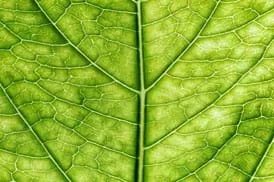 Copyright 2004 Microsoft Corporation, One Microsoft Way, Redmond, WA 98052-6399 USA. All rights reserved.
There are many different parts to a plant that help it survive, photosynthesize, and take in air and water. Can you think of any of the parts? Most land plants have roots, a stem or trunk, branches and leaves. Do you know which of these parts helps the plant to breathe? The leaves help the plant take in air through tiny holes called stomata. Plants take in carbon dioxide from the air and release nice, clean oxygen. Who needs to breathe oxygen? We do and so do other animals! So, plants help provide us with some of the oxygen we need to breathe and survive. Do you know which part of the plant takes in water? Yes, plants take in water through their roots. What happens when we humans take in extra water? We get rid of extra water in our bodies through sweat and urine. Plants get rid of the water through their leaves, in a process called transpiration. The water they take in can be dirty, but they release clean water during transpiration.
Why do you think an engineer would care about plants? Engineers use plants to help create cleaner air for people to breathe and cleaner water for people to drink. For example, engineers use plants when designing water treatment processes. Since plants can take in dirty water and clean it, engineers incorporate plants into the cleaning process as a way to clean up dirty water, and then they send it through pipes to our homes and schools, safe to drink. Cleaning the water using plants helps us stay healthy. Other engineers use plants to build entire houses or products, called green products. Engineers also were inspired by the photosynthesis process in plants to design solar panels to provide us with a renewable energy source.
How do plants grow? For a plant, their life begins as a seed, which turns into a root, and eventually expands to a leaf, a flower and sometimes fruit. Today we are going to look at how plants grow, what affects how they grow, and how we can use this information as engineers to design better technologies for cleaning air and water for people to use.
Before the Activity
- Gather materials and make copies of the What Do Plants Need? Worksheet (PDF), one per person.
- For best results, soak the seeds in water overnight.
With the Students: Part 1: Planting the Seeds
- Divide the class into teams of two or three students each.
- With a marker or pencil (or on a piece of tape), have students write their team name on the planting cups and number the cups #1 and #2.
- Have students fill each planting cup about ¾ full of potting soil.
- In each planting cup, have them plant two seeds a little below the surface of the soil. (Technique: Sometimes it helps to poke a hole in the soil with a pencil and drop in the seeds. Then cover the top of the seeds with soil.)
- Have students add a little water to the soil as moisture for the seeds.
- Have student teams place all their #1 cups in a dark location, and their #2 cups in a bright, sunny location.
- Hand out the worksheets. Ask students predict the following:
- What will happen to the seeds placed in the dark area?
- What will happen to the seeds placed in the light area?
- Keep the seeds in their respective locations for a little more than a week, watering when the soil gets dry.
- After the planting cups are set aside, have students draw and label the parts of a plant on the back of their worksheets. Do this either as a research exercise using books or the Internet, or as a word search in which the teacher provide the part names and the students draw and label their own plants. While discussing the parts of a plant, discuss the photosynthesis and transpiration processes.
With the Students: Part 2: Observing Light vs. Dark
- After a week, remove the cups from the dark location and compare them to the cups placed in the bright, sunny location. Ask students to record their observations on their worksheets.
- From each container, pull a seedling out of the soil; compare the root systems. In the observation column on their worksheets, have the students record what they see.
- Lead a class discussion about their expectations vs. the actual outcomes. Were their predictions correct?
- Lead a class discussion about the observed differences in growth, above and below soil. Was light important for the seedlings' growth? Ask the class to tell you what they know about photosynthesis. Use their responses to explain that photosynthesis is how plants use light to make food.
- Move all the seedlings to the bright location. After a few days, observe and record any changes. Revisit the concept of photosynthesis and discuss how it has been limited. Considering what you now know about the importance of photosynthesis, where would be the best and worst places to grow seeds and plants (Worst places: In a closet, drawer, box, refrigerator, basement, cave, etc.).
- Conclude with the engineering design post-activity assessment activity described in the Assessment section.
With the Students: Part 3: Transpiration
- Take a few of the healthy seedlings and place a clear bottle or jar over them. On their worksheets, have students record their predictions of what will happen to these seedlings overnight.
- The next day, look at the seedlings under the glass jars. What happened to them? Have them write their observations on their worksheets. (Overnight, condensation collects on the inside of the glass. This is the water vapor that is emitted by the plant when it exchanges oxygen for carbon dioxide, called transpiration. If the plants did not demonstrate much transpiration, place the plants in a sunny area under the glass jar, water them a little, and record observations after a few more days.)
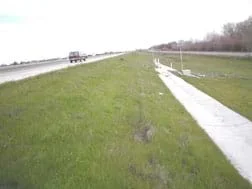 This roadside landscaping is engineered design that uses vegetation to remove suspended solids from storm water before it enters the storm drain.Copyright Lara Larsen, RBF Consulting. All rights reserved.
- Conclude by leading a class discussion about transpiration — the process by which water absorbed by plants, usually through the roots, is evaporated into the atmosphere from the plant surface, principally from the leaves. Even though we rarely see it, plants are releasing moisture all the time. Has anyone ever been in a greenhouse filled with plants? Was it dry or humid in there? Did you see condensation on the windows? Plants can be used to clean dirty air and water since they take in the air and water around them through their leaves and roots, and release clean oxygen and water back into the atmosphere. How might this be helpful to people? How might we use plants to improve our environment? (Possible answers: Keep live plants in our homes and classrooms to improve the air quality; plant trees and grasses around roads and factories; engineers incorporate tiny plants, lagoons and wetlands into municipal biological water treatment processes; plant trees and vegetation along roadways to prevent erosion and landslides, and clean and/or absorb storm water runoff; use renewable plants to make the products we need [green products], engineers and researchers plant grasses and trees to clean up contaminated groundwater and soil; take care of our forests and parks because they keep the air and water of our planet in good health.)
- biodome
- A human-made, closed environment containing plants and animals existing in equilibrium.
- energy
- The capacity for vigorous activity; available power; the capacity to do work. For example, He ate chocolate for quick energy.
- engineer
- A person who applies scientific and mathematical principles to creative and practical ends such as the design, manufacture and operation of efficient and economical structures, machines, processes and systems.
- environment
- The surroundings in which an organism lives, including air, water, land, natural resources, flora, fauna, humans and their interrelationships. (Examples: Tundra, coniferous forest, deciduous forest, grassland prairie, mountains and rain forest.)
- plant cycle
- The life cycle of a plant: from a seed to seedling to flowers to fruits, and back to seeds again. Flowers become fruits and fruits have seeds inside them.
- photosynthesis
- The process in green plants by which carbohydrates are made from carbon dioxide and water using sunlight as the energy source.
- root
- The part of a plant that usually grows downward into the soil, anchoring the plant and absorbing nutrients and water.
- stem
- The main stalk of a plant.
- stomata
- The pores found on the leaf of a plant.
- transpiration
- The process by which water absorbed by plants, usually through the roots, is evaporated into the atmosphere from the plant surface, principally from the leaves.
Pre-Activity Assessment
Prediction: Have students predict the outcome of the activity before the activity is performed. Ask the class to write a prediction on their worksheets about what they think will happen to each set of plants (or seeds), those in sunlight and those in darkness. Have them also predict what might happen to the plant in the glass jar.
Activity Embedded Assessment
Worksheet: Have students record their observations on the activity worksheet; review their answers to gauge their mastery of the subject. Ask students to support an argument that plants get the materials they need for growth chiefly from air and water.
Diagram: Have the class draw and label the parts of a plant on the back of their worksheets. Do this either as a research exercise using books or the Internet, or as a word search in which the teacher provides the parts, and students draw and label their own plants. Or, provide materials to construct a representative plant by gluing or drawing on a separate piece of paper, using brown pipe cleaners, collected leaves and markers. Remind students to include the source of energy for the plant to make its own food (the sun).
Post-Activity Assessment
Engineering Design: Have student groups think about how an engineer would use the information they learned about photosynthesis and transpiration in plants to create water cleaning technologies. Have each group pretend to be an engineering company that is designing a new water treatment facility. Have each group draw a picture of a water treatment process illustration the following steps: how water comes into the building or collection area, how plants could be used to clean the water, how the clean water would be collected, and how the cleaned water would be distributed to the community.
Make sure that someone takes care of the plants in the sunlight. Even a few days of direct sun without water might be enough to ruin the experiment, making it difficult to differentiate the plants that received sunlight from the plants that did not.
This activity takes at least two weeks, roughly three meetings, to complete. Therefore, doing another activity on the second and third meeting days is recommended since they only call for short discussions and recording observations. This allows you to put seeds or plants into model biodomes, spend time outlining the process of photosynthesis or diagramming the parts of the plant cell, or introduce the next lesson.
Local Clean Water: Have students research or visit their local water treatment facility. Does it use plants or bacteria in any way to clean the water? How did engineers design the treatment facility to mimic nature?
Plant Cell Parts: Have students research the parts of the plant cell. Which parts are involved in photosynthesis or transpiration? Have them explain how the different parts of a plant cell might be useful to engineers trying to develop water treatment technologies. Can engineers mimic the parts of the plant cells in any way?
Using Green Plants for Clean Up: Assign students to investigate and prepare a report on the creative ways engineers use plants to clean our air and water. For example, one company designed a system to clean wastewater at a highway rest area located far away from any accessible water treatment facility. They used a natural biological process — a series of engineered ecosystems containing plants, insects, snails and worms — to clean the waste from the water. The treated wastewater is recycled back into the restrooms to flush toilets. See the Living Technologies website for more information and photographs: http://www.tfhrc.gov/pubrds/mayjun00/vermont.htm.
Green Products: Assign students to investigate and prepare a report on examples of ways engineers have creatively use plants to design eco-friendly "green products" — everything from bamboo (a type of grass) floors to kitchen cabinets made from wheat straw and sunflower seed husks to many other types of plant-based building materials.
Engineering with Plants: Assign students to investigate and prepare a report on examples of phytoremediation — a low-tech and low-cost cleanup technology for contaminated soils, groundwater and wastewater. In what ways have green plants been used to remove or render harmless such environmental contaminants as heavy metals, trace elements, organic compounds and radioactive compounds in soil or water?
- For lower grades, more time and instruction may be needed to explain and put together a hypothesis and record observations. Consider conducting the activity as a class, with the hypothesis and observations completed as a group. To do this, plant four cups of seeds with two cups placed in a bright, sunny area and two cups in a dark space. Have students alternate watering, and checking and recording the plant growth each day.
- For upper grades, add an assignment from the Activity Extensions section.
Bush, Mark B. Ecology of a Changing Planet, Second Edition. Saddle River, NJ: Prentice Hall, 2000.
Chlorophyll. Last modified October 15, 2006. Wikipedia, the Free Encyclopedia. Accessed October 18, 2006. http://en.wikipedia.org/wiki/Chlorophyl
Farrell, Molly and Liz Van der Hoven and Tedann Olsen. Vermont Rest Area Uses Green Wastewater Treatment System. Posted May/June 2000. Public Roads, Vol. 63, No. 6. Federal Highway Administration, U.S. Department of Transportation. Accessed November 2, 2006. http://www.tfhrc.gov/pubrds/mayjun00/vermont.htm
Contributors
Christopher Valenti; Malinda Schaefer Zarske; Denise W. Carlson
Supporting Program
Integrated Teaching and Learning Program, College of Engineering, University of Colorado Boulder
Acknowledgements
The contents of this digital library curriculum were developed under a grant from the Fund for the Improvement of Postsecondary Education (FIPSE), U.S. Department of Education and National Science Foundation GK-12 grant no. 0338326. However, these contents do not necessarily represent the policies of the Department of Education or National Science Foundation, and you should not assume endorsement by the federal government.
Copyright
2004 by Regents of the University of Colorado.