
Got Energy? Spinning a Food Web
Students learn about energy flow in food webs, including the roles of the sun, producers, consumers and decomposers in the energy cycle. They model a food web and create diagrams of food webs using their own drawings and/or images from nature or wildlife magazines. Students investigate the links between the sun, plants and animals, building their understanding of the web of nutrient dependency and energy transfer.
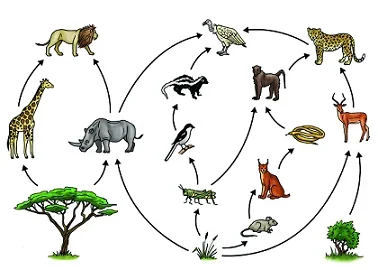 Students investigate food websCopyright Flickr https://www.flickr.com/photos/121935927@N06/13578885414
Understanding energy flow and transfer helps many engineers do their jobs. Some engineers improve energy efficiency and develop viable renewable energy sources. Other engineers design and develop new technologies that improve food and energy production, or measure, model or predict the climate and weather energy cycles. Some engineers design and develop human-created environments, such as biodomes and space stations. Other engineers use their understanding of the natural energy cycles and food webs as they work to minimize the impact on ecosystems of a new dam or river re-routing.
After this lesson, students should be able to:
- Compare and contrast producers and consumers in a food chain or food web.
- Diagram the flow of energy through simple food chains and food webs.
- Explain how engineers use knowledge of energy flow through food chains and webs to work with new energy sources, technologies and designed environments.
- Identify and describe the variety of energy sources
Grade 4
Do you agree with this alignment? - Create and evaluate models of the flow of nonliving components or resources through an ecosystem
Grade 4
Do you agree with this alignment?
- Energy comes in different forms.
Grades 3-5
Do you agree with this alignment? - STEL-2F Describe how a subsystem is a system that operates as part of another, larger system.
Grades 3-5
Do you agree with this alignment?
- 5-LS2-1 Develop a model to describe the movement of matter among plants, animals, decomposers, and the environment.
Grade 5
This resource focuses on the following Three Dimensional Learning aspects of NGSS:
Science & Engineering Practices- Develop a model to describe phenomena.Do you agree with this alignment?
- Science explanations describe the mechanisms for natural events.Do you agree with this alignment?
Disciplinary Core Ideas- The food of almost any kind of animal can be traced back to plants. Organisms are related in food webs in which some animals eat plants for food and other animals eat the animals that eat plants. Some organisms, such as fungi and bacteria, break down dead organisms (both plants or plants parts and animals) and therefore operate as "decomposers." Decomposition eventually restores (recycles) some materials back to the soil. Organisms can survive only in environments in which their particular needs are met. A healthy ecosystem is one in which multiple species of different types are each able to meet their needs in a relatively stable web of life. Newly introduced species can damage the balance of an ecosystem.Do you agree with this alignment?
- Matter cycles between the air and soil and among plants, animals, and microbes as these organisms live and die. Organisms obtain gases, and water, from the environment, and release waste matter (gas, liquid, or solid) back into the environment.Do you agree with this alignment?
Crosscutting Concepts- A system can be described in terms of its components and their interactions.Do you agree with this alignment?
Do you agree with this alignment? - Develop a model to describe phenomena.
- 5-PS3-1 Use models to describe that energy in animals' food (used for body repair, growth, motion, and to maintain body warmth) was once energy from the sun.
Grade 5
This resource focuses on the following Three Dimensional Learning aspects of NGSS:
Science & Engineering Practices- Use models to describe phenomena.Do you agree with this alignment?
Disciplinary Core Ideas- Food provides animals with the materials they need for body repair and growth and the energy they need to maintain body warmth and for motion.Do you agree with this alignment?
- The energy released [from] food was once energy from the sun that was captured by plants in the chemical process that forms plant matter (from air and water).Do you agree with this alignment?
Crosscutting Concepts- Energy can be transferred in various ways and between objects.Do you agree with this alignment?
Do you agree with this alignment? - Use models to describe phenomena.
Each group needs:
- 1 piece of cardboard or construction paper
- 1 or 2 nature or wildlife magazines (such as National Geographic, Natural History, Ranger Rick, etc.)
- scissors
- glue
For the entire class to share:
- several balls of string or yarn (can be re-used for future projects)
In your own words, can you explain what makes an environment or an ecosystem? (Key points: An environment is the surrounding area that an organism lives in, including the air, water, food and energy for that organism to survive. An ecosystem is a whole working unit that includes an area's living organisms and nonliving environmental conditions, linked by nutrient and energy cycles.) How is the environment you live in different from another animal's, say a frog or a deer? How are these environments the same? (Make a T-chart on the board or overhead projector to list environment similarities and differences.) What keeps an environment in motion? What fuels the animals and plants that live within these ecosystems? That's right, nutrients, water and energy!
Why do we eat breakfast, lunch, dinner (and maybe a snack) every day? We must eat to provide ourselves with the nutrients that help us to move, grow and stay healthy. Our food gives us the energy we need to perform daily activities. Do you know what is in food that gives us energy? (Answer: Nutrients, including proteins, carbohydrates and amino acids.)
Who remembers what a food chain is? A food chain is a series of nutrients and energy moving through a chain of organisms. Can you trace a food chain of the vegetables, fruit, cheese, eggs or meat that you had for breakfast or will have for dinner? Who can give us an example of a food chain? (Examples: Sun --> grass --> cows [hamburger, milk, butter, cheese], Sun --> soybeans [tofu, soymilk], and Sun --> wheat plants --> wheat grain [bread].) Where do all of these food chains start? That's right, the sun! All food chains start with the sun, which provides energy to producers (organisms that are capable of making their own food, such as plants) that use photosynthesis to grow and become food for consumers like us (any organism that gets its food by eating producers or other organisms). Decomposers (such as bacteria, molds, mushrooms and mildew) break down discarded plant and animal (organic) materials into simpler substances, which returns nutrients to the soil and atmosphere for new plants to use to grow.
 Example food chainsCopyright Program, College of Engineering, University of Colorado at Boulder, 2006.
Now, why would an engineer care about a food chain? Well, because engineers are interested in everything that involves energy. It is the job of engineers to come up with new fuels and ways to conserve the energy we already use. Many types of engineers — chemical, mechanical and civil — work on projects that use energy flow and transfer. Energy efficiency (saving energy) and energy sources are incredibly important fields as everyone wants to find ways to use fewer natural resources, such as trees and fossil fuels, as energy sources. Can you name any renewable energy sources? (Examples: Wind, water and solar.) Engineers also investigate foods and how they grow and supply us with energy. Engineers look at how energy moves through a food chain and use that understanding to develop other energy technologies, even biodomes and space stations. Engineers ask questions such as, "How much energy is needed to grow plants in this environment?" and "How much food is needed to provide enough energy to the organisms or people living in this environment?" Those are some pretty important questions!
Today, we are going to learn more about food chains and a special type of food chain called a food web. Can anyone guess what a food web is? A food web is what happens when one organism gets energy from more than one source, such as people eating vegetables, chicken and milk for one meal. Food chains are often drawn with arrows that point in one direction, for example, from the sun to a plant. The arrows show us the direction that energy is moving through a food chain. Food webs are more complicated; they have arrows that go all over the place, from animals to both plants and other animals. Are you ready to look at some food webs? Let's go!
(Optional: This may be a good time to use the attached Example Food Web Worksheet (PDF)to acquaint students with the concept of food webs before beginning the activity.)
Before the Activity
- Gather materials.
- Hold a class discussion. Explain the idea that food chains are sometimes too simple to show what is actually going on in an environment. For example, humans eat more than chicken; they also eat fish, vegetables, fruit, grains, cheese and other types of meat. Bears and mountain lions eat birds and fish, and bears also eat berries. Skunks eat insects, bird eggs, baby birds, as well as fruit and berries. If possible, have the class research food webs in a variety of ecosystems online or in natural history books.
- Consider using the attached Example Food Web Worksheet (PDF)to acquaint students with the concept before beginning the activity.
With the Students: Part 1 — Human Food Web
- Divide the class into teams of eight students each. (Groups may be larger or smaller, if desired, but they must be at least five students each.)
- Have all the students stand in a circle.
- Distribute a ball of string or yarn to one member of each group. This person represents the sun and starts each food web.
- Have the first student hold tightly to the end of the string and toss the ball of string to another person in the group, across the circle.
- Have the second person name one thing in the ecosystem that uses energy from the sun. Next, have this person clasp the string with one hand and toss the ball of string on to another student in the circle with their other hand.
- Have the third student name something that eats or is eaten by the previous item named.
- Continue until all students in the circle are connected with the ball of string at least once.
- Have the student groups stop and look at the web they have created. Are some webs more complex than others? Why? (Answer: Some species may have been named twice because they are consumers of multiple things; some ecosystems have more variety of food sources, etc.) Point out to students how they have modeled a food chain or food web.
With the Students: Part 2 — Drawing Food Chains and Webs
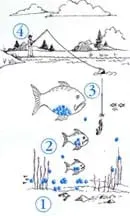 An aquatic environment food chain.Copyright National Institutes of Health, http://orf.od.nih.gov/ Environmental+Protection/ Mercury+Free/Mercury HealthHazards.htm# foodchain
- Divide the class into teams of two students each.
- Ask each pair to think of a terrestrial food chain and an aquatic food chain, and create each of these with words on one side of a piece of paper, using arrows to show the energy flow.
- Discuss the food webs they created as a class in Part 1, and tell them that they are now going to construct a food web in their pairs using pictures.
- Pass out an assortment of nature and wildlife magazines.
- Instruct the groups to make food webs on the other side of their paper by either drawing pictures of the living things in their food chains or finding them in the magazines and gluing them onto the paper. Suggest that they use arrows to show the direction of the flow of energy between the images.
- Conclude with an informal discussion using the questions and answers provided in the post-activity assessment of the Assessment section.
- biodome
- A human-made, closed environment containing plants and animals existing in equilibrium.
- consumer
- An organism requiring complex organic compounds for food, which it obtains by preying on other organisms or by eating organic matter.
- decomposer
- Organisms such as bacteria and fungi that decompose dead plants and animals.
- ecosystem
- A functional unit consisting of all the living organisms (plants, animals and microbes) in a given area, and all the nonliving physical and chemical factors of their environment, linked together through nutrient cycling and energy flow. An ecosystem can be of any size — a log, pond, field, forest or the Earth's biosphere — but it always functions as a whole unit.
- energy
- The capacity for vigorous activity; available power; the capacity to do work. For example, I eat chocolate to get quick energy.
- engineer
- A person who applies scientific and mathematical principles to creative and practical ends such as the design, manufacture and operation of efficient and economical structures, machines, processes and systems.
- environment
- The surroundings in which an organism lives, including air, water, land, natural resources, flora, fauna, humans and their interrelationships. (Examples: Tundra, coniferous forest, deciduous forest, grassland prairie, mountains and rain forest.)
- food chain
- A sequence of organisms, each of which uses the next, lower member of the sequence as a food source. Source: U.S. Environmental Protection Agency: http://www.epa.gov/OCEPAterms/fterms.html.
- food web
- A complex network of many interconnected food chains and feeding interactions.
- photosynthesis
- The process in green plants by which carbohydrates are made from carbon dioxide and water using sunlight as the energy source.
- producer
- Any organism that is capable of producing its own food, usually through photosynthesis.
Pre-Activity Assessment
Idea Web: Ask students to brainstorm a list of environments. What different organisms live in these environments, both plants and animals? From where do these organisms get their energy and nutrients? Are there any energy or nutrient sources that are the same for all the environments?
Activity Embedded Assessment
Hypothesize: Ask each group what would happen if we combined two or more of their food webs. (Answer: If the food webs were combined, they would become more complex. More consumer food options might result. Fewer energy sources [plants or producers] might lead to more competition for food among the consumers.)
Drawing: Have students draw a diagram of their food web in the Part 1: Human Food Web activity.
Post-Activity Assessment
Informal Discussion: What Happens to the Energy? Solicit, integrate and summarize student responses.
- How do we use the energy that is in the food we eat? (Discussion points: We use energy to move, keep warm [we give off heat all the time, and this heat energy comes from the food we eat] grow, think, stay healthy, and stay alive. What is left is stored in our bodies.)
- If only a fraction of the energy that an herbivore (plant eater) gets from plant food becomes part of the herbivore's body (its biomass), what happens to the rest of it? (Discussion points: The rest of the energy from the plant food is lost as waste [in droppings] or is used up for movement, keeping warm or just staying alive.)
- Is the same true for carnivores? (Discussion points: Yes, when a carnivore eats another animal, only a fraction of the energy from its animal food is incorporated into the carnivore's body.)
- Introduce the class to the idea that energy is lost at each link in the food chain or web because the living things pass on much less energy than they receive. This energy loss means that most food chains are only four or five links long. Can they find any long food chains within the food webs they made today?
- Which item on their food web probably had the most energy? Which item had the least? (Discussion points: Many engineers work with energy efficiency and conservation. Engineers pay attention to when energy is gained and energy is lost. Engineers design technologies for alternate sources of energy and ways to keep more energy in a system.)
- How do you think an engineer might use information about a food chain or web when designing a biodome or space station in which humans live? (Discussion points: To figure out how much energy is needed to grow plants in the artificial environment. To find out how much food is needed to provide enough energy to the organisms or people living in the environment. To make sure to include plants, animals and other organisms that are part of the same food web. To make sure the artificial ecosystem conditions provide the right kind and amount of resources [sunshine, air, nutrients, soil, water, climate, etc.] to support all the food web organisms. To conserve and re-use resources because they are important to survive and in limited supply.)
It may help to do an example food chain and/or web on the classroom board to clear up confusion before gluing begins. Or, use the attached Example Food Web Worksheet (PDF)to acquaint students with the concept before beginning the activity.
Add-on to the Part 1: Human Food Web. Have one species in the web suddenly be threatened by extinction by asking that student to sit down. Which student(s) feel a tug on their string as a result of the first student sitting down? Those students should also sit down, and so on. Every student should end up sitting, since they are all connected. Make sure that one of the species in the web is a human; this helps to illustrate the human impact on other living things. (Adapted from: the Cornwall Wildlife Trust's Education Center, http://www.cornwallwildlifetrust.org.uk/education/school_grounds_activities).
Alternate project for Part 2: Drawing Food Chains and Webs. If string and wire or straws are available, have students construct their food webs as mobiles.
Assign students to research food webs in a variety of ecosystems online or in natural history books. Omnivores, such as humans, bears and skunks, often have more complicated food webs.
- For lower grades, make less complicated food chains instead of food webs. For example, have students make paper food chains by drawing or gluing pictures of food chain components onto separate pieces of paper. Then tape them together in the appropriate order.
- For upper grades, have students prepare their food webs and present them to the class discussing the interconnectedness and relationships of the animals and plants. Also, have students consider the effect of other nutrient cycles on their food web, such as carbon, nitrogen and water.
Bush, Mark B. Ecology of a Changing Planet, Second Edition. Saddle River, NJ: Prentice Hall, 2000.
Dictionary.com. Lexico Publishing Group, LLC. Accessed December 5, 2006.
Food Chains and Webs, Making a Food Chain. Cornwall Wildlife Trust, UK. http://www.cornwallwildlifetrust.org.uk/ Accessed December 5, 2006. (Source of part of this activity; also includes additional fun and easy classroom and student activities)
Contributors
Christopher Valenti; Malinda Schaefer Zarske; Denise Carlson
Supporting Program
Integrated Teaching and Learning Program, College of Engineering, University of Colorado Boulder
Acknowledgements
The contents of this digital library curriculum were developed under a grant from the Fund for the Improvement of Postsecondary Education (FIPSE), U.S. Department of Education and National Science Foundation GK-12 grant no. 0338326. However, these contents do not necessarily represent the policies of the Department of Education or National Science Foundation, and you should not assume endorsement by the federal government.
Copyright
2004 by Regents of the University of Colorado.