
Environments and Ecosystems
 The delicate balance of plant, animal and human existence.Copyright Department for Environment and Heritage, Government of South Australia http://www.environment.sa.gov.au/Home
Students explore the biosphere and its associated environments and ecosystems in the context of creating a model ecosystem, learning along the way about the animals and resources. Students investigate different types of ecosystems, learn new vocabulary, and consider why a solid understanding of one's environment and the interdependence of an ecosystem can inform the choices we make and the way we engineer our communities. This lesson is part of a series of six lessons in which students use their growing understanding of various environments and the engineering design process, to design and create their own model biodome ecosystems.
Engineers adapt designs for housing, cities and many types of buildings to specific environments and ecosystems. They use their environment, knowledge of the biosphere and the concept of ecosystems to inform their designs and shape the human-built environment. Engineers and scientists use biodomes to study ecosystems and model how living and nonliving things interact in those natural environments. They also collaborate to use this information to predict the availability of water for communities.
After this lesson, students should be able to:
- Have a working knowledge of the various types of environments and ecosystems.
- Have a working knowledge of vocabulary related to environments and ecosystems.
- Define the biosphere and discuss its components.
- Identify how engineers can use their knowledge of environments, the biosphere and ecosystems.
- Identify the components that make a habitat type unique
Grade 4
Do you agree with this alignment? - Compare and contrast different habitat types
Grade 4
Do you agree with this alignment?
- The use of technology affects the environment in good and bad ways.
Grades 3-5
Do you agree with this alignment? - STEL-5D Determine factors that influence changes in a society's technological systems or infrastructure.
Grades 3-5
Do you agree with this alignment?
- 3-LS3-2 Use evidence to support the explanation that traits can be influenced by the environment.
Grade 3
This resource focuses on the following Three Dimensional Learning aspects of NGSS:
Science & Engineering Practices- Use evidence (e.g., observations, patterns) to support an explanation.Do you agree with this alignment?
Disciplinary Core Ideas- Other characteristics result from individuals' interactions with the environment, which can range from diet to learning. Many characteristics involve both inheritance and environment.Do you agree with this alignment?
- The environment also affects the traits that an organism develops.Do you agree with this alignment?
Crosscutting Concepts- Cause and effect relationships are routinely identified and used to explain change.Do you agree with this alignment?
Do you agree with this alignment? - Use evidence (e.g., observations, patterns) to support an explanation.
- 3-LS4-3 Construct an argument with evidence that in a particular habitat some organisms can survive well, some survive less well, and some cannot survive at all.
Grade 3
This resource focuses on the following Three Dimensional Learning aspects of NGSS:
Science & Engineering Practices- Construct an argument with evidence.Do you agree with this alignment?
Disciplinary Core Ideas- For any particular environment, some kinds of organisms survive well, some survive less well, and some cannot survive at all.Do you agree with this alignment?
Crosscutting Concepts- Cause and effect relationships are routinely identified and used to explain change.Do you agree with this alignment?
- Knowledge of relevant scientific concepts and research findings is important in engineering.Do you agree with this alignment?
Do you agree with this alignment? - Construct an argument with evidence.
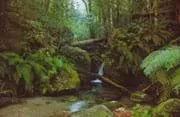 A rain forest environment.Copyright Ministerio Publilco do Estado do Parana, Curitiba, PR http://www.mp.pr.gov.br/
Two very different environments exist on our planet: land and water. The organisms that live in these environments have very similar requirements but may respond to them differently. Organisms that live on land must develop a way to combat gravity. They need legs or wings if they want to move. A tree develops a way to get water to move upwards (against gravity). Organisms in water take advantage of water properties to support their body, so they tend to be more hydro-dynamically designed
Compared to many animals and plants, humans are not very physically adapted to the environments in which they live. We comfortably tolerate only a small temperature range, between 63 and 99° Fahrenheit. As a result, we tend to adapt our environment to our needs rather than doing much adapting ourselves. Certain factors such as population call for further adaptaion, have students explore these factors in the hands-on design activity, Population Density: How Much Space Do You Have?
Engineers use their understanding of environments and ecosystems and their respective climates/weather types to design buildings, to inform the layout of communities, and to, in a large part, make the environments in which we live adapted to our needs. See Table 1 for examples of animals and plants that can be found in various environments. Engineers and scientists also collaborate to use this information to predict availability of water for communities.
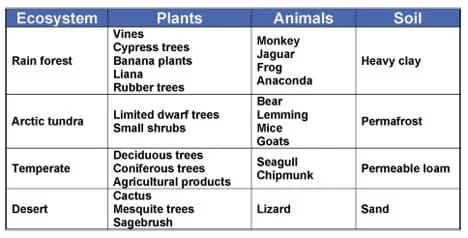 Table 1. Example plants, animals and soil found in different ecosystems.Copyright Christopher Valenti, ITL Program, College of Engineering, University of Colorado Boulder
What are environments and ecosystems and why do we need to understand them? An environment is the surrounding area in which an organism lives, including the air, water, food and energy required for that organism to survive. An ecosystem includes all the living organisms and the nonliving things in an area that are linked together through the flow of nutrients and energy. On our planet, there are many different environments where organisms can live. There are mountains, valleys, trees, snow, and water environments, as well as hot and cold climate environments. (Conduct a class discussion [see the Pre-Lesson Assessment activities described in the Assessment section] to explore with students various types of environments and ecosystems [such as tropical rain forest, tundra, etc.] and their characteristics [climates, plants, animals, soils, weather, etc.]). (Optional: Consider showing students the attached PowerPoint presentation, Environments & Ecosystems Visual Aids (PPT).)
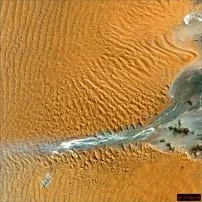 Namib Desert in Southern Africa.Copyright U.S. Library of Congress http://www.loc.gov/index.html
Animals, plants and other organisms have different physical characteristics that make them more adapted to a particular environment. However, different types of organisms can live together in similar environments. Birds have hollow bones (making them lighter) and feathers that help them to fly. Large animals need support and bone structure to walk; as a result, they have backbones and legs. Still, both of these animals might live in a forest.
Some physical characteristics make an organism less adapted for other environments. For example, whales have blubber so they can withstand cold temperatures and other mammals have thick fur, which protects them from the cold. Because of these characteristics, these animals would not survive very well in a hot desert environment. Also, some animals can adapt to changes in their environment by changing their physical characteristics or changing their surroundings. What are some things that protect us from the climate and/or weather that we experience? (Possible answers: Warm clothing homes/buildings with heating or air conditioning; homes/buildings that can withstand wind, snow, rain or other more severe weather conditions such as earthquakes or hurricanes.) Engineers help us design most of the things you just named! All organisms have a place in this world and are adapted to a specific niche or role within their environment.
Let's imagine that we are traveling through different environments on a mission to collect information about the plants, animals, weather and climate. All of these things make up the Earth's biosphere, which contains both living and nonliving components, such as air, soil, water and sunlight. The biosphere is the portion of the Earth where life is found. It is made up of all the different environments and ecosystems. Some examples of environments found in the biosphere include tropical rain forests, deserts, other forest types (such as deciduous or coniferous), grassland prairie and arctic climates.
Do you know what a biodome is? It is something that people make to model a particular environment and the community of organisms that live there. Engineers and scientists use biodomes to study ecosystems and model how living and nonliving things interact in those natural environments. Can you think of other reasons why studying the environment, climates and ecosystems, might be important to an engineer? (Possible answers: To learn how to better design structures to withstand hurricanes, earthquakes or tsunamis, as well as snow loads, flood prevention, etc.)
In this unit, we are going to become engineers who create model ecosystems. We will design and create our own biodomes and watch what happens to the living and nonliving things we place in them. We will have to learn as much as possible about the environment, though, so we can design and build successful biodomes!
Can you define the biosphere and what it contains? (Answer: The biosphere is the part of the Earth's atmosphere that is capable of supporting life and includes both living and nonliving things. It includes plants, animals, weather and climate.) What are some examples of environments found in the biosphere (Possible answers: Tropical rainforests, deserts, other forest types [such as deciduous or coniferous], grassland prairie and arctic climates.) How does an understanding of the different ecosystems help engineers to design our towns and cities, and shape the environment? (Answer: Engineers use information about environments and ecosystems to design homes and buildings that are comfortable for us to live and work.)
- abiotic
- Nonliving, for example, sunlight or rocks.
- biodome
- A human-made, closed environment containing plants and animals existing in equilibrium.
- biome
- An area with a certain set of ecological characteristics, including a specific climate, plants and animals living in it.
- biosphere
- The part of the Earth's atmosphere that is capable of supporting life and includes both living and nonliving things.
- biotic
- Pertaining to life or living organisms.
- characteristic
- A distinguishing feature or quality.
- climate
- The average weather, usually over a 30-year time period, for a particular region and time period. Climate is not the same as weather; it is the average pattern of weather for a particular region. Weather describes the short-term state of the atmosphere. Climatic elements include precipitation, temperature, humidity, sunshine, wind velocity, phenomena such as fog, frost and hailstorms.
- ecosystem
- A functional unit consisting of all the living organisms (plants, animals and microbes) in a given area, and all the nonliving physical and chemical factors of their environment, linked together through nutrient cycling and energy flow. An ecosystem can be of any size — a log, pond, field, forest or the Earth's biosphere — but it always functions as a whole unit.
- engineer
- A person who applies scientific and mathematical principles to creative and practical ends such as the design, manufacture and operation of efficient and economical structures, machines, processes and systems.
- environment
- The surroundings in which an organism lives, including air, water, land, natural resources, flora, fauna, humans, and their interrelationships. (Examples: Tundra, coniferous forest, deciduous forest, grassland prairie, mountains and rain forest.)
- equilibrium
- A stable condition of being in balance.
- habitat
- The natural home of a plant or animal.
- homeostasis
- Equilibrium of an internal environment.
- model
- (verb) To simulate, make or construct something to help visualize or learn about something else (as the living human body, a process or an ecosystem) that cannot be directly observed or experimented upon. (noun) A representation of something, sometimes on a smaller scale.
- niche
- A unique ecological role that an organism plays in an ecosystem.
Pre-Lesson Assessment
Pre-Unit Quiz: To conduct an overall pre/post assessment of the Biodomes curricular unit (six lessons, with associated activities), administer the Pre-Unit Quiz (PDF) to the class before beginning any discussion on Biodomes. Then, after completion of lesson 6, administer the same (post-unit) quiz to the same students and compare pre- to post- scores. In addition, this short quiz is suitable to administer to a control group of students who have not completed the unit, to comparatively test the impact of the curricular unit on learning.
Group Discussion: As a class, have the students engage in open discussion. Solicit, integrate and summarize student responses, writing their ideas on the classroom board. All ideas should be respectfully heard. Take an uncritical position and discourage criticism of ideas. Have students raise their hands to respond. Ask the students:
- What different types of environments can you think of? (See Table 1 examples.)
- (For each environment) What is the climate like? What kind of weather might occur? (Dry or humid? Sunny or foggy? Hot or cold? Snowstorms or tornados?)
- (For each environment) What types of plants and animals live there? (See Table 1 examples.)
Picture Discussion: Using books or the internet, show students photographs of different types of environments. In an informal class discussion, have students identify:
- What types of animals and plants might be present in each environment?
- What resources would be present for people?
- How would those resources need to be conserved in order for people to survive?
Post-Introduction Assessment
Writing and Drawing/Drafting Reflection: Ask students to write a paragraph in their science journal or on a sheet of paper that describes themselves and where they live. They should include a description of their environment, habitat and community, and consider themselves as part of a population. Add a drawing or drafting component by having students place themselves in an environment of their choice and design a living space to protect themselves from the conditions of that environment. Remind students that engineers sometimes create these types of designs.
Group Discussion: Solicit, integrate and summarize student responses.
- Have students discuss and identify biotic and abiotic factors in the biosphere. This includes living and nonliving things, animals and plants, as well as the air, soil, rocks and sunlight.
- Pick an environment that is different from where the students live (for example, a rain forest, desert or arctic tundra.) Ask students to describe how their lives might be different if they lived in this new environment. Then, ask them to explain how they, as an engineer, would design a home for this environment. (For example, would you want thick walls in a tropical environment or in a desert?)
- Have students discuss why engineers and scientists might study different environments and ecosystems, as well as the extreme weather conditions that exist within different climates, such as floods, hurricanes, earthquakes, volcanoes or tsunamis.
Lesson Summary Assessment
Using Evidence: Ask students to write a paragraph using evidence to support the explanation that traits can be influenced by the environment. They can use what was taught in the lesson or do outside research as evidence.
Option 1 - Worksheet to Class Poster: Use the Environments and Ecosystems Worksheet (PDF)as an exploratory activity for students to chart the various plants, animals and soil that are present in different ecosystems. Have students complete the worksheets individually and then share their information with the class to create one large ecosystem chart on a poster-sized sheet to hang in the classroom. See Table 1 for possible worksheet answers.
Option 2 - Worksheet to Class Chart: Have students complete the Environments and Ecosystems Worksheet (PDF) as an individual investigation project, using books or the internet. Then, ask them to share their discoveries by providing them with sticky notes to record what they discovered about the different environments, encouraging them to use the vocabulary learned in their research. Have them post their responses on a poster chart divided into columns for each type of ecosystem. Once all notes are posted, read aloud some of the sticky notes, or have students come up and select notes to share with the class. Refer to the completed environments and ecosystems chart during subsequent lessons in this unit.
Climates Research Project: As an individual exploratory research project, have students research the climates that are present in different environments and ecosystems. After selecting an environment type, research to find out its climate, rainfall, temperature and extreme conditions. Ask them to consider how they, as engineers, might take the climate into consideration for the design of homes or structures in the environment they are researching.
Use the internet to find additional resources that describe the characteristics of our planet's many ecosystems. Start with the following websites:
Discovery Channel Online
Ecosystems: http://library.thinkquest.org/11353/ecosystems.htm
Hawaiian Ecosystems at Risk Project (HEAR)
National Geographic
Sustainable Ecosystems Institute
U.S. Environmental Protection Agency (EPA) Student Center: http://www.epa.gov/students
U.S. Fish and Wildlife Service
Bush, Mark B. Ecology of a Changing Planet. Second Edition. Saddle River, NJ: Prentice Hall, 2000.
Dictionary.com. Lexico Publishing Group, LLC. Accessed October 9, 2006.
Environmental Health Center Glossary. Updated September 27, 2005. National Safety Council. http://www.nsc.org/Pages/Home.aspx Accessed October 9, 2006.
Glossary of Terms. Public Entity Environment Management System Resource Center, Peer Center. http://www.peercenter.net/about/glossary.cfm Accessed October 9, 2006.
Weather and Climate Terminology, Glossary Data Lookup and Reference Service. Weather Guide, NetCent Communication. http://weather.ncbuy.com/glossary.html?action=LETTER&term=C Accessed October 9, 2006.
Contributors
Christopher Valenti; Malinda Schaefer Zarske; Denise W. Carlson
Supporting Program
Integrated Teaching and Learning Program, College of Engineering, University of Colorado Boulder
Acknowledgements
The contents of this digital library curriculum were developed under a grant from the Fund for the Improvement of Postsecondary Education (FIPSE), U.S. Department of Education and National Science Foundation GK-12 grant no. 0338326. However, these contents do not necessarily represent the policies of the Department of Education or National Science Foundation, and you should not assume endorsement by the federal government.
Copyright
2006 by Regents of the University of Colorado