
Mini-Landslide
Students explore how different materials (sand, gravel, lava rock) with different water contents on different slopes result in landslides of different severity. They measure the severity by how far the landslide debris extends into model houses placed in the flood plain. This activity is a small-scale model of a debris chute currently being used by engineers and scientists to study landslide characteristics. Much of this activity setup is the same as for the Survive That Tsunami activity in Lesson 5 of the Natural Disasters unit.
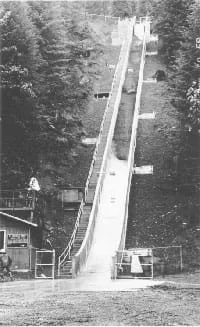 A 100-meter long debris chute used to simulate landslides.Copyright U.S. Geological Survey http://vulcan.wr.usgs.gov/ Projects/MassMovement/Publications/OFR92-483/OFR92-483_inlined.html.
To keep us safe from landslides, engineers first study these natural disasters in great detail. They experiment with a model debris chute in Oregon to simulate landslides, and design computer models to predict landslide behavior under various conditions. These engineers also develop measurement tools to gather data from real landslides and apply what they learn to real-world applications to mitigate landslide danger. This includes designing human-made structures (tunnels, roads, homes) that reduce the danger and destruction due to landslides and/or do not cause future landslides, and designing buildings and structures that keep us safe.
After this activity, students should be able to:
- Define landslides as the result of gravity and friction acting on different types of earth (rock, soil, sand, gravel, etc.).
- Relate that different types of materials create different landslide dynamics.
- Explain that water adds weight to landslide materials and reduces friction, increasing landslide dangers.
- Describe that studying landslides allows engineers to determine where and how to construct buildings to protect people from landslides, and to develop structures for protecting buildings from landslides.
- Earth's surface changes constantly through a variety of processes and forces
Grade 5
Do you agree with this alignment?
- Students will develop an understanding of the attributes of design.
Grades K-12
Do you agree with this alignment? - Students will develop an understanding of engineering design.
Grades K-12
Do you agree with this alignment? - Models are used to communicate and test design ideas and processes.
Grades 3-5
Do you agree with this alignment? - Modern communities are usually planned according to guidelines.
Grades 3-5
Do you agree with this alignment?
- 3-5-ETS1-3 Plan and carry out fair tests in which variables are controlled and failure points are considered to identify aspects of a model or prototype that can be improved.
Grades 3-5
This resource focuses on the following Three Dimensional Learning aspects of NGSS:
Science & Engineering Practices- Plan and conduct an investigation collaboratively to produce data to serve as the basis for evidence, using fair tests in which variables are controlled and the number of trials considered.Do you agree with this alignment?
Disciplinary Core Ideas- Tests are often designed to identify failure points or difficulties, which suggest the elements of the design that need to be improved.Do you agree with this alignment?
- Different solutions need to be tested in order to determine which of them best solves the problem, given the criteria and the constraints.Do you agree with this alignment?
Do you agree with this alignment? - Plan and conduct an investigation collaboratively to produce data to serve as the basis for evidence, using fair tests in which variables are controlled and the number of trials considered.
- 4-ESS3-2 Generate and compare multiple solutions to reduce the impacts of natural Earth processes on humans.
Grade 4
This resource focuses on the following Three Dimensional Learning aspects of NGSS:
Science & Engineering Practices- Generate and compare multiple solutions to a problem based on how well they meet the criteria and constraints of the design solution.Do you agree with this alignment?
Disciplinary Core Ideas- A variety of hazards result from natural processes (e.g., earthquakes, tsunamis, volcanic eruptions). Humans cannot eliminate the hazards but can take steps to reduce their impacts.Do you agree with this alignment?
- Testing a solution involves investigating how well it performs under a range of likely conditions.Do you agree with this alignment?
Crosscutting Concepts- Cause and effect relationships are routinely identified, tested, and used to explain change.Do you agree with this alignment?
- Engineers improve existing technologies or develop new ones to increase their benefits, to decrease known risks, and to meet societal demands.Do you agree with this alignment?
Do you agree with this alignment? - Generate and compare multiple solutions to a problem based on how well they meet the criteria and constraints of the design solution.
Each group needs:
- Model House Template (PDF)
- cardstock, 1 sheet, for construction of model houses
- transparent tape
- scissors
- markers, colored pencils, or crayons to decorate houses
- 2 small paper cups; one for water, one for test material
- Mini-Landslide Worksheet (PDF), one per student
To share with the entire class:
Note: Most of the following materials can be reused, some for the Survive That Tsunami activity in Lesson 6 of the Natural Disasters unit.
- 2 ft (.6 m) section of plastic downspout (available at hardware stores; ~$5)
- 1 small bag of sand
- 1 small bag of gravel
- 1 small bag of volcanic (lava) potting rock (available at garden and landscaping stores)
- plastic bins to hold, wet and store the sand, gravel and volcanic potting rock (optional, but helpful)
- 1 large, shallow, plastic waterproof tub (8-in x 14-in x 30-in or 20-cm x 36-cm x 76-cm, clear plastic is better but not necessary)
- plastic scoop (optional, or use small paper cup)
- duct tape
- scissors (to cut downspout plastic)
- ruler (or tape measure)
- stack of books, stool or chair, to support downspout
A basic understanding of gravity and friction is critical to understanding landslides. A familiarity with geological events (volcanic eruptions, earthquakes and tsunamis) is helpful to understanding landslide causes and effects.
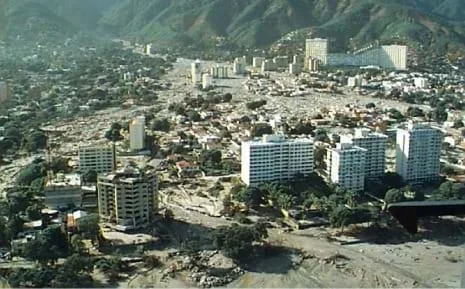 Figure 1. In December 1999, massive amounts of sediment were deposited throughout the urban community of Caraballeda, Venezuela, by floods and debris flows.Copyright U.S. Geological Survey, http://pr.water.usgs.gov/public/venezuela.
Not all hills and mountains are made of the same materials. There are different types of rock, sand and soil found everywhere. Have you played with sand before? How about modeling clay? If you made a castle out of each of these materials, which one would be more likely to fall down? (Answer: The one made from sand.) One hillside made of a certain material (or materials) may be more stable than another of the same size and shape. Also, when you add water to different materials, it is hard to predict what might happen. The material something is made of is important to how well it holds up or how strong it is. Landslides are the result of gravity and friction acting on these different types of earth materials (rock, soil, sand, gravel, etc.). The best thing that an engineer can do is to develop a model of the different materials and see what happens in a landslide.
To give you an idea of how important building a model can be to predicting a landslide, let's use the example of a city in South America near the Andes Mountains that was in the path of a landslide in 1999 (see Figure 1). This city was buried in almost 1.8 million tons (1.6 million metric tons) of mud, rock, sand and other debris from the landslide. Full-size, 18-wheeled dump trucks carry about 80,000 pounds (40 tons or 36 metric tons). It would take 45,000 of these trucks to carry this much stuff away. That's a lot! Building a model of possible landslide areas helps engineers and scientists predict just how much earth material might cover a city.
Today, we are going to have some fun and learn more about landslides by creating our own mini-landslides. We are going to build mini-houses, too, and see if they get wiped out by the landslides. Since not all hills and mountains are made of the same materials, we are going to test a couple of different situations. Scientists and engineers perform these same types of experiments to understand how real-life landslides work—let's give it a try!
Before the Activity
- Gather materials and make copies of the Mini-Landslide Worksheet (PDF) and Model House Template (PDF).
- Set up the mini-landslide model activity in advance by first cutting the downspout in half so that you have two equal sections. Tip: Cut through the narrow sides of the downspout to create the widest chutes possible.
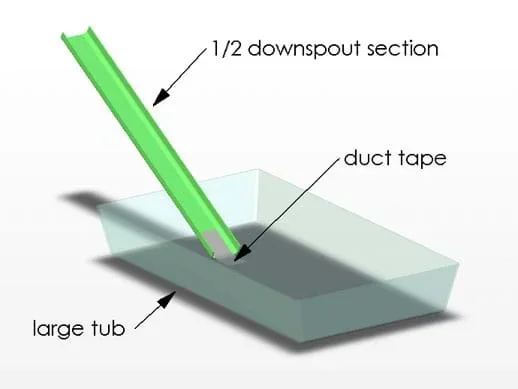 Figure 2. Pre-activity setup.Copyright Tim Nicklas, ITL Program, College of Engineering, University of Colorado at Boulder, 2005.
- Duct tape one downspout chute section to the bottom of the plastic tub, approximately in the middle of the tub, to create a shallow angle without the downspout interfering with the tub wall (see Figure 2).
- Support the top end of the downspout by taping it to a stack of books, stool or chair.
With the Students
- Divide the class into three teams (approximately 8-10 students per team).
- Have each team use the Model House Template (PDF) to construct three houses with the cardboard stock (for a total of nine houses) (see Figure 3). (This is a great time to point out to the students that they are working with geometric shapes.)
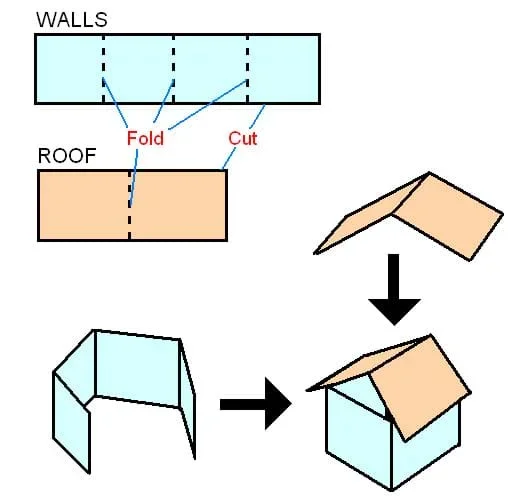 Figure 3. How to construct the model houses.Copyright Geoffrey Hill, ITL Program, College of Engineering, University of Colorado at Boulder, 2005.
- Next, assign each team to test the properties of one of the following materials: sand, gravel or lava rock. Each group performs three trials, assisted by the instructor, while the rest of the teams watch and record measurements on their worksheets.
- Begin the experiment by cleaning off the flood plain and having students place their houses in three locations relative to the debris chute. During the experiment trials, students will predict whether or not certain locations are safe from the landslide. The suggested locations are 1) Two inches (5 cm) in front of and two inches (5 cm) to side of the chute path, 2) four inches (10 cm) in front of and two inches (5 cm) to the other side of the chute path, 3) six inches (15 cm) directly in front of chute path (see Figure 4). Label the houses (1, 2, 3) with numbers on the rooftops.
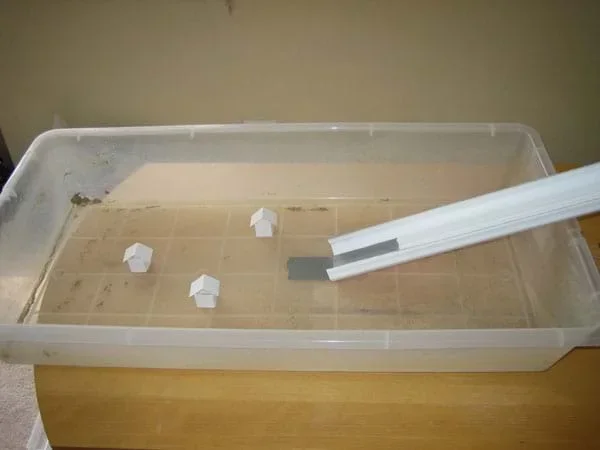 Figure 4. Placement of model houses in flood plain at the base of the landslide chute.Copyright Tim Nicklas, ITL Program, College of Engineering, University of Colorado at Boulder, 2005.
- Ask the students to make predictions. Which of the model buildings will be "damaged" (moved from their original location, or worse) during each landslide trial? Have students record their prediction on their worksheets.
- Note: For consistency throughout the experiment, make sure the sand and the chute are already damp before the first trial begins.
- Trial 1: Make sure the chute is at the shallowest angle allowed by the bin (see Figure 5). Using a small paper cup, place a one cup of sand at the top of the chute (see Figure 5). The material should not slide down the chute at this shallow angle.
- Next, increase the angle of the slope until the material is on the verge of sliding. Then, simulate an earthquake, a common trigger for landslides, by shaking the chute. The material is not expected to go very far on this trial. It may not even make it out of the chute.
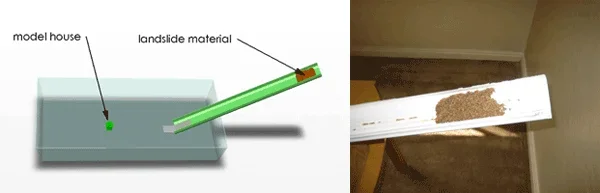 Figure 5. Placing material in the landslide chute.Copyright Tim Nicklas, ITL Program, College of Engineering, University of Colorado at Boulder, 2005.
- Secure the chute at this angle by placing books (or a stool or chair, as necessary) under it and taping it in place. Prepare for the next trial.
- Trial 2: This time, place the material in the chute and have a student bring you a paper cup one-quarter full of water. Pour the water into the chute above the material and observe what happens (see Figure 6). Have students record their observations on their worksheets.
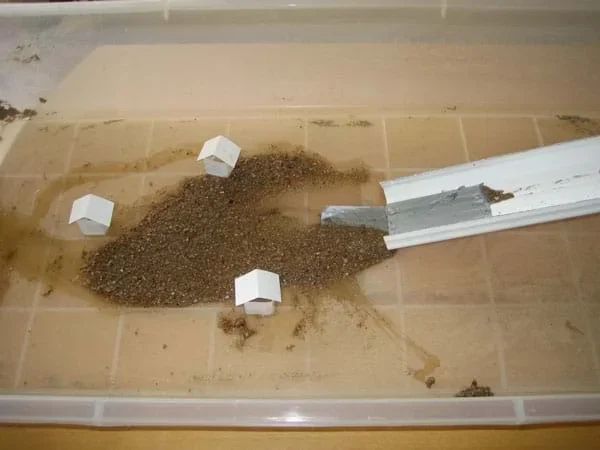 Figure 6. Houses after trial using ¼ paper cup of water.Copyright Tim Nicklas, ITL Program, College of Engineering, University of Colorado at Boulder, 2005.
- Trial 3: The third trial is similar to the second, except with more water. Use a paper cup half full of water. Pour the water into the chute above the material and observe what happens. Have students record their observations on their worksheets.
- Repeat this procedure with the other two teams for the other two materials.
- Conclude with a class discussion comparing results. How good were student predictions? What did you observe? How did the steepness of the chute make a difference in the damage caused by the landslides? How did the addition of water make a difference in the severity of the landslide damage? Which material caused the worst landslides? Which landslide scenario caused the most damage? What if we combined the materials? What were the best locations in the trials? Where would the safest location be on the flood plain? How would you change the design or construction of your model house to make it survive the landslide better? How can a mini-landslide model like this help us understand the many different conditions and results from real landslides? How would students apply what they've learned to real-world landslide situations? Conduct the activities described in the Assessment section.
- debris
- The scattered remains of something broken or destroyed; rubble or wreckage.
- debris flow
- A churning, water-saturated mass of rock, soil and organic matter that rushes down mountain slopes, typically originating as a landslide. (Source: USGS)
- friction
- Force that resists the relative motion or tendency to such motion of two bodies in contact.
- gravity
- The natural force of attraction exerted by a celestial body, such as Earth, upon objects at or near its surface, tending to draw them toward the center of the body.
- landslide
- The downward sliding movement of a mass of earth, rock and/or other fill, under the influence of gravity.
- model
- (noun) A small object, usually built to scale, that represents in detail another, often larger object. (verb, as in computer modeling) To make a mathematical description of observed behavior (data, conditions, assumptions), for the purpose of predicting behavior.
- trigger
- An event that initiates a landslide.
- unstable vs. stable
- Whether or not a slope is prone to landslides.
Pre-Activity Assessment
Discussion Questions: Solicit, integrate and summarize student responses.
- Discuss causes and effects of landslides.
- What would make a more dangerous landslide... one that is made of boulders or one made of sand, gravel and soil? (Answer: It depends on how far the landslide reaches. A single, heavy boulder sounds more destructive than sand and gravel, but sometimes landslides made of smaller materials can travel much further and affect more buildings and people.)
Activity Embedded Assessment
Predictions: Ask students to predict whether each model house will be damaged or moved during each type of trial in the activity, and record their predictions on their worksheets.
Post-Activity Assessment
Worksheet: Have students record on their worksheets their observations about which landslide scenario caused the most damage and compare these to their peers. How did the steepness of the chute make a difference in the damage of the landslides? How did the addition of water make a difference in the severity of the landslide damage? Which material caused the worst landslides? Which landslide scenario caused the most damage? How can model help us understand real landslides? How would students apply what they've learned to real-world landslide situations? Have student share their observations with the class. Review students' worksheets to gauge their mastery of the subject.
Re-Design Practice: Engineers use small-scale models like our mini-landslide model to experiment with different situations and designs without having to create full-size landslides. With this in mind, on their worksheets, have students list any design or fabrication changes they would make to their model houses. Also have them consider what would be safer locations for house placement. Discuss as a class.
- By mixing water with the sand, gravel and lava rocks, it can get messy and slippery. Conduct outside if possible.
The first run on the chute when it is dry will have different results than all subsequent runs when the chute is wet. So, for uniformity, perform one run with wet material before the trials.
It is also best if the three materials are damp when performing the trials. Like the chute, the materials react differently when wet. Damp materials produce greater uniformity in spreading.
Have students re-design and place their own new buildings to survive a landslide. Give them some limited supplies and a building size constraint, perhaps about one cubic inch (2.5 cm2).
Each landslide material made a different pattern after it came down the chute. Have the students investigate more about the patterns made by the different materials. Then, have them create an informational flyer for an imaginary town that could be affected by a landslide from one of those materials.
Engineers often use modeling to simulate natural disasters. They create different types of models for different purposes, such as mathematical models, computer models and prototype models. Have students investigate when and why different types of models are used.
Have students work in groups of three or four to design, build and test strong mountains that can support houses through a rainstorm. Details are as follows:
- Gather the following materials: topsoil, random objects (weed blocker, tulle, cotton balls, toothpicks, Popsicle® sticks), LEGO® pieces (3-4 pieces per group), plastic bins (1 per group), and a "rain-maker" (a plastic cup with holes punched in the bottom).
- Have students brainstorm the things that make landslides happen.
- Natural causes: poor soil structure, vibrational force (earthquakes or volcanoes), groundwater pumping, heavy erosion from wind or water
- Human causes: deforestation (emphasize the impact of taking roots out of soil), construction
- Have students design their mountains. Each should include their material in their designs, which include a plastic bin with a soil/sand/gravel mixture, some LEGO pieces to build a house, and a cup of random materials (the fewer, the better – recommend 2 cotton balls, 1 Popsicle stick, 2 toothpicks, 1 piece of mesh or tulle – scale the amount of materials they get based on their ages).
- Tell students that they have two chances to build a mountain out of these materials. Explain the challenge and requirements:
- Make your mountain as tall as possible. (This keeps groups from settling for small mounds that will never erode.)
- The mountain may not be anchored by the sides of the plastic bin; it must be free-standing.
- No unrealistic designs. For example, do not permit students to drape a cloth over an entire mountain. To facilitate this, make the rule that in the second iteration, the additional materials should not be visible; in other words, all materials must be used to internally strengthen the mountain.
- Before building, give students the materials they have to work with (those materials in addition to the bins with soil mixture) and have them draw the mountain design with labels and details. Tell them they must get their design approved before building.
- Once approved, they can build, test, re-build, re-test. At the end, leave time for clean-up (there is lots!) and some time for them to each reflect (in writing) what worked and what they would do differently next time.
Dictionary.com. Lexico Publishing Group, LLC. Accessed February 15, 2006. (Source of some vocabulary definitions, with some adaptation)
Lesson 5 – Landslides. Environmental Geology, Geology Education, Mansfield University, Mansfield, PA. Accessed February 15, 2006. http://www.geologyeducation.com/blackboard/lan/lanlessonsummer.html
Landslide Simulation. Environmental Geology, Geology Education, Mansfield University, Mansfield, PA. Accessed February 15, 2006. (Excellent video animation provides a realistic view of how landslide processes work and the damage that can be done by them; large, 2 MB file) http://www.geologyeducation.com/blackboard/lan/landsld.gif
- Natural Disasters: Earthquakes, Volcanoes, Tornadoes & More
Contributors
Timothy S. Nicklas; Geoffrey Hill; Emily Gill; Malinda Schaefer Zarske; Denise W. Carlson
Supporting Program
Integrated Teaching and Learning Program, College of Engineering, University of Colorado Boulder
Acknowledgements
The contents of this digital library curriculum were developed under grants from the Fund for the Improvement of Postsecondary Education (FIPSE), U.S. Department of Education and National Science Foundation (GK-12 grant no. 0338326). However, these contents do not necessarily represent the policies of the Department of Education or National Science Foundation, and you should not assume endorsement by the federal government.
Copyright
2006 by Regents of the University of Colorado.