
Volcanic Panic!
Students learn about the causes, composition and types of volcanoes. They begin with an overview of the Earth's interior and how volcanoes form. Once students know how volcanoes function, they learn how engineers predict eruptions. In a class demonstration, students watch and measure a mock volcanic eruption and observe the eruption phases, seeing how a volcano gets its shape and provides us with clues to predict a blast.
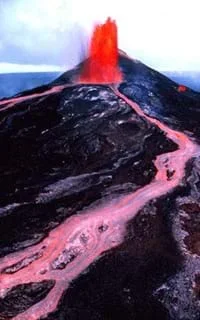 Kilauea in Hawaii.Copyright Federal Emergency Management Agency http://www.fema.gov/kids
While volcanoes cannot be prevented, we can do our best to predict them so that human populations near volcanoes can be safely evacuated before an eruption. To predict eruptions, engineers design and build many different devices to detect subtle changes in a volcano that occur before it erupts. Engineers use their science and math skills to build specialized instruments that can detect gases, changes in the shape of the volcano, as well as monitor earthquakes that may signal a possible eruption.
After this lesson, students should be able to:
- Describe several parts of a volcano.
- List the three main types of volcanoes.
- Name at least one famous volcano.
- Explain that engineers build devices used to predict volcanic eruptions.
- Develop and communicate an evidence based scientific explanation around one or more factors that change Earth's surface
Grade 5
Do you agree with this alignment?
- STEL-3D Explain how various relationships can exist between technology and engineering and other content areas.
Grades 3-5
Do you agree with this alignment?
- CCC.8.3-5.8 Engineers improve existing technologies or develop new ones to increase their benefits, to decrease known risks, and to meet societal demands.
Grades 3-5
Do you agree with this alignment? - DCI.ESS3.B.3-5.3 A variety of hazards result from natural processes (e.g., earthquakes, tsunamis, volcanic eruptions). Humans cannot eliminate the hazards but can take steps to reduce their impacts.
Grade 4
Do you agree with this alignment?
A volcano is a place on the Earth's surface at which material from the center of the Earth escapes to the surface. Volcanoes usually occur along the fault lines that separate the tectonic plates that make up the Earth's crust. The typical image of a volcano is a large cone with glowing red lava flowing out of the top. Different types of volcanoes — cinder cones, shield volcanoes and stratovolcanoes — have different types of eruptions and other unique characteristics.
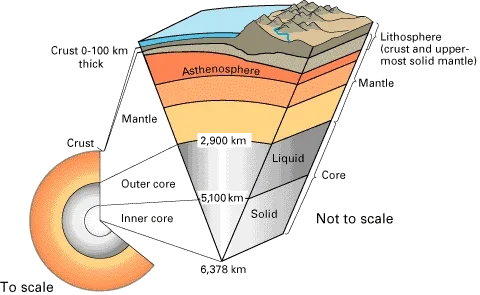 Figure 1. The layers of the interior of the Earth.Copyright U.S. Geological Survey http://pubs.usgs.gov/publications/text/inside.html
The Layers of the Earth
To understand volcanoes we must first understand what is inside the Earth. The Earth is made of three distinct layers (see Figure 1). The innermost layer of the Earth, the core, is made mostly of iron. The inner core is solid, while the outer core is liquid. The middle layer of the Earth is the mantle. The mantle is a semi-molten layer between the core and the outermost layer, which is known as the crust. The crust is the solid layer on which we live. The crust is much thinner than the other two layers. If you think of the Earth as an egg, the crust would be the shell, the mantle would be the egg white, and the core would be the yolk.
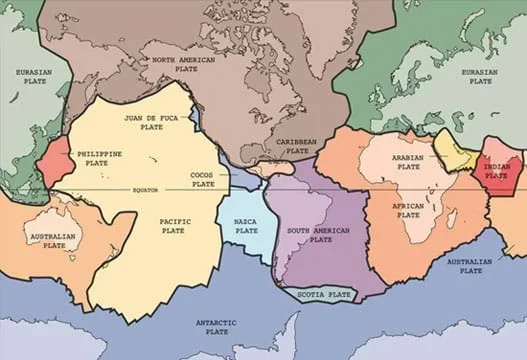 Figure 2. The tectonic plates of the Earth.Copyright U.S. Geological Survey http://geology.er.usgs.gov/eastern/plates.html
As we know from studying earthquakes, the crust of the Earth is not one solid piece. It is broken into about 15 pieces called tectonic plates (see Figure 2).
Where Volcanoes Form
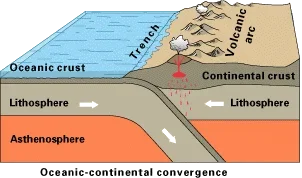 Figure 3. The formation of convergent boundary volcanoes.Copyright U.S. Geological Survey http://www.usgs.gov
Boundaries between plates are called fault lines. Typically (though not always), volcanoes occur at one of two types of fault lines. One is a convergent boundary, where one plate slides under another plate. As one plate slides under, it is forced down into the mantle where the pressure and heat are extreme. Under these conditions, the crust melts, forming magma, which is forced up through the crust above it, finally reaching the surface and forming a volcano (see Figure 3). Upon reaching the surface, the magma is called lava.
Volcanoes can also form at a divergent boundary, where the plates are moving apart. The plates leave a gap where magma from the mantle can escape to the surface. These faults are usually under oceans and form mid-ocean ridges. Figure 4 shows volcanoes being formed along fault lines, including divergent boundaries.
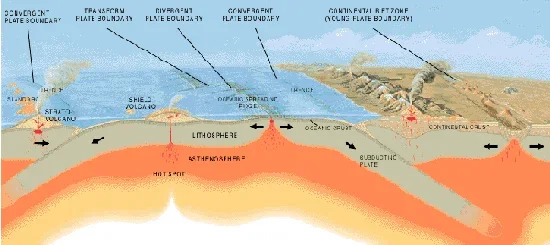 Figure 4. The numerous ways in which volcanoes form.Copyright U.S. Geological Survey http://www.usgs.gov
Another place volcanoes form is over hot spots. A hot spot is a location in the mantle at which the temperature is abnormally high. In these places, magma forces its way up to the surface, forming a volcano. A famous hot spot is the one that is forming the Hawaiian Islands chain (see Figure 5). The magma from the hot spot forms a sea mount (undersea mountain) that becomes an island once it is taller than the sea level. As the tectonic plate moves over the fixed hot spot, a series of islands form.
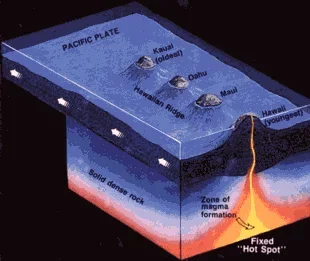 Figure 5. The formation of the Hawaiian Islands due to a hot spot under the moving Pacific Plate.Copyright U.S. Geological Survey http://pubs.usgs.gov/publications/text/hotspots.html#anchor19316266
Parts of a Volcano
A volcano has many parts (see Figure 6). Under a volcano, from a pocket of molten rock known as the magma chamber, hot magma travels up through a fissure, called a vent. While a volcano can have more than one vent to the surface, it usually has one central vent. Magma exits the volcano at the crater, becoming lava. The crater is typically a bowl-shaped opening located at the top of the cone. If the eruption is violent, ash and rock are launched into the air. This material is collectively known as tephra. Much of the material ejected from the volcano collects on its sides. After many eruptions, enough layers, known as strata, build up to form a volcano's recognizable cone shape.
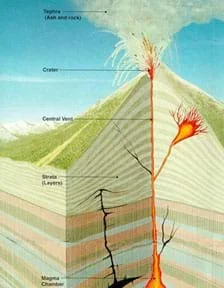 Figure 6. The parts of a volcano.Copyright U.S. Geological Survey, http://interactive2.usgs.gov/learningweb/teachers/volcanoes.htm.
Volcanoes Types
The three main types of volcanoes are cinder cone, shield volcano and stratovolcano. A cinder cone is the most common. Also known as scoria cones, they are usually small and made of volcanic fragments from previous eruptions, called cinders or scoria. They have steep sides and typically a bowl-shaped crater (see Figure 7).
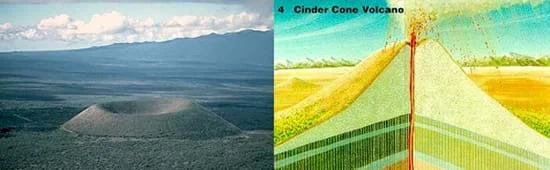 Figure 7. (left) Cinder cone Pu`u ka Pele near Mauna Kea on the island of Hawaii. (right) Cut-away diagram showing the shape and interior of a cinder cone.Copyright U.S. Geological Survey http://volcanoes.usgs.gov/Products/Pglossary/CinderCone.html http://interactive2.usgs.gov/learningweb/teachers/volcanoes.htm
Another type of volcano is a shield volcano, which is formed almost entirely of liquid lava. The lava flows out of a vent and slowly slides down the side of the volcano. As the lava cools, it forms a broad cone of basalt. The slopes of a shield volcano are usually very gentle (see Figure 8).
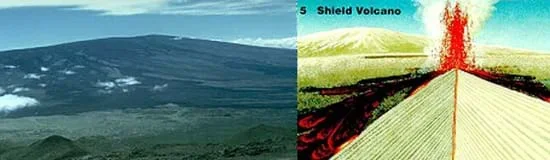 Figure 8. (left) Shield volcano Mauna Loa on the island of Hawaii. (right) Cut-away diagram shows the shape and interior of a shield volcano.Copyright U.S. Geological Survey http://volcanoes.usgs.gov/Products/Pglossary/ShieldVolcano.html http://interactive2.usgs.gov/learningweb/teachers/volcanoes.htm
And last, stratovolcanoes have the tall conical shape most often associated with volcanoes (see Figure 9). They have very steep sides and often form during violent eruptions. They are made of tephra and solidified lava.
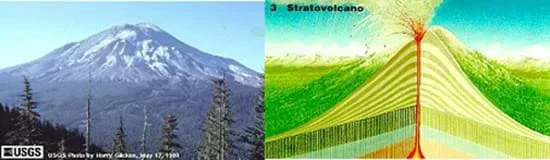 Figure 9. (left) Stratovolcano Mt. St. Helens, WA, before its 1980 eruption. (right) Cut-away diagram shows the shape and interior of a stratovolcano.Copyright Harry Glicken (left), U.S. Geological Survey http://vulcan.wr.usgs.gov/Volcanoes/MSH/Images/before_after.html http://interactive2.usgs.gov/learningweb/teachers/volcanoeshtm
Prediction of Volcanic Eruptions
To give people advance warning that a volcano is going to erupt, engineers and scientists are creative in designing and building devices to detect natural indicators of volcanic eruptions. Warning signs include earthquakes, gas emissions, change in magnetic field, and the swelling of the volcano itself. To monitor active volcanoes, seismometers detect the vibration of earthquakes, tilt meters detect even slight changes in the shape of the mountain (see Figure 10), and other devices monitor and measure escaping gases. Students can use the associated activity Ready to Erupt! to learn the important phases of an erruption to help predict disasters!
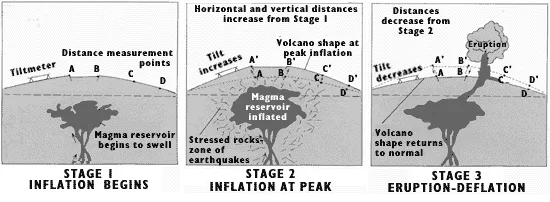 Figure 10. Tilt meters are used to predict volcanic eruptions.Copyright U.S. Geological Survey http://pubs.usgs.gov/gip/monitor/contents.html
Explosive ash eruptions from volcanoes can shut down airports, disrupt air routes and temporarily stop air supply service to remote areas. Some of the equipment that engineers design to monitor volcanoes help people in the Federal Aviation Administration and airlines make better decisions on flying during volcanic eruptions.
What is a volcano? Who can describe one for me? (Lead students to the idea that a volcano is a place where material from the inside of the Earth is escaping to the surface.) The prime material involved is molten (or melted) rock that comes from the layer of the Earth known as the mantle. Do you know what magma is called once it reaches the surface? The answer is lava. Do you think all volcanoes are the same? Well, they are not. There are different causes, types of eruptions, as well as different shapes. Today we are going to learn more about the parts of a volcano as well as what makes them unique. And, we will learn about what engineers are doing to help predict when volcanoes erupt.
A volcano has several basic parts. Under the volcano is a pocket of molten rock known as the magma chamber. This molten rock, or magma, travels through a crack known as a vent from the magma chamber to the surface of the Earth. Magma exits the volcano at the crater, becoming lava. If the eruption is violent, then ash and rock are launched into the air. Much of the material ejected from the volcano collects on the sides of the volcano, building it up; these layers are known as strata. After many eruptions, enough layers build up to form the recognizable cone shape of a volcano.
The three main types of volcanoes are: cinder cone, shield volcano and stratovolcano:
- Cinder cones, the most common volcano type, are usually fairly small with steep sides and a bowl-shaped crater. They throw out mostly small pieces of rock from near the vent, and form a small cone from the build-up of cindery (burned rock fragments) lava.
- A shield volcano is formed almost entirely from great amounts of liquid lava. The lava flows out of a vent and slides down the side of the volcano, making a wide, gentle-sloping cone. Mauna Loa, in Hawaii, is a shield volcano, and the largest volcano in the world!
- Stratovolcanoes have a tall conical shape with very steep sides, and look the way most people imagine volcanoes. They form during very violent eruptions of rock and lava. Their shape is made of tephra (ash and rock that was launched into the air) and solidified lava. Mt. St. Helens in Washington is one example.
Volcanoes are natural events in the life of our planet. Historically, volcanoes have formed all over the Earth and have impacted nearby populations (see Table 1). Do you know of any famous volcanoes?
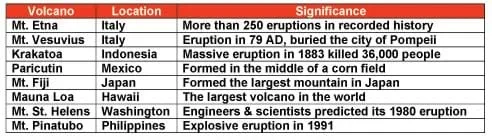 Table 1. Famous volcanoes.
When a volcano erupts, there is very little we can do to stop its destructive power. Our best hope is to predict an eruption before it occurs so that people near the volcano can leave. Engineers and scientists build devices that tell us when an eruption is going to take place.
Some signs that a volcano is going to erupt soon include earthquakes, gas emissions, change in magnetic field, and the swelling of the volcano itself. Earthquakes begin occurring as magma pushes its way up through the volcano. Engineers use devices called seismometers (detects vibrations) to detect these earthquakes. As the magma chamber becomes enlarged, signifying a potential eruption, the rock above the chamber gets pushed up, changing the shape of the volcano. To detect a change in the shape of a volcano, we survey the mountain or use devices called tilt meters (detects change in the tilt of a structure). Other devices measure gases escaping from the volcano as another clue to predicting eruptions. Engineers design and build the instruments to detect these very small changes in the volcano so that people living near the volcano can be warned and evacuated, so lives can be saved.
Today, we learned a lot about volcanoes! Can you give a general definition for a volcano? (Answer: A location on the Earth's surface where material from inside the Earth escapes to the surface.) What are some of the main parts of a volcano? (Answers: Vent, magma chamber, tephra, cone and crater.) What are the three types of volcanoes? (Answer: Cinder cones, shield volcano and stratovolcanoes.) What do engineers have to do with volcanoes? (Answer: Engineers design and build special instruments to detect natural indicators of volcanic eruptions, so that people can be safely evacuated before the blast.)
- cinder cone
- A steep and small volcano made from the chunks of volcanic material (cinders) from previous eruptions.
- cone
- The body of a volcano, in the shape of a cone. The crater is typically located at the top of the cone.
- crater
- A bowl-shaped opening at the top of a volcano. This is typically where tephra and lava escape from the volcano.
- detect
- To discover or find the existence of something.
- eruption
- The act of forcing out or releasing something, such as steam or magma, with violence or suddenness.
- evacuate
- To withdraw from or leave a place or area, especially as a protective measure.
- fault
- The cracks in the crust of the Earth that mark the boundary between tectonic plates.
- lava
- Magma that has reached the surface of the Earth.
- magma
- Molten rock.
- magma chamber
- A chamber below the Earth's surface that contains a large quantity of magma.
- mantle
- The layer of the Earth between the crust and the core.
- molten
- Made liquid by heat; melted.
- shield volcano
- A volcano with gentle slopes formed by successive liquid lava eruptions.
- stratovolcano
- A steep-sided volcano comprised of many layers of tephra, lava and other volcanic material.
- tectonic plate
- A piece of the Earth's crust that moves slowly over the mantle.
- tephra
- Any solid material ejected into the atmosphere from a volcanic eruption.
- volcano
- An opening in the Earth's crust through which molten lava, ash and gases are ejected.
Pre-Lesson Assessment
Class Poll: Before the lesson, ask the entire class the questions below. Have students raise their hands to answer. Write their answers (or key facts) on the board, and summarize (in percentages or number of students) how many answered the same or similarly. Ask the students:
- What is a volcano?
- Can you name any famous volcanoes?
- Do you know where volcanoes usually occur?
Post-Introduction Assessment
Voting: Ask a true/false question and have students vote by holding thumbs up for true and thumbs down for false. Tally the votes and write the totals on the board. Give the right answer.
- True or False: Lava is magma that has reached the surface. (Answer: True)
- True or False: All volcanoes are the same. (Answer: False. There are three different types of volcanoes.)
- True or False: We cannot detect when a volcano is going to erupt. (Answer: False. While no one can detect exactly when a volcano will erupt, we can usually determine that one is due to occur.)
Lesson Summary Assessment
Engineering Design: Engineers often work with scientists to design instruments to detect if a volcano is going to erupt so that people near the volcano can be warned and evacuated. Working in teams, have students brainstorm ways that engineers might be able to tell if a volcano is swelling (getting bigger) and that an eruption might be about to happen. Have them sketch or design an instrument that could help detect an eruption, and present their designs to the class.
Historically, volcanoes have had a big impact on nearby populations. Have students each research a specific volcano, finding out its location, the last time it erupted, what type it is, and whether or not it currently threatens any population centers. Have students make posters describing their volcanoes, including drawings, pictures and facts. Possible volcanoes might include: Kilauea, Cotopaxi, Stromboli, Popocatepetl, Montserrat or any listed in Table 1 in the Introduction / Motivation section.
What is the ring of fire? (Answer: A geological arc that encircles the Pacific Ocean and includes three-quarters of the world's volcanoes.) Ask students to research the locations of active volcanoes on Earth.
Dictionary.com. Lexico Publishing Group, LLC., www.dictionary.com, accessed February 9, 2006. (Source of some vocabulary definitions, with some adaptation)
Kious, W. Jacquelyne and Tilling, Robert I. This Dynamic Earth: The Story of Plate Tectonics. Last modified December 2, 2005. U.S. Geological Survey, U.S. Department of the Interior. Accessed February 2006.
Tilling, Robert I. Monitoring Active Volcanoes. Last updated April 30, 1999. U.S. Geological Survey, U.S. Department of the Interior. Accessed February 8, 2006. http://pubs.usgs.gov/
U.S. Geological Survey Volcano Hazard Program. Last modified January 11, 2006. U.S. Geological Survey, U.S. Department of the Interior. Accessed February 8, 2006. http://volcanoes.usgs.gov/
Contributors
Geoffrey Hill; Malinda Schaefer Zarske; Denise W. Carlson
Supporting Program
Integrated Teaching and Learning Program, College of Engineering, University of Colorado Boulder
Acknowledgements
The contents of this digital library curriculum were developed under grants from the Fund for the Improvement of Postsecondary Education (FIPSE), U.S. Department of Education and National Science Foundation (GK-12 grant no. 0338326). However, these contents do not necessarily represent the policies of the DOE or NSF, and you should not assume endorsement by the federal government.
Copyright
2006 by Regents of the University of Colorado