
Naturally Disastrous
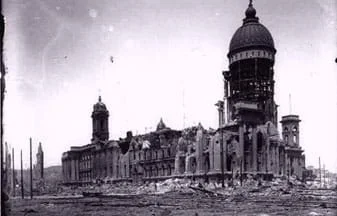 San Francisco City Hall after the 1906 earthquake.Copyright U.S. Geological Survey http://quake.wr.usgs.gov/info/1906/images/damage6.jpg.
Students are introduced to natural disasters and learn the difference between natural hazards and natural disasters. They discover the many types of natural hazards—avalanche, earthquake, flood, forest fire, hurricane, landslide, thunderstorm, tornado, tsunami and volcano—as well as specific examples of natural disasters. Students also explore why understanding these natural hazards is important to engineers and everyone's survival on our planet.
Engineers learn about our planet so that humans can exist with and survive its natural hazards. Engineers must be aware of natural hazards in order to prevent or minimize their harmful effects on people and property. They create devices that detect natural hazards, build structures to withstand them, and invent devices to study them. Our homes must withstand the powerful forces of wind, snow, water, fire and moving earth. Engineers design avalanche beacons and airbags, lightning rods and all kinds of environmental sensors. They also design special equipment to fight fires on the ground and from the air.
After this lesson, students should be able to:
- Differentiate between a natural disaster and a natural hazard.
- Name at least three different natural hazards.
- Explain why engineers care about natural disasters.
- Analyze and interpret data identifying ways Earth's surface is constantly changing through a variety of processes and forces such as plate tectonics, erosion, deposition, solar influences, climate, and human activity
Grade 5
Do you agree with this alignment?
- STEL-3D Explain how various relationships can exist between technology and engineering and other content areas.
Grades 3-5
Do you agree with this alignment?
- DCI.ESS3.B.3-5.3 A variety of hazards result from natural processes (e.g., earthquakes, tsunamis, volcanic eruptions). Humans cannot eliminate the hazards but can take steps to reduce their impacts.
Grade 4
Do you agree with this alignment?
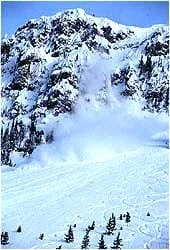 An avalanche in the Cascade Mountains, WA.Copyright King County, WA http://www.metrokc.gov
Natural Hazards: What is a natural hazard? A natural hazard is any naturally occurring event that poses a danger to human life or property. "Natural hazards" is a general term for events such as volcanoes, earthquakes and tsunamis. Types of natural hazards include: avalanche, earthquake, flood, forest fire, hurricane/typhoon/cyclone, landslide, thunderstorm/blizzard/ice storm, tornado, tsunami and volcano. Below are short descriptions of these natural hazards. In later lessons of this unit, many of these natural hazards are examined in more detail.
 Engineering students at the University of Colorado at Boulder designed and created a jacket avalanche airbag that can be rapidly inflated to keep a person closer to the surface of an avalanche, and thus more likely to survive.Copyright 2006 Lawrence E. Carlson, ITL Program, College of Engineering and Applied Science, University of Colorado Boulder
An avalanche is a large mass of snow, ice and/or rock that is carried down a slope by gravity. Typically, the term avalanche refers to snow sliding down a mountain. Of several different kinds of avalanches, the most common and most dangerous is a slab avalanche. A slab avalanche occurs when a large section of snow can no longer stick to the side of a slope and is overcome by the force of gravity. These typically form on slopes that have an incline between 25 and 60 degrees. Most avalanche victims are backcountry skiers, but avalanches can sometimes destroy human settlements. One example is the mountain town of Montroc in France, which was hit by an avalanche in 1999, killing 12 people. Predicting and preventing avalanches can be difficult, but engineers use several methods to mitigate the impact of avalanches. Passive methods include snow fences and retarding structures that hold the snow on the slope or redirect or slow the avalanche so that it does not damage structures. Active techniques typically involve triggering small avalanches with explosives in order to prevent larger avalanches from forming. Engineers also design devices such as beacons and airbags that people can wear in the backcountry to help them survive an avalanche. A beacon is an electronic transmitter that helps rescuers find a buried person, while airbags inflate during an avalanche, keeping the a person buoyant as well as providing breathing room once the avalanche stops.
Earthquakes are potentially devastating natural hazards. Earthquakes are formed as the tectonic plates that make up the crust of the earth rub against each other. While approximately 8,000 earthquakes occur every day worldwide, nearly all are too small to feel. Occasionally one is large and close enough to a populated area to create significant damage. Engineers design devices such as seismometers and lasers that can help predict earthquakes through the data they collect. Engineers take into consideration the powerful forces of earthquakes when designing structures and bridges.
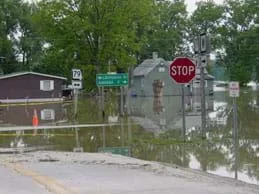 Flood of Clarksville, MO, by the Mississippi River in 2001.Copyright NOAA http://www.crh.noaa.gov/images/ahps2/lsx/clkm7/2001_flood.jpg.
Floods are natural hazards that involve an overflow of water that submerges usually dry land. Of the many different types and causes of floods, the most common are periodic river flooding and flash flooding. Periodic river flooding is caused by melting snow and spring rain increasing a river's water level. Even though this type of flooding is easy to predict since the water level rises at a slow rate, these floods can still be disastrous if the amount of water is more than is expected. Flash floods occur when water from rainstorms is suddenly too much for streams and rivers to contain. Engineers design river gauges and weather monitoring devices that take measurements that help us predict and monitor floods. They also design dams and levees to prevent and minimize flooding.
Forest fires are natural hazards that can be tremendously destructive. Forest fires occur in heavily forested areas during the dry season. They are usually started by lightning or human activities such as campfires. Periodic forest fires are good for the forest because they help to thin the forest and allow for new growth. Forest fires also have the potential to destroy houses and towns in or near forested areas. To minimize the impact of forest fires, engineers design tractors that cut and clear fire lanes (forest strips in which all vegetation is removed) to halt the spread of a forest fire. Engineers also design aircraft that drop water or chemical retardants on fires.
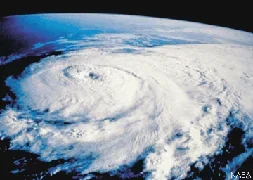 Hurricane Elena, as seen from space, in 1985.Copyright NOAA http://hurricanes.noaa.gov/prepare/.
Hurricanes are powerful tropical storms with wind speeds in excess of 74 mph (119 kph). Hurricanes form in the warm ocean waters near the equator. A hurricane has an organized rotation with a central "eye" where the winds are calm. The eye is typically between 20 and 40 miles (32-64 k) in diameter. Surrounding the eye is the eye wall — where the winds are usually the strongest and are accompanied by heavy rain. Beyond the eye wall are rain bands, which are long thunderstorms that curve out away from the center of the storm. Damage from hurricanes is caused by the high winds, a powerful storm surge as the storm makes land fall, and inland flooding as an area is saturated with heavy rain. Hurricanes are known as typhoons in the Pacific Ocean and as cyclones in the Indian Ocean. Engineers address the dangers of hurricanes by designing weather instruments and satellites that detect these storms and predict their paths. Engineers also design structures and sea walls to help people and property survive storms and minimize destruction.
Landslides are similar to avalanches in that they involve gravity pulling material down slopes. Of the wide variety of types and causes of landslides, the most common are caused by heavy rains and erosion. Engineers create monitoring devices to help predict landslides, as well as nets, anchors and walls that support slopes and hold back landslides.
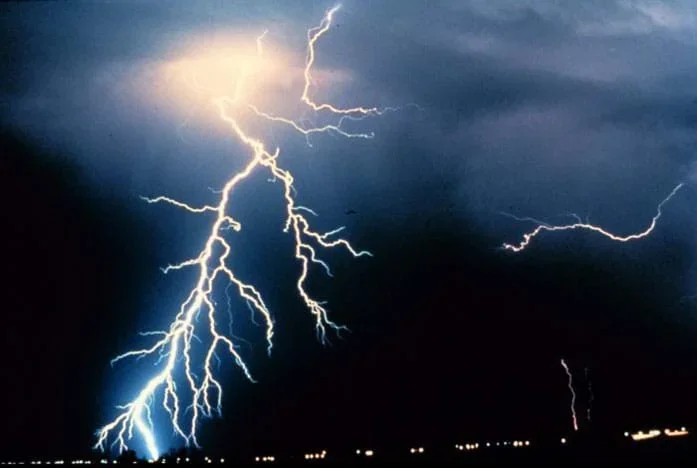 Lightning from a thunderstorm.Copyright NOAA http://www.nws.noaa.gov/om/wcm/lightning/photos.htm.
A thunderstorm is a severe storm characterized by thunder and lightning. Thunderstorms are often accompanied by heavy rain, hail or (rarely) snow. The term thunderstorm comes from the thunder that accompanies the lightning. Thunder is the sound of the shockwave caused by the lightning heating and expanding the air around it. Lightning is the discharge of electrical energy that is formed as particles in a cloud rub against each other. This is similar to the static electricity that forms if you rub a balloon on your hair, but it is much more powerful; each bolt of lightning transfers 500 megajoules of electricity. Thunderstorms are dangerous and damaging because of the risk of being struck by lightning, the destruction caused by hail, the possibility of flash flooding, and the potential for tornados. Engineers design radar that is used to track storms and warn residents of storm paths. They also design lightning rods, which provide safe routes for lightning to reach the ground.
Tornadoes are powerful, funnel-shaped windstorms. Tornadoes usually start as vigorous thunderstorms that form supercells. A supercell is a thunderstorm with a rotating core, called a mesocyclone. As the mesocyclone descends, it forms a funnel cloud. Once the swirling funnel cloud reaches the ground it is called a tornado. With wind speeds of up to 300 mph (483 kph), tornadoes can be incredibly destructive. Tornadoes that form over water are called waterspouts. Engineers track tornadoes in the same way they track thunderstorms.
Tsunamis are large waves caused by displacement in the sea floor, typically caused by landslides or earthquakes under the ocean. The huge waves can move far inland, threatening coastal areas and wreaking havoc on communities. Engineers design special ocean buoys to detect the tsunami when it is still far out in the ocean so that people can be given advance warning to evacuate coastal areas.
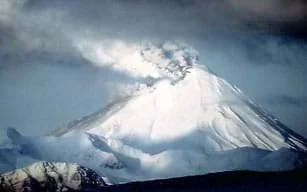 Kanaga stratovolcano in Alaska.Copyright U.S. Geological Survey http://volcanoes.usgs.gov/Products/Pglossary/volcano.html.
Volcanoes are formed when liquid magma located under the crust of the earth finds a way to the surface. When it reaches the surface it is known as lava. Volcanoes can erupt violently with a huge explosion, spreading lava, ash and rock over a large area. Or, they can erupt more calmly, as when lava oozes out of the ground. Three basic types of volcanoes are shield volcanoes, stratovolcanoes and cinder cones. Shield volcanoes form when lava flows like a liquid creating a low and wide (shield-like) dome. Stratovolcanoes are large, conical-shaped volcanoes formed by layers of deposit from explosive eruptions. Cinder cones are usually smaller and form from the scoria of a single eruption. Scoria is solidified chunks of magma. Engineers create devices such as tiltmeters to monitor mountains so that nearby inhabitants can be warned of impending eruptions.
Natural Disasters: What is a natural disaster? A natural disaster is any natural hazard that affects human lives or property. A natural hazard, such as an earthquake that occurs at the bottom of the sea and that no one feels, is not considered a natural disaster, while an earthquake such as the one in Pakistan in 2005 that killed nearly 100,000 people and destroyed many homes and roads was a terrible natural disaster.
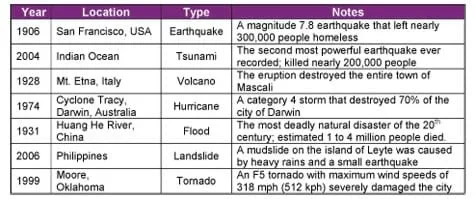 Table 1. Examples of natural disasters in recent human history.
Engineers must study and understand natural hazards to be able to create structures that can survive and protect people from their powerful forces. Engineers also design devices and tools that people use to detect the powerful and natural forces of our planet, as well as methods for avoiding or diverting natural hazards. Refer to the associated activity Engineering to Prevent Natural Disasters: Save Our City! for students to learn about some of the basic methods that engineers use to detect and prevent natural disasters and are challenged to decide where to place these devices on a map of an hypothetical city.
What is a natural disaster? Can you give me an example of a natural disaster? (Expect students to mention natural forces that cause destruction such as volcanoes, earthquakes, tsunamis, floods, hurricanes, tornados, landslides, etc. Write these examples on the classroom board.)
If a volcano erupts in Antarctica, where no human is affected, is it a natural disaster? What about an earthquake that no one feels? Well, these are actually considered natural hazards, not natural disasters. The difference between a natural disaster and a natural hazard is that a natural hazard has the potential to cause damage to people, but doesn't necessarily, while a natural disaster is a natural hazard that affects human populations. For example: Volcanoes are natural hazards because they have the potential to erupt and affect humans. Mt. Pinatubo, a volcano, erupted in the Philippines in 1991 destroying communities and taking the lives of 300 people, making the Mt. Pinatubo eruption a natural disaster.
Why do engineers care about natural hazards? Engineers must understand natural hazards in order to understand their effects on the "things" they create. They also must know where natural hazards are likely to occur, so they can contribute to the design of communities to help people survive and minimize the impact of natural hazards. Engineers design structures such as buildings and bridges so they do not fall down in earthquakes, they build channels to deflect lava flows from volcanoes, and they raise buildings on stilts to limit the damage from high water. Engineers also design instruments that collect data and make measurements, which helps us predict natural hazards like hurricanes, earthquakes, tsunamis and floods. Engineers develop tracking devices for thunderstorms and tornadoes. Engineers also design the equipment and devices used by rescuers to find people buried in avalanches or collapsed buildings.
What is a natural hazard? (Answer: A natural event that has the power to damage or destroy property as well as injure or take lives.) We discussed that volcanoes, earthquakes, tsunamis, floods, hurricanes, tornados and landslides are examples of natural hazards.
What is the difference between a natural disaster and a natural hazard? (Answer: Natural hazards are natural occurances that pose danger to human settlements and lives, while natural disasters are specific happenings that harm people.)
Can anyone tell us about a specific natural disaster? What types of natural hazards occur in the region where we live?
Why are studying and understanding the natural events of our planet important for engineers? (Answer: Engineers must understand hazards and disasters in order to create devices that can monitor, predict, prevent and/or minimize the impact of natural forces as well as design structures so people can survive them.)
- avalanche
- A large slide of snow, ice and/or earth down a slope.
- earthquake
- Shaking of the ground caused by friction between the tectonic plates.
- engineer
- A person who applies his/her understanding of science and mathematics to creating things for the benefit of humanity and our planet.
- flood
- When normally dry land is submerged with water.
- forest fire
- An uncontrolled fire in a forested area.
- hurricane
- An organized rotating storm that forms in or near the tropics.
- landslide
- A large movement of earth down a slope.
- natural disaster
- A disaster affecting humans that is caused by a natural hazard.
- natural hazard
- A natural event that has the ability to cause destruction.
- thunderstorm
- A powerful storm that includes lightning and thunder.
- tornado
- A funnel-shaped storm characterized by high winds.
- tsunami
- A large ocean wave caused by the displacement of the sea floor.
- volcano
- An opening in the earth's crust through which molten lava, ash and gases are ejected.
Pre-Lesson Assessment
Discussion Questions: Solicit answers to the following questions and explain to students these questions will be answered as we explore the lesson.
- What is a natural disaster?
- Name a specific example of a natural disaster.
- Can we prevent or predict natural disasters?
Post-Introduction Assessment
Voting: Have students vote on the following true/false questions and then explain the answers.
- True or False: Natural hazards and natural disasters are exactly the same thing. (False: Natural hazards are natural occurances on our planet that have destructive powers, while natural disasters are what we call specific natural hazards that caused the destruction of human settlements and lives).
- True or False: The 1906 San Francisco earthquake that left nearly 300,000 people homeless was a natural disaster. (True: This earthquake was a specific event that caused lots of destruction to the people and property in that city).
- True or False: A nuclear power plant meltdown is a natural hazard. (False: A nuclear power plant is created by humans and is therefore not a natural event.)
- True or False: A fire that started by a burning candle and destroyed the personal belongings of all the people who live in an apartment building is a natural disaster. (False: This fire sounds like a disaster, but it was caused by humans and is therefore not considered a natural disaster.)
Lesson Summary Assessment
Drawing: Have students make and label drawings that each illustrate one type of natural hazard. To turn them into drawings of natural disasters, have them show the hazard affecting people and communities. Have students discuss how an engineer might help track or predict the pictured event. As an extension, have students act as engineers and draw devices or structures with the purpose of protecting people, warning people or predicting the timing or location of natural hazards.
Summary Questions: Ask the students and discuss as a class:
- What is a natural hazard? (Answer: A natural event that has the power to damage or destroy property as well as injure or take lives.)
- What is an example of a natural hazard? (Answers: Avalanche, volcano, earthquake, hurricane, tornado, landslide, thunderstorm, flood, forest fire.)
- What is a natural disaster? (Answer: A specific event in which a natural hazard did damage to a human population.)
- What is an example of a natural disaster? (Answer: See Table 1.)
- Why do engineers care about natural hazards and natural disasters? (Answer: Engineers care because they must first understand hazards before they can create devices that monitor, predict, prevent or minimize the impact of natural hazards, as well as design structures that can survive natural hazards and protect people.)</
Have students research specific natural disasters, making posters that describes them. Have them talk about what natural hazard caused each disaster as well as the effects and what might have been done to prevent or minimize the impact of the disaster.
As a side activity, have students learn more about potential and kinetic energy as they design and build a way to safely and accurately deliver relief goods (represented by an egg) to people in a natural disaster area with no road access. Similar to real-world engineering design teams, students must design their devices with constraints such as limited materials. This Bombs Away! activity is targeted for sixth-grade studens but may be suitable for grades 4-8.
Ask students to think about the types of natural disasters that might occur in the region in which they live. Then, imagining that a natural disaster occurs in their community, what have engineers created that would help students survive the dangerous situation? For example, if you are safe during a blizzard, what keeps you safe? Engineer-designed examples might include: Strong roof, insulated walls, heating system, lighting, communication devices (radio, television, phones), indoor plumbing and electricity, stoves and refrigerators, warm clothing made with modern fabrics, weather predicting and warning devices, safe vehicles, etc. Have them summarize in a one-page paper.
Abromeit, Doug, Anne Marie Deveraux, and Britt Overby. Forest Service National Avalanche Center. U.S. Forest Service. Accessed December 20, 2006. http://www.avalanche.org
Central Region Headquarters, NOAA's National Weather Service. Updated November 17, 2006. NOAA. Accessed December 20, 2006. (Find out about weather events currently happening everywhere in the US) http://www.crh.noaa.gov/crh/
National Hurricane Center and Tropical Prediction Center. Updated December 7, 2006. NOAA/National Weather Service, Miami, FL. Accessed December 20, 2006. http://www.nhc.noaa.gov/
National Interagency Fire Center. NIFC, Boise, ID. Accessed December 20, 2006. http://www.nifc.gov/
Lightning Safety: Photos, Medical, Brochures, More. Office of Climate, Water and Weather Services, NOAA/National Weather Service, Silver Springs, MD. Accessed December 20, 2006. http://www.lightningsafety.noaa.gov/
Sawall, Hardy. Avalanche Defense Techniques. Michigan Technological University. Accessed December 20, 2006. http://www.geo.mtu.edu/
Volcano Hazards Program. Last modified December 10, 2006. U.S. Geological Survey. Accessed December 20, 2006. http://volcanoes.usgs.gov/
Watson, John and Kathie. Last updated October 23, 1997. Predicting Earthquakes – General Interest Publication. U.S. Geological Survey. Accessed December 20, 2006. http://pubs.usgs.gov/gip/earthq1/predict.html
Contributors
Geoffrey Hill; Malinda Schaefer Zarske; Denise W. Carlson
Supporting Program
Integrated Teaching and Learning Program, College of Engineering, University of Colorado Boulder
Acknowledgements
The contents of this digital library curriculum were developed under a grant from the Fund for the Improvement of Postsecondary Education (FIPSE), U.S. Department of Education and National Science Foundation GK-12 grant no. 0338326. However, these contents do not necessarily represent the policies of the Department of Education or National Science Foundation, and you should not assume endorsement by the federal government.
Copyright
2006 by Regents of the University of Colorado.