
Survive That Tsunami! Testing Model Villages in Big Waves
Students use a table-top-sized tsunami generator to observe the formation and devastation of a tsunami. They see how a tsunami moves across the ocean and what happens when it reaches the continental shelf. Students make villages of model houses and buildings to test how different material types are impacted by the huge waves. They further discuss how engineers design buildings to survive tsunamis. Much of this activity setup is the same as for the Mini-Landscape activity in Lesson 4 of the Natural Disasters unit.
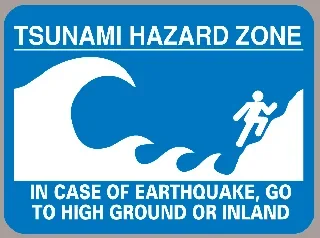 Students learn about tsunamis and their devastationCopyright Geological Survey, http://pubs.usgs.gov/ circ/c1187/images/tsunami.gif.
No one can stop tsunamis from forming since we cannot prevent earthquakes, volcanoes and landslides, but we can devise ways to minimize the impact of these killer waves on human communities. Engineers design and install seismographs, tide gauges, ocean floor pressure sensors and loud sirens. Engineers also design buildings using materials and shapes that are more likely to survive a tsunami. Between high-tech detection systems and smart structures, the impact of a tsunami strike can be lessened dramatically. But, in many areas, dense populations, unreliable local communication, and poor or nonexistent roads remain the biggest obstacles to quick evacuation to safety.
After this activity, students should be able to:
- Explain what causes tsunamis, including movement under the surface of the ocean.
- Communicate that buildings constructed with materials that are heavier are more likely to survive a tsunami, but may be too expensive or not available.
- Describe how engineers cannot prevent tsunamis, but they can design and build buildings so that they are more resistant to tsunamis.
- Develop and communicate an evidence based scientific explanation around one or more factors that change Earth's surface
Grade 5
Do you agree with this alignment?
- Students will develop an understanding of the attributes of design.
Grades K-12
Do you agree with this alignment? - Models are used to communicate and test design ideas and processes.
Grades 3-5
Do you agree with this alignment?
- 3-5-ETS1-2 Generate and compare multiple possible solutions to a problem based on how well each is likely to meet the criteria and constraints of the problem.
Grades 3-5
This resource focuses on the following Three Dimensional Learning aspects of NGSS:
Science & Engineering Practices- Generate and compare multiple solutions to a problem based on how well they meet the criteria and constraints of the design problem.Do you agree with this alignment?
Disciplinary Core Ideas- Research on a problem should be carried out before beginning to design a solution. Testing a solution involves investigating how well it performs under a range of likely conditions.Do you agree with this alignment?
- At whatever stage, communicating with peers about proposed solutions is an important part of the design process, and shared ideas can lead to improved designs.Do you agree with this alignment?
Crosscutting Concepts- Engineers improve existing technologies or develop new ones to increase their benefits, to decrease known risks, and to meet societal demands.Do you agree with this alignment?
Do you agree with this alignment? - Generate and compare multiple solutions to a problem based on how well they meet the criteria and constraints of the design problem.
- 3-5-ETS1-3 Plan and carry out fair tests in which variables are controlled and failure points are considered to identify aspects of a model or prototype that can be improved.
Grades 3-5
This resource focuses on the following Three Dimensional Learning aspects of NGSS:
Science & Engineering Practices- Plan and conduct an investigation collaboratively to produce data to serve as the basis for evidence, using fair tests in which variables are controlled and the number of trials considered.Do you agree with this alignment?
Disciplinary Core Ideas- Tests are often designed to identify failure points or difficulties, which suggest the elements of the design that need to be improved.Do you agree with this alignment?
- Different solutions need to be tested in order to determine which of them best solves the problem, given the criteria and the constraints.Do you agree with this alignment?
Do you agree with this alignment? - Plan and conduct an investigation collaboratively to produce data to serve as the basis for evidence, using fair tests in which variables are controlled and the number of trials considered.
- 4-ESS3-2 Generate and compare multiple solutions to reduce the impacts of natural Earth processes on humans.
Grade 4
This resource focuses on the following Three Dimensional Learning aspects of NGSS:
Science & Engineering Practices- Generate and compare multiple solutions to a problem based on how well they meet the criteria and constraints of the design solution.Do you agree with this alignment?
Disciplinary Core Ideas- A variety of hazards result from natural processes (e.g., earthquakes, tsunamis, volcanic eruptions). Humans cannot eliminate the hazards but can take steps to reduce their impacts.Do you agree with this alignment?
- Testing a solution involves investigating how well it performs under a range of likely conditions.Do you agree with this alignment?
Crosscutting Concepts- Cause and effect relationships are routinely identified, tested, and used to explain change.Do you agree with this alignment?
- Engineers improve existing technologies or develop new ones to increase their benefits, to decrease known risks, and to meet societal demands.Do you agree with this alignment?
Do you agree with this alignment? - Generate and compare multiple solutions to a problem based on how well they meet the criteria and constraints of the design solution.
Divide the class into three groups. Students in group A need:
- 2 sheets of tissue paper (the gift wrap type)
Students in group B need:
- 3 sheets of cardstock or manila envelope material
Students in group C need:
- 3 sheets of notebook paper
- 40 toothpicks
To share with the entire class:
- masking tape
- scissors
- Model House Template (PDF)
To make brass model houses:
- 1 piece brass sheet metal, 4-in x 10-in x .01-in thick (or 10-cm x 25-cm x .025-cm thick, available at hobby or hardware store)
- Tin snips (scissors also work, but cutting the brass dulls them)
For the table-top-sized tsunami generator:
Note: Most of the following materials can be reused, some for the Mini-Landslide activity in Lesson 5 of the Natural Disasters unit.
- 1 large, shallow, plastic waterproof tub (8-in x 14-in x 30-in or 20-cm x 36-cm x 76-cm, clear plastic is better but not necessary)
- 20 to 30-pound (9 to 14 kg) bag of sand
- 1 piece of sheet metal, ~20-in x 10-in x 0.1-in thick (as long as it is rigid, it is thick enough) or 51-cm x 25-cm x .25-cm thick
- duct tape
A familiarity with the concepts of tectonic plates, earthquakes, volcanoes and landslides.
What is a tsunami? Well, it is a really large wave — much larger than the waves you see when you splash in a pool or surf at the beach. The difference between a regular wave and a tsunami is that a regular wave is just a surface disturbance of the water, and a tsunami is a disturbance that reaches all the way to the ocean floor!
What do you think causes a tsunami? Well, tsunamis can be caused by anything that moves the ocean or sea floor, like earthquakes, volcanoes and landslides. Think about an underwater earthquake that is caused by the moving of tectonic plates. Do you think that this could move the sea floor and create a tsunami? Yes, it could! Do you think engineers can prevent tsunamis? Engineers cannot prevent natural events like earthquakes or volcanoes, or the tsunamis that can result from them. So, what can engineers do about tsunamis? One thing engineers can do is build structures that can survive a tsunami.
In December 2004 a huge tsunami hit the beach in Indonesia. Do you know from what material most of the destroyed houses were made? Most were made of wood, and some were actually made of paper. What do you think are the advantages and disadvantages of wooden or paper houses? How might houses made of these materials be a disadvantage when it comes to a tsunami? Well, a house made out of weak material, such as wood or paper, probably will not survive the great forces of a tsunami. So, what can engineers do so that a building or structure is able to survive a tsunami? (Possible ideas: Build it out of stronger material; build it on stilts.) What might be some disadvantages of these types of the new houses? (Possible ideas: More costly and difficult to construct, look different than usual buildings.)
Today, we are going to explore some of the choices that engineers have when designing buildings with tsunamis in mind and make some conclusions as to what shapes and materials make the most tsunami-resistant buildings. Today you are going to make a model building and see if it will survive a tsunami. Your criteria is to build a house that will withstand a simulated tsunami given constraints (using only materials provided- tissue paper, cardstock, notebook paper, toothpicks) of this activity. Are you ready?
Before the Activity
- Gather materials and make copies of the Model House Template (PDF) for the students.
- (Optional, for younger students, or to speed up the activity) Pre-cut the model house materials, using the Model House Template (PDF). Prepare as many sets (one roof and one wall) of each material (tissue paper, cardstock, notebook paper) as you want the students to construct of each material. For example, for a class of 30 students, prepare 10 sets of each of the three types of material.
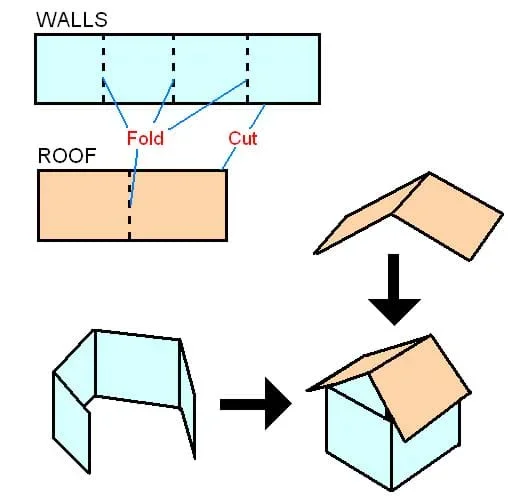 Figure 1. How to construct the model houses.Copyright Geoffrey Hill, ITL Program, College of Engineering, University of Colorado at Boulder, 2005.
- Make 4 brass houses. Using the Model House Template (PDF), use tin snips to cut out four walls and four roofs. Fold the walls and roofs as shown in Figure 1. Tape the roofs to the walls.
- Set up the tsunami generator. It is best to set it up outside, although indoors may work, too.
- Fill one end of the tub with sand, creating a continental shelf and beach (see Figures 2 and 3).
- At the opposite end of the tub, attach the metal sheet to the bottom of the tub using a piece of duct tape along one edge, so it works like a hinge (see Figures 2 and 3).
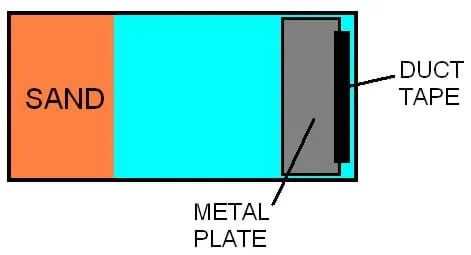 Figure 2. Tsunami generator, view from above.Copyright Geoffrey Hill, ITL Program, College of Engineering, University of Colorado at Boulder, 2005.
- Fill the tub with water so that most of the sand is covered, but leave some sand above the waterline to represent a sandy beach (see Figure 3).
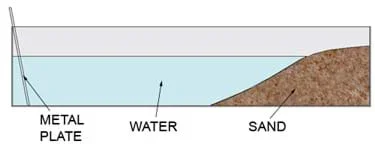 Figure 3. Tsunami generator, a side view.Copyright Geoffrey Hill, ITL Program, College of Engineering, University of Colorado at Boulder, 2005.
- Test the tsunami generator by first leaning the metal plate against the back wall of the tub and then pushing the plate all the way down into the water. A tsunami should form that covers most or the entire beach. To adjust the wave height, adjust the speed with which you push down the plate (see Figure 4).
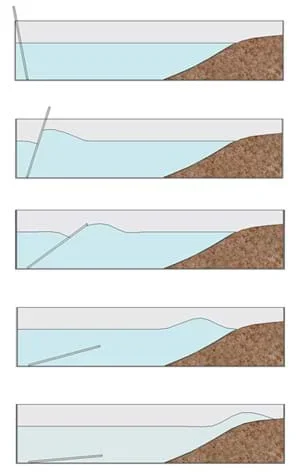 Figure 4. Tsunami generator in action. Pushing the metal plate down into the water creates a wave that moves across the tub of water and onto the sandy beach.Copyright Geoffrey Hill, ITL Program, College of Engineering, University of Colorado at Boulder, 2005.
With the Students
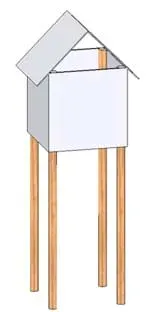 Figure 5. Model house on toothpick stilts.Copyright Geoffrey Hill, ITL Program, College of Engineering, University of Colorado at Boulder, 2005.
- Divide the class into three groups (A, B and C). Each group will make a different type of house, using either tissue paper, cardstock or notebook paper and toothpicks. Students in each group need not sit together while they construct their model houses.
- Provide each student with supplies according to his/her assigned group, as well as access to scissors and masking tape.
- Demonstrate the construction of the buildings as shown in Figure 1 and on the diagram on the Model House Template. (This is a great time to point out to the students that they are working with geometric shapes.)
- Provide time for each student to construct his/her type of building (tissue, cardstock or notebook paper) using scissors and tape.
- Have the students who construct the buildings using notebook paper tape toothpicks to the four corners of their buildings so that the toothpicks work as stilts (see Figure 5).
- Give the students time to decorate their houses using markers. They can label and decorate their model structures to represent a variety of community buildings, such as houses, schools, bank, grocery store, restaurant, police station, library, city hall, power plant, playground, factory, boat marina, etc.
- Explain to the students that the metal plate in the tsunami generator model demonstrates the sea floor movement causing huge ocean waves.
- In four different trials, set up the buildings made by each group of students, and the brass buildings made by the teacher. First, have the students who constructed their model buildings from tissue paper place them scattered across on the beach to create a paper model village (see Figure 6). Before the tsunami, have students predict what will happen to the village.
- A tsunami hits! Using the metal plate, create a wave that swamps most of the land. Create several more waves and remind the students that there is usually more than one wave associated with a tsunami. Expect the waves to destroy most of the tissue paper buildings.
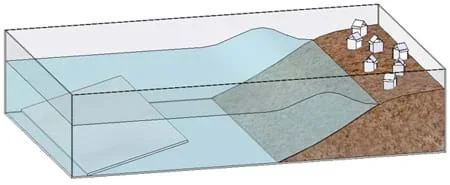 Figure 6. A tsunami wave moves towards the paper model village.Copyright Geoffrey Hill, ITL Program, College of Engineering, University of Colorado at Boulder, 2005.
- Ask the students what they thought of the tsunami hitting the tissue village. Is this what they expected? Why did the tissue buildings fail so easily? What else do you observe?
- Perform steps 8 - 10 again, this time with the students who built the cardstock buildings. In this scenario, students observe that some buildings move slightly, but overall the cardstock village survives better than the tissue village. Note: After several waves the sand erodes slightly, so build up the continental shelf and beach with more sand, as needed.
- Perform steps 8 - 10 again, this time with the students who built the notebook paper buildings with toothpick stilts. Make sure students just set the stilted buildings on the sand and do not push the toothpicks all the way into the sand (see Figure 7).
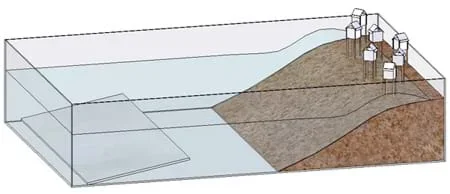 Figure 7. A tsunami wave moves through the stilts of this paper model village.Copyright Geoffrey Hill, ITL Program, College of Engineering, University of Colorado at Boulder, 2005.
- Finally perform steps 8-10 again, this time placing on the beach the brass buildings the teacher made in advance of the activity (see Figure 8). Have several tsunamis wash over them.
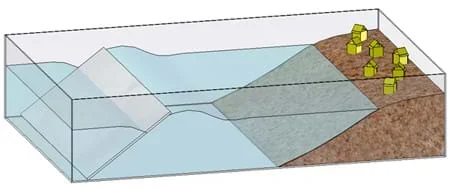 Figure 8. Brass model house village.Copyright Geoffrey Hill, ITL Program, College of Engineering, University of Colorado at Boulder, 2005.
- Conclude with a class discussion comparing results of the four trials. Talk with the students about their observations. Which materials held up the best? Worst? Rank the types of model buildings in order from worst to best at surviving the tsunamis. How might engineers design a building or structure so it is able to survive a tsunami? What might be some disadvantages of these types of houses? How might you re-design your model buildings to improve their chances of surviving big waves? Conduct the summary assessment activities as described in the Assessment section.
- prevent
- To keep from happening.
- sea floor
- (or ocean floor) The bottom of a sea or ocean.
- structure
- Something constructed, such as a building, house, school, bridge or pier.
- survive
- To remain alive or in existence. To remain functional or usable.
- tectonic plate
- A piece of the Earth's crust that slides over the molten rock of the mantle. As the plates rub against each other, earthquakes result that potentially cause tsunamis.
- tsunami
- A large sea wave of local or distant origin that results from large-scale seafloor displacements associated with large earthquakes, major submarine slides or exploding volcanic islands.
- wave
- The up and down movement of water.
Pre-Activity Assessment
Voting: Have the class vote yes or no on the following question:
- Can engineers prevent tsunamis? (Answer: No. Tsunamis are natural events caused by earthquakes, landslides and volcanoes, over which people have no control. Since we cannot control or prevent tsunamis, engineers help us predict and survive them.)
Discussion: Review natural processes and their impacts and compare/contrast with types of damage inflicted by tsunamis. You can also show videos of natural processes llustrating the before/after changes in earth systems to provide supplemental information for students.
Activity Embedded Assessment
Prediction: Have students predict the outcome of the activity before the activity is performed. Before hitting each village with a wave, ask the students: What do you think is going to happen to the village? (Students should start to realize that the buildings made from the lighter and more water absorbent materials are more susceptible to tsunami damage. The heavier buildings and those built up and away from the water are most likely to survive.) Have the students rank the houses from lightest to heaviest materials in their summary observations.
Post-Activity Assessment
Concluding Discussion: Ask the students and discuss as a class:
- Describe the results of the four tsunami trials? How did they compare? What did you observe?
- Rank the types of model buildings in order from worst to best at surviving the tsunamis.
- How might engineers design a building or structure so it is able to survive a tsunami? (Possible answers: Build it out of concrete, stone or bricks [heavier, stronger materials]; build it on stilts so it is above the water flow; make sure it has a deep footing into the soil; or shape it so that water flows around it.)
- What might be some disadvantages of these types of houses? (Possible answers: Buildings like this might cost more to construct, be more difficult to build, or be considered less attractive.)
- How might you re-design your models to improve their chances of surviving big waves?
Re-Engineering: Ask the students how they might improve the buildings in their village. Have them sketch or test their concepts for tsunami-resistant buildings. What material would they use? How would they be shaped? What features would they have? Where would they be located?
Making Sense: Have students reflect about the science phenomena they explored and/or the science and engineering skills they used by completing the Making Sense Assessment (PDF).
- Students should not handle the brass houses since the edges are sharp.
This activity can be messy, so it is best to set it up outside.
To create more controlled and consistent waves, have the teacher operate the tsunami generator for each trial. It helps to practice creating waves before conducting this activity in class.
Have students research the house designs engineers have come up with to resist tsunamis. Look at the website http://senseable.mit.edu/tsunami-prajnopaya/ to see what a group of engineers from Harvard and MIT are doing. Have them write a paragraph describing the building and what makes it unique.
- For lower grades, pre-cut the paper and consider pre-building the structures.
- For upper grades, after exploring what happens to the different villages during a tsunami, have students design and build their own new buildings to survive a tsunami. Provide limited supplies and a size constraint of 2.5 cubic cm.
Dictionary.com. Lexico Publishing Group, LLC. Accessed March 1, 2006. (Source of some vocabulary definitions, with some adaptation) http://www.dictionary.com
ITIC, International Tsunami Information Centre. Updated January 17, 2006. U.S. National Weather Service, NOAA. Accessed March 1, 2006. http://www.tsunamiwave.info/
NOAA Tsunami Website. 2005. National Oceanic and Atmospheric Administration. Accessed March 1, 2006. http://www.tsunami.noaa.gov
Tsunami Safe(r) House: A Design for the Prajnopaya Foundation. 2005. SENSEable City Laboratory, Massachusetts Institute of Technology. Cambridge, MA. Accessed March 1, 2006. http://senseable.mit.edu/tsunami-prajnopaya/
- Natural Disasters: Earthquakes, Volcanoes, Tornadoes & More
Contributors
Geoffrey Hill; Malinda Schaefer Zarske; Denise Carlson
Supporting Program
Integrated Teaching and Learning Program, College of Engineering, University of Colorado Boulder
Acknowledgements
The contents of this digital library curriculum were developed under a grant from the Fund for the Improvement of Postsecondary Education (FIPSE), U.S. Department of Education, and National Science Foundation GK-12 grant no 0338326. However, these contents do not necessarily represent the policies of the Department of Education or National Science Foundation, and you should not assume endorsement by the federal government.
Copyright
2006 by Regents of the University of Colorado.