
Natural Disasters: Earthquakes, Volcanoes, Tornadoes & More
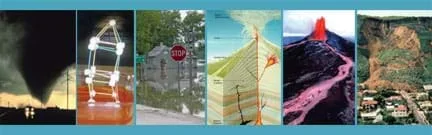 Natural hazards include tornados, earthquakes, floods, volcanoes and landslides.Copyright NOAA Photo Library http://usasearch.gov/search?v%3aproject=firstgov-noaa-images&v%3afile=viv_1085%4028%3aPraO0F&v%3aframe=viewimage&v%3astate=root%7croot-80-20%7c0&id=Ndoc96&rpaid=&; 2004 Jessica Todd, ITL Program, University of Colorado Boulder; NOAA http://www.crh.noaa.gov/images/ahps2/lsx/clkm7/2001_flood.jpg; US Geological Survey http://interactive2.usgs.gov/learningweb/teachers/volcanoes.htm; FEMA http://www.fema.gov/kids/p_vol07.htm; RL Schuster, US Geological Survey, US Department of the Interior http://pubs.usgs.gov/of/2001/ofr-01-0276/
All lessons provide a real-world engineering context, helping students understand what engineers study and create to help people live with natural hazards. Overview of topics by lesson:
- introduction to natural hazards and natural disasters
- the structure and dynamics of the Earth, its layers, tectonic plates, continental drift and faults
- earthquake measurement including seismographs, and structural considerations
- the Earth’s core and the causes, composition and types of volcanoes
- characteristics of and contributing factors to land and mud slides
- understanding tsunami formation and devastation to human-made structures
- various causes of flooding and the Earth’s water cycle
- the characteristics, damage and occurrence of tornados, and structure design to withstand high winds
Engineers learn about our planet so that humans can exist with and survive its powerful natural forces. Engineers must be aware of natural hazards in order to prevent or minimize their harmful effects on people and property. By creating improved techniques and materials, engineers make sure the structures we rely upon are built strong enough to reduce human injuries and casualties from the tremendous natural forces of wind, snow, water, fire and moving earth. While most natural hazards cannot be prevented, engineers do their best to create data gathering, monitoring, measuring, prediction and warning equipment, tools and models to protect human populations. Engineers use their science and math skills to build instruments and computer programs that can detect gases, changes in the shape of volcanoes, monitor underground movement, and estimate storm locations and severity. Data is collected by cameras, seismometers, GPS, pressure sensors, radar and satellites. Other helpful technologies include avalanche beacons and airbags, lightning rods, building shock absorbers and sliders, and warning sirens. Engineers work with scientists to determine locations at which dangers exist, how to minimize risks, and how to prevent the actions of people from creating catastrophes. Engineers also design test facilities to simulate and study hazard characteristics and model scenarios with computer simulations. Engineers also analyze and learn from past failures as a way to continue to improve structural designs, advance warning systems and emergency procedures for human safety. As engineers create devices that detect natural hazards, build structures to withstand them, and invent devices to study them, they use the process of gathering and analyzing data to better understand problems and formulate solutions.
- 4-ESS2-2 Analyze and interpret data from maps to describe patterns of Earth's features.
Grade 4
This resource focuses on the following Three Dimensional Learning aspects of NGSS:
Science & Engineering Practices- Analyze and interpret data to make sense of phenomena using logical reasoning.Do you agree with this alignment?
Disciplinary Core Ideas- The locations of mountain ranges, deep ocean trenches, ocean floor structures, earthquakes, and volcanoes occur in patterns. Most earthquakes and volcanoes occur in bands that are often along the boundaries between continents and oceans. Major mountain chains form inside continents or near their edges. Maps can help locate the different land and water features areas of Earth.Do you agree with this alignment?
Crosscutting Concepts- Patterns can be used as evidence to support an explanation.Do you agree with this alignment?
Do you agree with this alignment? - Analyze and interpret data to make sense of phenomena using logical reasoning.
- 4-ESS3-2 Generate and compare multiple solutions to reduce the impacts of natural Earth processes on humans.
Grade 4
This resource focuses on the following Three Dimensional Learning aspects of NGSS:
Science & Engineering Practices- Generate and compare multiple solutions to a problem based on how well they meet the criteria and constraints of the design solution.Do you agree with this alignment?
Disciplinary Core Ideas- A variety of hazards result from natural processes (e.g., earthquakes, tsunamis, volcanic eruptions). Humans cannot eliminate the hazards but can take steps to reduce their impacts.Do you agree with this alignment?
- Testing a solution involves investigating how well it performs under a range of likely conditions.Do you agree with this alignment?
Crosscutting Concepts- Cause and effect relationships are routinely identified, tested, and used to explain change.Do you agree with this alignment?
- Engineers improve existing technologies or develop new ones to increase their benefits, to decrease known risks, and to meet societal demands.Do you agree with this alignment?
Do you agree with this alignment? - Generate and compare multiple solutions to a problem based on how well they meet the criteria and constraints of the design solution.
- MS-ESS2-2 Construct an explanation based on evidence for how geoscience processes have changed Earth's surface at varying time and spatial scales.
Grades 6-8
This resource focuses on the following Three Dimensional Learning aspects of NGSS:
Science & Engineering Practices- Construct a scientific explanation based on valid and reliable evidence obtained from sources (including the students' own experiments) and the assumption that theories and laws that describe the natural world operate today as they did in the past and will continue to do so in the future.Do you agree with this alignment?
Disciplinary Core Ideas- The planet's systems interact over scales that range from microscopic to global in size, and they operate over fractions of a second to billions of years. These interactions have shaped Earth's history and will determine its future.Do you agree with this alignment?
- Water's movements—both on the land and underground—cause weathering and erosion, which change the land's surface features and create underground formations.Do you agree with this alignment?
Crosscutting Concepts- Time, space, and energy phenomena can be observed at various scales using models to study systems that are too large or too small.Do you agree with this alignment?
Do you agree with this alignment? - Construct a scientific explanation based on valid and reliable evidence obtained from sources (including the students' own experiments) and the assumption that theories and laws that describe the natural world operate today as they did in the past and will continue to do so in the future.
- MS-ESS3-2 Analyze and interpret data on natural hazards to forecast future catastrophic events and inform the development of technologies to mitigate their effects.
Grades 6-8
This resource focuses on the following Three Dimensional Learning aspects of NGSS:
Science & Engineering Practices- Construct an oral and written argument supported by empirical evidence and scientific reasoning to support or refute an explanation or a model for a phenomenon or a solution to a problem.Do you agree with this alignment?
Disciplinary Core Ideas- Mapping the history of natural hazards in a region, combined with an understanding of related geologic forces can help forecast the locations and likelihoods of future events.Do you agree with this alignment?
Crosscutting Concepts- The uses of technologies and any limitations on their use are driven by individual or societal needs, desires, and values; by the findings of scientific research; and by differences in such factors as climate, natural resources, and economic conditions. Thus technology use varies from region to region and over time.Do you agree with this alignment?
- Graphs, charts, and images can be used to identify patterns in data.Do you agree with this alignment?
Do you agree with this alignment? - Construct an oral and written argument supported by empirical evidence and scientific reasoning to support or refute an explanation or a model for a phenomenon or a solution to a problem.
The following schedule provides a suggested order of the lessons and activities. However, you may choose to only teach some of the activities – as your time and priorities permit.
- Naturally Disastrous lesson
- Engineering to Prevent Natural Disasters: Save Our City! activity
- Earthquake Formation: Crust, Plates, Currents, Drift and Faults lesson
- Scale Model of the Earth activity
- Drifting Continents activity
- Faulty Movement activity
- Earthquakes Rock! lesson
- Testing Model Structures: Jell-O Earthquake in the Classroom activity
- Seismology in the Classroom activity
- Mercalli Scale Illustrated activity
- Magnitude of the Richter Scale activity
- Volcanic Panic! lesson
- Ready to Erupt! activity
- All About Landslides: Land on the Run lesson
- Mini-Landslide activity
- Tsunami Attack! Giant Wave Characteristics and Causes lesson
- Survive That Tsunami! Testing Model Villages in Big Waves activity
- Water, Water Everywhere lesson and Floodplain Modeling activity
- Floodplain Modeling activity
- Tornado! lesson
- Windstorm activity
- Tornado Damage! activity
- A Tornado in My State? activity
- Build it Better! activity
- Natural Disasters: Earthquakes, Volcanoes, Tornadoes & More
Supporting Program
Integrated Teaching and Learning Program, College of Engineering and Applied Science, University of Colorado Boulder
Acknowledgements
This digital library content was developed by the Integrated Teaching and Learning Program under National Science Foundation GK-12 grant no. 0338326. However, these contents do not necessarily represent the policies of the National Science Foundation, and you should not assume endorsement by the federal government.
Copyright
2006 by Regents of the University of Colorado