
Earthquakes Rock!
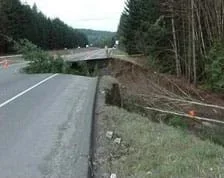 Figure 1. Extreme road damage from a 6.8 earthquake near Olympia, WA.Copyright Washington Department of Transportation http:// www.wsdot.wa.gov/
Students learn the two main methods to measure earthquakes, the Richter Scale and the Mercalli Scale. Students are challenged by the associated activities to make a model of a seismograph—a measuring device that records an earthquake on a seismogram. As well as to investigate which structural designs are most likely to survive an earthquake. And, they illustrate an informational guide to the Mercalli Scale.
Civil, structural, mechanical and materials engineers make sure the structures we rely upon are built strong enough to keep us safe. To reduce the number of human injuries and casualties, they research and test new and improved techniques and materials that help structures withstand the tremendous earthquake forces. For example, engineers have developed shock absorbers and structure sliders—techniques that isolate the foundation of a building from the ground so the building and the earth move independently. They also create monitoring equipment to predict and measure earthquakes and warn surrounding communities.
After this lesson, students should be able to:
- Describe how humans are affected by earthquakes.
- Explain the distribution and causes of earthquakes that shape/change the Earth.
- Understand why engineers need to learn about earthquakes.
- Identify cause-effect relationships involved in earthquakes.
- Analyze and interpret data identifying ways Earth's surface is constantly changing through a variety of processes and forces such as plate tectonics, erosion, deposition, solar influences, climate, and human activity
Grade 5
Do you agree with this alignment? - Develop and communicate an evidence based scientific explanation around one or more factors that change Earth's surface
Grade 5
Do you agree with this alignment?
- Models are used to communicate and test design ideas and processes.
Grades 3-5
Do you agree with this alignment?
- MS-ESS3-2 Analyze and interpret data on natural hazards to forecast future catastrophic events and inform the development of technologies to mitigate their effects.
Grades 6-8
This resource focuses on the following Three Dimensional Learning aspects of NGSS:
Science & Engineering Practices- Construct an oral and written argument supported by empirical evidence and scientific reasoning to support or refute an explanation or a model for a phenomenon or a solution to a problem.Do you agree with this alignment?
Disciplinary Core Ideas- Mapping the history of natural hazards in a region, combined with an understanding of related geologic forces can help forecast the locations and likelihoods of future events.Do you agree with this alignment?
Crosscutting Concepts- The uses of technologies and any limitations on their use are driven by individual or societal needs, desires, and values; by the findings of scientific research; and by differences in such factors as climate, natural resources, and economic conditions. Thus technology use varies from region to region and over time.Do you agree with this alignment?
- Graphs, charts, and images can be used to identify patterns in data.Do you agree with this alignment?
Do you agree with this alignment? - Construct an oral and written argument supported by empirical evidence and scientific reasoning to support or refute an explanation or a model for a phenomenon or a solution to a problem.
Where do earthquakes usually occur? Do the effects of an earthquake travel? How do scientists measure the force of earthquakes? How do scientists measure earthquake damage?
Earthquakes occur along the boundaries of the Earth's many tectonic plates, near faults. Most earthquakes occur along the Ring of Fire, which encircles the Pacific Ocean (see Figure 3). It is the boundary of the Pacific Plate that underlies the Pacific Ocean. The eastern boundary of this ring is called the San Andreas Fault, which is 800 miles long and lies along the coast of California, Washington and Alaska. The western boundary of this plate lies near Japan. Earthquakes also occur in places where tectonic plates are moving away from each other where volcanoes are forming or erupting. The force of the volcanic magma rising to the surface causes earthquakes.
The engineering feats of humans have also been known to create earthquakes. In 1963 in Denver, pumping wastewater into deep underground holding areas caused a series of earthquakes that stopped when the pumping ended. Both the Hoover Dam (see Figure 4) in the U.S. and the Aswan High Dam in Egypt caused earthquakes because of the added pressure due to the weight of the water behind the dams.
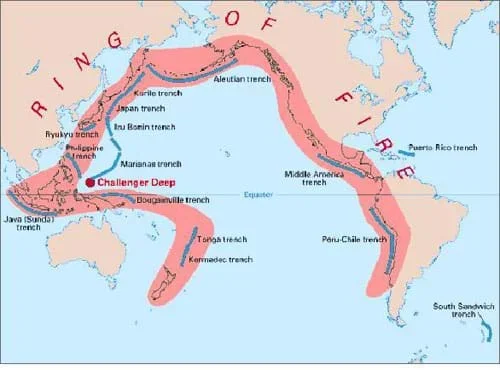 Figure 3. Ring of Fire - an area in which scientists believe most earthquakes occur.Copyright http://pubs.usgs.gov/gip/dynamic/fire.html
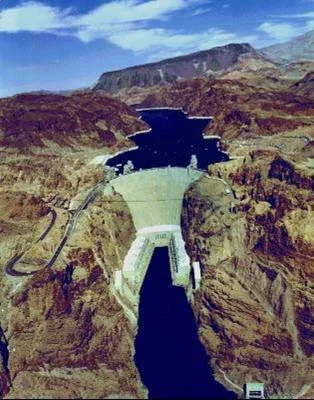 Figure 4. Hoover Dam, Boulder City, Nevada, USA.Copyright http://www.usbr.gov/
Earthquakes happen when rocks break due to high stress, usually caused by friction of tectonic plates moving by one another. The point where this rock rupture occurs is called the focus of the earthquake and is very far beneath the Earth's surface. The location on the actual surface of the Earth, directly above the focus, is called the epicenter of the earthquake. Most damage occurs at the epicenter. The release of force at the earthquake's focus creates vibrations that travel in seismic waves away from this spot. There are two main types of seismic waves: surface waves, which travel along the surface of the earth and cause little damage, and body waves, which travel underground and cause major damage. The first and fastest body waves to travel from the focus of an earthquake are called P waves or Primary waves. Like sound waves, these are compression waves. A Slinky™ spring toy demonstrates compression waves when the slinky is stretched out and one side quickly springs back or is pushed towards the other end. The rings of the slinky push against each other and travel along the outstretched spring. Secondary waves or S waves are slower than P waves and cause most of the damage in an earthquake. S waves move back and forth in a shearing motion. Secondary waves can be demonstrated by wiggling a rope in a snake-like motion along the floor. S waves cause buildings to shake and sway, and cause most of the destruction during an earthquake. Aftershocks are vibrations that occur after the main earthquake has passed. They can occur for days after the main earthquake and often cause as much or more damage than the original earthquake. Megathrust earthquakes — those that are result of two tectonic plates falling beneath each other — often cause tremendous tsunami waves that have been known to kill thousands of coastal people at one time. Unfortunately, aftershocks and tsunamis pose a real threat to clean up and rescue crews.
Seismographs measure the body and surface waves that travel from the focus of earthquakes — or simply, the amount of ground motion produced by an earthquake (Refer to the Seismology in the Classroom activity to have students conduct their own analysis of a seismograph). There are two commonly used scales to rate the strength of an earthquake, 1) the Richter Scale and 2) the Mercalli Scale. The force of an earthquake is measured using the Richter Scale, which rates the amplitude of the waves — as measured on a seismograph — on a scale from 1 (pounds of movement) to 9 (tons of movement). An earthquake rating of 1 to 2 usually cannot be detected by humans, but only by instruments. Each number on the Richter scale indicates an increase of ten times the force of the previous number. Thus, the Richter rating of 2 is ten times the force of a 1. A Richter rating of 3 is ten times a rating of 2 or one hundred times a rating of l. (See the Magnitude of the Richter Scale activity and handout for more information.) The Mercalli Scale, which measures intensity, is another method to measures earthquake damage. The 1931 Modified Mercalli scale used in the United States assigns a Roman numeral in the range I (not felt at all) to XII (buildings destroyed, nearly total damage) to each earthquake effect and measures the overall affects at certain locations. (Refer to the Mercalli Scale Illustrated Activity for an interactive opportunity for students to better understand the Mercalli Scale.)
The history of earthquakes is interesting for students. Earthquakes can occur anywhere in the world. The world's largest recorded earthquakes have all been megathrust events, occurring where one tectonic plate descends the other. The most damaging earthquake in the U.S. was the earthquake in Prince William Sound, Alaska, on March 28, 1964, with a magnitude of 9.2. This earthquake is also the second biggest earthquake in the world (the largest occurred in Chile on May 22, 1960, with a magnitude of 9.5). A recent and devastating underwater earthquake occurred on December 26, 2004, off the west coast of northern Sumatra in Indonesia. This earthquake, measuring 9.0 on the Richter Scale, is the fourth largest earthquake in the world since 1900 and is the largest since the 1964 Prince William Sound, Alaska, earthquake. The 1906 San Francisco Earthquake, measured 8.3 on the Richter Scale. More recently, California's 1992 Yucca Valley earthquake generated a reading of 7.6, and the 1994 Northridge earthquake measured 6.9. Earthquakes range from "nearly felt" to "overwhelmingly devastating" all over the world. In the U.S., California and Alaska have the most frequency of earthquakes, and North Dakota and Florida have the fewest earthquakes. Students can gain a better understanding of how engineers design structures to resist such devastation in the hands-on Testing Model Structures: Jell-O Earthquake in the Classroom activity.
Although earthquakes are a natural phenomenon, they have caused billions of dollars worth of damage to buildings and other structures in the world (see Figures 1 and 2). For example, on March 27, 1964, in Prince William Sound, Alaska, an earthquake resulted in $538 million in damage (according to NOAA national data centers). The most damaging earthquake in the U.S. was the 1906 San Francisco earthquake, which measured 8.3 on the Richter scale. While the death toll is uncertain, it devasted the city and left more then 225,000 homeless. More recently, one of the deadliest natural disasers in recorded history was an undersea Indian Ocean earthquake that occurred on December 26, 2004. With an epicenter off the west coast of Sumatra, Indonesia, the earthquake triggered a series of tsunamis along the Indian Ocean coast, killing more than 225,000 people in 11 countries, and destroying coastal communities with waves up to 30 meters (100 feet). This megathrust earthquake measured 9.0 on the Richter Scale and was the fourth largest earthquake in the world since 1900 and is the largest since the 1964 Prince William Sound earthquake. Other notable earthquakes have occurred all over the world. California had the Loma Prieta earthquake in 1989 with a reading of 7.1. Alaska's earthquake in Prince William Sound in 1964 measured an 8.5 and another in 2002 in Fairbanks also measured 8.5. Other well-known and devastating earthquakes were in Tokyo in 1923 (8.2), Russia in 1952 (9.0), Alaska in 1957 (9.1), Chile in 1960 (9.5), China in 1976 (8.0) and Mexico City in 1985 (8.1).
Most earthquakes happen around the boundaries of tectonic plates; however, the engineering feats of humans have also been known to create earthquakes. In Denver, Colorado, in 1963, pumping wastewater into deep underground holding areas caused a series of earthquakes that stopped when the pumping ended. Both the Hoover Dam in the U.S. and the Aswan High Dam in Egypt caused earthquakes because of the added pressure due to the weight of the water behind the dams.
Earthquakes cause waves of movement to occur in the ground. Waves that travel along the Earth's surface are called surface waves and waves that travel underground are called body waves. The first and fastest of the body waves to travel from the center of an earthquake are called P waves or primary waves. Secondary waves or S waves are slower than P waves and move back and forth.
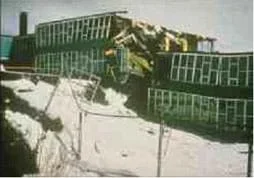 Figure 2. Severe earthquake damage to a school in Alaska.Copyright NOAA http://www.ngdc.noaa.gov/seg/hazard/slideset/5/ 5_slides.html
(Student activity: Have students line up to demonstrate the two types of body waves. For the P waves, or primary waves, have the first person bump shoulders with the person next in line, who bumps shoulders with the next person and so on. This demonstrates a compression wave. Go outside or into a gymnasium space to demonstrate S waves with a [gentle] game of snap the whip. Have students line up and hold hands. The first person in line runs first in one direction and then back to make the line look and move like a long snake.)
Civil engineers focus on how to make buildings and other structures more robust to withstand earthquakes — and other natural events — and reduce the loss of life and property damage. Can you imagine the consequences if the Hoover Dam in Boulder City, Nevada, cracked and crumbled apart as a result of an earthquake? The repercussions of such a disaster would be enormous! Engineers work hard to protect humans from the impacts of an earthquake and take this and similar challenges very seriously. So much so that they have designed high-tech monitoring equipment to accurately predict and measure earthquakes. In fact, engineers are continually refining and enhancing such equipment to make it better and even more accurate. Additionally, they test and research better materials and methods to make structures withstand an earthquake's tremendous force. For example, engineers have solved some damage to buildings by developing shock absorbers. These isolate the foundation of a building from the ground so the building and the earth move independently of each other.
How did your structure survive the earthquake? (Listen to student stories about how their model structures stood up to the Jell-O® earthquake. Review earthquake damage.) Are all earthquakes the same strength? Can you feel every earthquake? How do we measure earthquakes? (Review the way earthquakes are measured using the Mercalli and Richter Scales.)
Where on Earth do earthquakes happen? (Answer: Earthquakes can occur anywhere on Earth.) Where do most earthquakes occur? (Answer: Around the boundaries of tectonic plates.) What are engineers are doing to help humans survive earthquakes? (Answer: They are creating instruments for improved prediction and warning. They are designing safer structures that can better resist earthquakes). Give me some examples of what you could tell a friend or family member about earthquakes. What advice would you give to someone who lives or visits an earthquake-prone area?
- aftershocks
- Shocks or tremors that occur after an earthquake. Aftershocks can cause as much or more damage than the earthquake itself.
- body waves
- Waves that emanate from the focus of an earthquake that travel underground. Includes P waves and S waves.
- compression waves
- Waves that travel by compressing molecules.
- epicenter
- The point on the Earth's surface directly above the focus or origin of the earthquake.
- fault
- A crack in the rock, caused by movement of the Earth's crust.
- focus
- The point under the surface of the Earth where an Earthquake begins.
- tectonic plate
- Section of the Earth's crust.
- magma
- Molten or melted rock from the Earth's mantle.
- megathrust
- An earthquake that occurs when one tectonic plate subducts beneath another. Megathrust earthquakes often generate large tsunamis that cause damage over a much wider area than is directly affected by ground shaking near the earthquake's rupture.
- mercalli scale
- A scale from I to XII that measures the amount of damage sustained in an earthquake.
- p waves
- Primary body waves, which travel from the focus of an earthquake. These are compression waves.
- pacific plate
- A tectonic plate underlying the Pacific Ocean.
- primary waves
- The first body waves which travel from the focus of an earthquake. P waves are compression waves.
- richter scale
- A scale from 1 to 9 that measures the strength of an earthquake.
- ring of fire
- The area around the Pacific Plate where many earthquakes and volcanic eruptions occur.
- s waves
- The slower secondary body waves that cause side-to-side movement.
- san andreas fault
- The 800 mile long fault along the edge of the Pacific Plate that runs under California, Washington and Alaska.
- secondary waves
- S waves or body waves which cause side-to-side movement.
- seismograph
- An instrument that measures how much the ground shakes or vibrates in an earthquake.
- seismogram
- A zig-zag line created by vibrations read from a seismograph caused by body waves.
- surface waves
- Waves that emanate from the epicenter of an earthquake which cause little damage.
- tsunami
- A series of ocean waves generated by any rapid large-scale disturbance of the sea water. Most tsunamis are generated by earthquakes, but they may also be caused by volcanic eruptions, landslides, undersea slumps or meteor impacts.
Pre-Lesson Assessment
Formation: Have students line up to demonstrate the two types of body waves. Demonstrate P waves, or primary waves, by the first person bumping shoulders with the person next in line, who bumps shoulders with the next person and so on. This demonstrates a compression wave. Go outside or in a bigger area to demonstrate S waves with a (gentle) game of snap the whip. Have the children line up and hold hands. The first person in line runs first in one direction and then back to make the line look and move like a long snake.
Discussion Questions: solicit, summarize, and integrate student responses
- What could happen to a city when there is an earthquake?
- What could happen to our school if there was an earthquake?
- What would we do should an earthquake occur? (Review safety information for an earthquake or have students brainstorm ways to help a city in crisis. For more information see Lesson Extension section.)
Post-Introduction Assessment
Question/Answer: Ask questions and have students raise their hands to respond.
- Where do most earthquakes occur? (Answer: Around the boundaries of tectonic plates.)
- Can humans cause an earthquake? (Answer: Yes. For example, pumping wastewater in to the ground, and building large dams, such as the Hoover Dam and the Aswain High Dam have caused earthquakes due to the pressure of the water.)
- What are two types of body waves that travel underground in an earthquake? (Answer: P and S waves.)
- Which type of wave moves back and forth like a whip? (Answer: S waves.)
- Is there any way to make buildings safer from an earthquake? (Answer: One way engineers reduce building damage is to design shock absorbers for buildings so that the building foundation is isolated from the ground, which allows the building and the earth to move independently of each other.)
Lesson Summary Assessment
Earthquake Acrostic Poem: To encourage students to synthesize and evaluate their learning, have them write an acrostic poem. Have them write the word "earthquake" vertically on a piece of paper. Use each letter in the word as the first letter of a word or phrase that gives information on earthquakes. For example, E = earth, A = active movement, R = Richter scale, etc.
Engineering Poster: Using the skills they learned in the three lesson activities and the lesson on how earthquakes form, have students create a poster of a best design for a building that would withstand an earthquake. Have them title their posters with an engineering firm name that they make up. (Example: Shaky Engineering Firm). Have the students work in teams of four if possible.
Human Matching: On separate pieces of paper, write either the term or the definition of the vocabulary words listed above. Ask for volunteers from the audience to come up to the front of the room, and give each student one of the pieces of paper. Have all volunteers read what is written on their papers one at a time. Have the audience match term to definition by voting. Have students "terms" stand by their "definitions." At the end, review the concepts.
Have students research famous earthquakes and reports back to the class.
Have students mark a map with currently occurring earthquake locations. The information can be researched at the following website: http://www.ngdc.noaa.gov/hazard/slideset/earthquakes/.
Prepare and present a class lesson in earthquake preparedness. Obtain information from the Federal Emergency Management Agency (FEMA), P.O. Box 70274, Washington, DC 20024. Also available for teachers: Seismic Sleuths FEMA 159, Earthquakes – A Teacher's Package for K-6, (American Geophysical Union and the Federal Emergency Management Agency P.O. Box 70274, Washington, DC 20024).
Have students search the internet for information and images from an earthquake in history that was not discussed in class. Lead a small discussion of findings during the next class and have students show the class the pictures they found.
Clark, John, David Flint, Tony Hare, Keith Hare and Clint Twist. Encyclopedia of our Earth, New York: Shooting Star Press, 1995.
Ganeri, Anita. Science Questions and Answers: Earth Science. New York: Dillon Press, 1993.
Knapp, Brian. The Grolier Illustrated Library of the Environment. Earth, Danbury, CT: Grolier Educational Corporation, 1995.
Press, Frank and Raymond Siever. Understanding Earth, New York, NY: W.H. Freeman and Company, 1998.
Silverstein, Alvin, Virginia Silverstein and Laura Silverstein Nunn. Plate Tectonics. Brookfield, CT: Twenty-First Century Books, 1998.
Walters, Martin and Felicity Trotman. A Prentice Hall Illustrated Dictionary. Earth Sciences. New York: Prentice Hall General Reference, 1991.
World Book. Young Scientist: Planet Earth. Water. Chicago: World Book, Inc., 1991.
Modified Mercalli Scale: http://www.abag.ca.gov/bayarea/eqmaps/doc/mmi.html
Contributors
Jessica Todd; Melissa Straten; Malinda Schaefer Zarske; Janet Yowell
Supporting Program
Integrated Teaching and Learning Program, College of Engineering, University of Colorado Boulder
Acknowledgements
The contents of this digital library curriculum were developed under a grant from the Fund for the Improvement of Postsecondary Education (FIPSE), U.S. Department of Education and National Science Foundation GK-12 grant no. 0338326. However, these contents do not necessarily represent the policies of the Department of Education or National Science Foundation, and you should not assume endorsement by the federal government.
Copyright
2004 by Regents of the University of Colorado.