
All About Landslides: Land on the Run
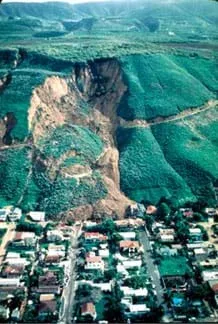 La Conchita, CA, landslide site, spring 1995.Copyright R.L. Schuster, U.S. Geological Survey http://pubs.usgs.gov/of/2001/ofr-01-0276/.
Students learn about landslides, discovering that there are different types of landslides that occur at different speeds — from very slow to very quick. All landslides are the result of gravity, friction and the materials involved. Both natural and human-made factors contribute to landslides. The interactions and different severity of these variables are demonstrated in the associated activity where students learn how scientists are studying landslides and current efforts to prevent them.
Landslides can be deadly and destructive to people and property. Engineers work with scientists to determine locations at which landslides might occur, how to minimize the damage, and how to prevent the actions of people from contributing to landslides. Engineers also design test facilities to simulate and study landslide characteristics, develop measuring devices to study real-world landslides, model landslides with computer simulations, and design structures to channel existing landslides around/under existing human-made structures such as buildings and highways.
After this lesson, students should be able to:
- Describe the basic characteristics of a landslide.
- Relate that gravity and friction are major factors in landslides.
- Explain several contributors to landslides: heavy rain, runoff water, earthquakes, human activities, forest fires, etc.
- List several ways that engineers reduce the danger and destruction of landslides.
- Develop and communicate an evidence based scientific explanation around one or more factors that change Earth's surface
Grade 5
Do you agree with this alignment?
- CCC.8.3-5.8 Engineers improve existing technologies or develop new ones to increase their benefits, to decrease known risks, and to meet societal demands.
Grades 3-5
Do you agree with this alignment? - DCI.ESS3.B.3-5.3 A variety of hazards result from natural processes (e.g., earthquakes, tsunamis, volcanic eruptions). Humans cannot eliminate the hazards but can take steps to reduce their impacts.
Grade 4
Do you agree with this alignment? - SEP.11.2 Science explanations describe the mechanisms for natural events.
Grade 5
Do you agree with this alignment?
A basic understanding of gravity and friction is critical to understanding landslides. A familiarity with geological events (volcanic eruptions, earthquakes and tsunamis) is helpful to understanding landslide causes and effects.
Use the Landslide Images PowerPoint presentation (PPT) as a helpful classroom tool. Show the PowerPoint presentation, or print out the slides to use with an overhead projector.
Landslides are a significant geologic hazard throughout many parts of the world, causing massive debris flows that impact people and property (see Figure 3). The U.S. Geological Survey defines landslides as the downslope movement of rock, soil or artificial fill under the influence of gravity. Landslides occur when the balance between the pull of gravity on material on a slope and the forces (friction and strength of material) acting to hold it in place is upset by some change. These changes, or triggers, are commonly either increased water content or rearrangement of the load on the slope. Earthquakes are also common triggers of landslides in many parts of the world.
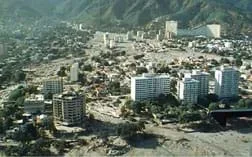 Figure 3. Massive amounts of sediment were deposited throughout the urban community of Caraballeda, Venezuela in December 1999 by floods and debris flows.Copyright U.S. Geological Survey http://pr.water.usgs.gov/public/venezuela.
Landslides can occur at an imperceptible rate, with the land matter moving only centimeters per year. Or, landslides can be very rapid, with land matter traveling at tens of meters per second. They have the power to move virtually anything in their path. Although landslides are primarily associated with mountainous regions, they can also occur in areas of generally low relief. In low-relief areas, landslides occur as human-caused cut-and-fill failures (roadways and building excavations, river bluff failures, lateral spreading landslides, collapse of mine-waste piles [especially coal], and a wide variety of slope failures associated with quarries and open-pit mines).
Landslide Triggers
Landslides occur when there is compromise in the stability of the land formation, or a trigger. Triggers can be naturally-occurring, human-made or a combination of the two:
- Removal of support: Removal of material from either erosion or excavation at the base of a slope that previously supported upslope material can reduce stability resulting in an immediate or eventual landslide.
- Removal of vegetation: Vegetation absorbs moisture and root structures increase soil stability. Consequently, forest fires and clear-cutting increase the risk of landslides.
- Addition of moisture: The addition of moisture is the most common cause of landslides. Some soils (such as clay) are hard when dry, but transform into soft mud when moisture is added. This reduces the shear strength of the soil and can result in landslides. Also, water pressure within the porosity of a soil has the effect of "inflating" the pore spaces and reducing the frictional forces between soil particles. This loss of friction can result in a rapid landslide.
- Addition of weight: Any additional weight at the top of a slope, including water, equates to increased force that the slope must support. If the added weight exceeds the shear strength or increases the pore pressure of the soils below, landslides result.
- Oversteepening: The addition of material to the top of a slope can increase the angle that the slope can support (angle of repose). Often, human-caused erosion, excavation or grading results in slopes that exceed the angle of repose.
- Vibrations: Movement from vibrations can instantaneously separate materials from each other, reducing friction and triggering a landslide. These vibrations can occur from earthquakes, blasting, heavy equipment and loud noises.
Types of Landslides
Landslides are described and classified in various ways depending upon the material(s) involved, mode of movement, rate of movement, and the water, air or ice content of the landslide material (see Figure 4).
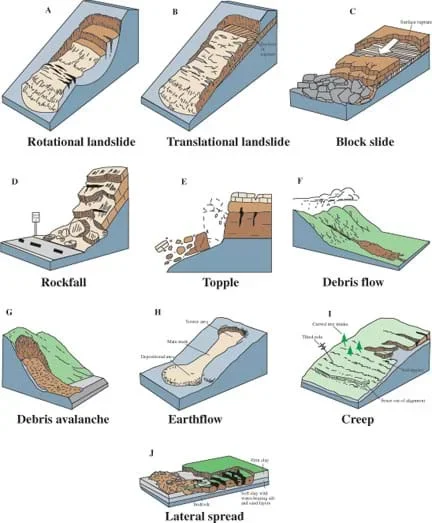 Figure 4. Major types of landslide movements.Copyright U.S. Geological Survey http://pubs.usgs.gov/cfs/2004/3072/
Engineering Applications
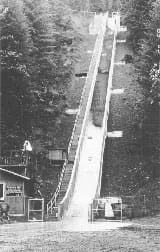 Figure 5. The USGS-CVO Debris-Flow Flume in Oregon provides a laboratory for the study of landslides.Copyright U.S. Geological Survey http://vulcan.wr.usgs.gov/Projects/MassMovement/Publications/OFR92-483/OFR92-483_inlined.html
- Debris chute for studying landslide dynamics: (This is the basis for this lesson's demonstration and activity) Since it is difficult to observe and measure real landslides, the U.S. Geological Survey engineers and scientists constructed a scale model flume in Oregon to conduct controlled experiments on debris flows. The flume (see Figure 5), is a concrete channel 95 m (310 ft) long, 2 m (6.6 ft) wide, and 1.2 m (4 ft) deep that slopes 31° (60%), an angle typical of terrain in which natural debris flows originate. Big bolts and concrete pads anchor it to the soil and rock. This debris flow flume recreates perhaps the most dangerous types of landslides and mudslides, those that end in an alluvial fan (see Figure 3). To create a debris flow, a variety of materials (soil, rocks, gravel) are placed behind a steel gate at the top, saturated with water and released. Sensors in the flume floor measure sliding and colliding forces in the flows. Windows in the side of the flume allow flows to be observed and photographed as they sweep past. Measurements from this experimental debris flow help engineers create computer models to forecast debris-flow behavior and develop technologies to mitigate the destructive effects of debris flow from landslides.
- Debris flume to redirect flow: An excellent example of landslide prevention by redirection may be found in British Columbia, Canada, where a debris chute resulted in multiple landslides that obstructed a highway. To protect the highway from future landslides; engineers built a retention structure to channel the landslide around the houses and under the highway (essentially a landslide underpass; see Figure 6-left). To do this, the stream bed was cleared, straightened and deepened to guide the debris flow.
- Smart boulder: Engineers designed an instrumented "smart boulder" (or "dumpling" as it is sometimes called) to gather information on the vigorous conditions within debris flows. The .3 m-diameter, 20 mm-thick, steel-walled instrument can monitor 3D accelerations, impact force, vibrational force, pressures and temperature conditions as it is carried in debris flows. Since flume experiments and mathematical models have limitations, studying full-scale debris flows collects data to validate and improve computer models, reducing the scaling effects of small-experiments.
- Computer modeling to determine stability during earthquakes: A real or hypothesized landslide-prone slope can be modeled with different earthquake scenarios to determine whether a landslide would be probable under given conditions.
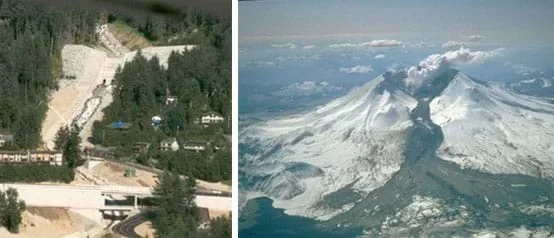 Figure 6. (left) Debris flow defensive structure at Howe Sound, BC, Canada. (right) Following the 1982 eruption of Mt. St. Helens, WA, melting snow and ice triggered a lahar (dark flow over the snow) that traveled down the flank of the mountain, into a lake and river.Copyright (left) Geology Department, Malaspina University-College, British Columbia, Canada Used with permission. (right) U.S. Geological Survey / Cascades Volcano Observatory. http://mala.bc.ca/~earles/howesound/ http://vulcan.wr.usgs.gov/Volcanoes/MSH/Images/mudflow_images.html
Relationship to Other Natural Disasters
- Earthquakes are the most common trigger for landslides.
- Landslides often coincide with torrential downpours of rain or massive snowmelt runoffs -conditions that often trigger flooding.
- Wildfires can also be a direct cause of landslides. The removal of vegetation from slopes decreases the stability of the soil because root structures that provide soil stability and absorb water are missing.
- Coastal landslides and underwater landslides can cause tsunamis.
- Volcanic eruptions can trigger massive landslides. One of the largest in U.S. history was a massive debris flow that resulted from a Mount St. Helens eruption (see Figure 6-right). Volcanic landslides are often referred to as lahars.
- An avalanche is a landslide involving a large amount of ice, snow and rock falling quickly down the side of a mountain.
How many of you like to slide down sliding boards (or slides) on the playground? So, what makes you slide down the sliding board? (Possible answers: It is slippery, it is steep, gravity pulls you towards the ground.) Has anyone ever been sledding? Or slid down a hill covered in wet grass or mud? The same thing happened to you each in these cases — it was slippery (water reduces friction) and gravity pulled you down the hill. How did you get started? Did you run and then slide, or did someone push you?
Has anyone heard of a landslide? It is a long word made up of two shorter words — land and slide. What do you think it means? Just like you slid down the sliding board, smaller pieces of land (such as sand, gravel, dirt and rock) can slide down hills, too.
Who likes to play in sandboxes or in the sand on the beach? Have you ever made your own mountain of sand and tried to dig a tunnel through it? What happens? (The sand keeps sliding down and trying to fill the hole as you dig.) This is a good example of how some landslides work.
Classroom Demonstration:
(optional, materials and instructions provided in the Mini-Landslide Activity in this lesson and unit) The debris flow flume classroom demonstration (see Figure 1) is a small-scale model of the U.S. Geological Survey debris flow flume (see Figure 5 and report in the References section). In this lesson, we refer to it as the mini-landslide tester.
 Figure 1. Mini-landslide tester activity setup.Copyright 2005 Tim Nicklas, ITL Program, College of Engineering, University of Colorado at Boulder
Position the slide so it is nearly horizontal and place a scoop of moist sand at the top of the chute. Tell the students that this represents material on top of a hill that could potentially slide. Place a miniature house in the tub in the path of the landslide. Increase the angle and ask students to guess when they think it will slide, and whether or not it will hit the small houses in the path below.
Repeat the demonstration, raising the slide to almost as steep an angle as before and asking the students what factors they think may trigger a landslide. One answer is earthquakes, so shake the slide to trigger the landslide. Another answer is heavy rain or runoff water. If the students do not come up with the answer of water immediately, ask them if they have ever slid on a Slip'n'Slide (plastic sheet sprayed with water from a sprinkler or hose). To demonstrate this, add a cup of water to the sand. Observe the extent of the landslide in each instance. Explain that the water both adds weight to the material and reduces friction (just like water reduces friction on the Slip'n'Slide)
The same thing happens to land on hillsides and mountainsides everywhere on our planet. Landslides and mudslides can be very dangerous (to wildlife, forests, people) and cause lots of property damage (to houses, roads) by the flow of debris. Landslides and mudslides are powerful and can move soil, gravel, rocks (see Figure 2), plants, trees, houses, cars, roads and people.
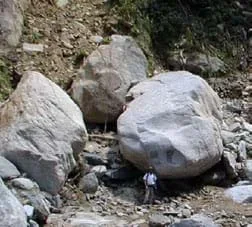 Figure 2. These huge boulders were transported by the December 1999 debris flows near La Guaira, Venezuela.Copyright U.S. Geological Survey http://pr.water.usgs.gov/public/venezuela.
Engineers carefully study landslides to figure out ways to protect people and property. This small model is similar to how engineers conduct experiments to see if real landslides would put nearby buildings in danger. In a forest in Oregon, they have a great big version of this slide that is as long as a football field, which they used as a model to experiment with landslides. It is important for us to know how landslides work because, just like the little model house that was hit by sand, whole cities have been buried by landslides.
Another way engineers study landslides is by making computer models of them. They use math and all of the information they collect from experiments to simulate (or model) landslides in different locations under different conditions. This is a lot easier than building a real one!
Another cool thing that engineers do to study landslides is build little boulders with all sorts of sensors in them. They place these special rocks in areas that experience landslides regularly. When a landslide occurs, the little boulder with the instruments records the distance, speeds and forces that the boulder experiences. In this way, engineers and scientists gather more data and see if the landslide and computer models are giving them the right answers.
In Canada, engineers determined that landslides were always occurring in one area, causing damage to local homes and blocking the highway. They came up with a solution to build a structure to channel the landslide around the houses and under the highway (see Figure 6). There are lots of ways that engineers help us understand and keep us safe from landslides! Students can conduct their own investigation with the Mini-Landslide activity to understand the properties and variables that affect them.
The landslides that we watched in the demonstration (and activity) happen very quickly. Some landslides take a long time, creeping along, centimeter by centimeter. They are not as dangerous to human lives, but they are just as destructive when it comes to destroying buildings and property. Gravity and friction are major factors in landslides. Gravity pulls the soil and dirt of a landslide down a slope that has become slippery. What are some things that affect gravity and friction in landslides? (Possible answers: Heavy rain, runoff water.)
Do you think that a landslide is more likely to occur on a hillside covered with trees and bushes, or one that is bare dirt? Hillsides with trees and shrubs are much more stable. The roots hold the earth in place and absorb lots of the water that makes landslides much worse. What do you think happens when people cut down all of the trees on a hillside, or a wildfire burns away all the trees and plants? That's right, landslides become much more likely. So imagine an area that just had a forest fire. If the fire is followed by a heavy rain, there is a good chance of a landslide. This cause-and-effect behavior of natural disasters happens all over the world. Just like forest fires, volcanoes and earthquakes can lead to landslides; landslides, in turn, can cause tsunamis.
What are engineers doing to keep us safe from natural disasters, such as landslides? Well, first, engineers study landslides in great detail. Then, they develop measurement tools to predict landslides, design buildings and structures that keep us safe, and design human-made structures (tunnels, roads, homes) that reduce the danger and destruction due to landslides and/or do not cause future landslides.
- avalanche
- A fall or slide of a large mass, as of snow or rock, down a mountainside.
- debris
- The scattered remains of something broken or destroyed; rubble or wreckage.
- debris flow
- A churning, water-saturated mass of rock, soil and organic matter that rushes down mountain slopes, typically originating as a landslide. (Source: USGS)
- erosion
- A group of natural processes by which material is worn away from the Earth's surface.
- friction
- Force that resists the relative motion or tendency to such motion of two bodies in contact.
- gravity
- The natural force of attraction exerted by a celestial body, such as Earth, upon objects at or near its surface, tending to draw them toward the center of the body.
- landslide
- The downward sliding movement of a relatively dry mass of earth, rock and/or other fill, under the influence of gravity.
- model
- (noun) A small object, usually built to scale, that represents in detail another, often larger object. (verb, as in computer modeling) To make a mathematical description of observed behavior (data, conditions, assumptions), for the purpose of predicting behavior.
- mudslide
- A landslide of mud (wet earth).
- mudflow
- A downhill movement of soft wet earth and debris, made fluid by rain or melted snow and often building up great speed.
- trigger
- An event that initiates a landslide.
- unstable vs. stable
- Whether or not a slope is prone to landslides.
Pre-Lesson Assessment
Know / Want to Know / Learn (KWL) Chart: Create a classroom KWL chart to help organize learning about a new topic. On a large sheet of paper or on the classroom board, draw a chart with the title "Landslides." Draw three columns titled, K, W and L, representing what students know about landslides, what they want to know about landslides and what they learned about landslides. Fill out the K and W sections during the lesson introduction as facts and questions emerge. Fill out the L section at the end of the lesson.
Post-Introduction Assessment
Question/Answer: Ask the students questions and have them raise their hands to respond. Write their answers on the board. Ask the students:
- What is a landslide? (Answer: It is when small pieces of land [such as sand, gravel, dirt and rock] slide down hills.)
- What are two things that affect landslides? (Answer: Gravity and friction.)
- What are some things that can cause or trigger a landslide? (Possible answers: Heavy rain, runoff water, earthquakes, something that shakes the land or makes it slippery, etc.)
- How do engineers work to keep us safe from landslides? (Answer: They build models of landslides to see if real landslides would put nearby buildings in danger, they build landslide detectors and sensors, and they develop buildings and structures that keep us safe from landslides.)
Lesson Summary Assessment
KWL Chart (Conclusion): As a class, finish column L of the KWL Chart as described in the Pre-Lesson Assessment section. List all of the things they learned about landslides. Were all of the W questions answered? What new things did they learn?
Safety Engineer: Have students use what they learned about landslides to create a safety brochure for people who want to move into a new community surrounded by mountains or tall hills. What safety tips would they give those people? Do they have suggestions for types of materials from which to build their homes? Have them include information on the types of soil that may affect the reach of a landslide. Have them title their posters with an engineering firm name that they make up (for example: Stable Soil Engineering Company).
Share examples of landslides that have occurred in the local area.
Avalanches are a type of landslide. Have students learn more about avalanches. What have engineers developed to detect them? What equipment is available for people who are caught in one?
Have students learn more about erosion and its ability to trigger a landslide.
Dictionary.com. Lexico Publishing Group, LLC., www.dictionary.com, accessed February 15, 2006. (Source of some vocabulary definitions, with some adaptation)
Hanisch, J., et al. "Dumpling – An "Intelligent" Boulder for Studying Internal Processes of Debris Flows." Proceedings, Third International Conference on Debris-Flow Hazards Mitigation, Davos, Switzerland, September 10-12, 2003. Rickenmann, Dieter & Chen, Cheng-lung editors, September 2003.
Highland, Lynn and Johnson, Margo. Landslide Types and Processes, Report Version 1.1. Fact Sheet 2004-3072, July 2004. Posted January 2006. U.S. Geological Survey, U.S. Department of the Interior. Accessed February 15, 2006. (pdf file) http://pbs.usgs.gov/fs/2004/3072/
Iverson, R.M., Costa, J.E. and LaHusen, R.G. Debris-Flow Flume at H.J. Andrews Experimental Forest, Oregon, USGS Open-File Report 92-483. Updated March 21, 2002. U.S. Geological Survey. Accessed February 15, 2006. http://vulcan.wr.usgs.gov/Projects/MassMovement/Publications/OFR92-483/OFR92-483_inlined.html
Lesson 5 – Landslides. Environmental Geology, Geology Education, Mansfield University, Mansfield, PA. Accessed February 15, 2006. http://www.geologyeducation.com/blackboard/lan/lanlessonsummer.html
Schuster, R.L., and Highland, L.M., 2001, Socioeconomic and Environmental impacts of landslides in the western Hemisphere: U.S. Geological Survey Open-File Report 01-0276. Accessed February 15, 2006. http://pubs.usgs.gov/of/2001/ofr-01-0276/
Video of La Conchita Slope Failure of 2005, 2005 Landslides Information. Last modified November 30, 2005. Landslides Hazards Program, U.S. Geological Survey, U.S. Department of the Interior. Accessed February 15, 2006. (Great video of land flowing like a liquid down a hillside). http://landslides.usgs.gov/recent/index.php
Contributors
Tim Nicklas; Malinda Schaefer Zarske; Denise W. Carlson
Supporting Program
Integrated Teaching and Learning Program, College of Engineering, University of Colorado Boulder
Acknowledgements
The contents of this digital library curriculum were developed under a grant from the Fund for the Improvement of Postsecondary Education (FIPSE), U.S. Department of Education and National Science Foundation GK-12 grant no. 0338326. However, these contents do not necessarily represent the policies of the Department of Education or National Science Foundation, and you should not assume endorsement by the federal government.
Copyright
2006 by Regents of the University of Colorado.