
Up, Up and Away! - Airplanes
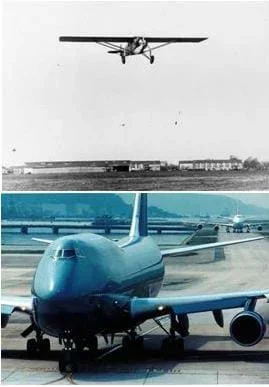 Students investigate airplanes and the science behind their movementCopyright Library of Congress; NASA Quest http://www.americaslibrary.gov/jb/jazz/jb_jazz_lindbergh_2_e.html http://quest.nasa.gov/aero/background/
The airplanes unit begins with a lesson on how airplanes create lift, which involves a discussion of air pressure and how wings use Bernoulli's principle to change air pressure. Following these lessons, students learn how airplanes are controlled and use paper airplanes to demonstrate these principles. Students learn about different kinds of airplanes and then design and build their own balsa wood airplanes based on what they have learned.
In designing airplanes, trains, cars, rockets and bicycles—nearly everything that moves through the air—engineers must understand Bernoulli's principle. The forces caused by moving air enable airplanes to fly and trains to slow. Engineers take advantage of the nature of air pressure so their designs of these and many other applications, function correctly, efficiently and safely. Engineers manipulate air pressure to create lift; they design wings so that the air moves faster over the top than under them, causing aircraft to lift during takeoff and during flight.
Weight is another important aspect of aircraft design that engineers take into consideration. Every additional part or piece on an airplane adds weight that makes it harder for it to overcome the force of gravity. So, when engineers design airplanes, they minimize weight when choosing materials and parts, while still assuring strength and safety. Engineers also design systems that create an action called thrust (utilizing Newton's third law of motion). To create thrust, engineers may use propellers, jets or rockets; the heavier the airplane, the more thrust required to move it.
When designing airplanes, engineers also keep in mind the force of drag and the principle of energy conservation. Since drag slows down airplanes and makes them less efficient, the goal is to design planes that reduce drag. The process of iterative design helps engineers learn from the mistakes of previous designs. Engineers often build small-scale aircraft models to test how they fly, avoiding the expense of testing at full-size, and they experiment with many different designs to find the best one. Engineers also use computer models to test aspects of their designs before they build the real thing; this is less expensive, easier and quicker since they can learn from the mistakes on the small-size, inexpensive models.
Engineers take into consideration the purpose of the airplane when they design it. Over the years, engineers have advanced the design of airplanes so they are more sophisticated and specialized. Engineers also design aircraft support systems and structures, such as runways, airports and support vehicles.
When designing new airplanes, engineers follow the steps of the engineering design process, and use invention techniques such as brainstorming, to come up with new ideas. Since engineers almost always work in teams, the ability to work together to come up with ideas and solutions is important. Engineers share their thoughts and build upon each others' ideas to come up with creative design solutions.
- CCSS.Math.Content.6.NS.B.2 Fluently divide multi-digit numbers using the standard algorithm.
Grade 6
Do you agree with this alignment? - CCSS.Math.Content.6.NS.B.3 Fluently add, subtract, multiply, and divide multi-digit decimals using the standard algorithm for each operation.
Grade 6
Do you agree with this alignment? - CCSS.Math.Content.6.SP.B.4 Display numerical data in plots on a number line, including dot plots, histograms, and box plots.
Grade 6
Do you agree with this alignment?
- MS-ETS1-1 Define the criteria and constraints of a design problem with sufficient precision to ensure a successful solution, taking into account relevant scientific principles and potential impacts on people and the natural environment that may limit possible solutions.
Grades 6-8
This resource focuses on the following Three Dimensional Learning aspects of NGSS:
Science & Engineering Practices- Define a design problem that can be solved through the development of an object, tool, process or system and includes multiple criteria and constraints, including scientific knowledge that may limit possible solutions.Do you agree with this alignment?
Disciplinary Core Ideas- The more precisely a design task's criteria and constraints can be defined, the more likely it is that the designed solution will be successful. Specification of constraints includes consideration of scientific principles and other relevant knowledge that is likely to limit possible solutions.Do you agree with this alignment?
Crosscutting Concepts- The uses of technologies and any limitations on their use are driven by individual or societal needs, desires, and values; by the findings of scientific research; and by differences in such factors as climate, natural resources, and economic conditions.Do you agree with this alignment?
- All human activity draws on natural resources and has both short and long-term consequences, positive as well as negative, for the health of people and the natural environment.Do you agree with this alignment?
Do you agree with this alignment? - Define a design problem that can be solved through the development of an object, tool, process or system and includes multiple criteria and constraints, including scientific knowledge that may limit possible solutions.
- MS-ETS1-2 Evaluate competing design solutions using a systematic process to determine how well they meet the criteria and constraints of the problem.
Grades 6-8
This resource focuses on the following Three Dimensional Learning aspects of NGSS:
Science & Engineering Practices- Evaluate competing design solutions based on jointly developed and agreed-upon design criteria.Do you agree with this alignment?
Disciplinary Core Ideas- There are systematic processes for evaluating solutions with respect to how well they meet the criteria and constraints of a problem.Do you agree with this alignment?
Do you agree with this alignment? - Evaluate competing design solutions based on jointly developed and agreed-upon design criteria.
- MS-ETS1-4 Develop a model to generate data for iterative testing and modification of a proposed object, tool, or process such that an optimal design can be achieved.
Grades 6-8
This resource focuses on the following Three Dimensional Learning aspects of NGSS:
Science & Engineering Practices- Develop a model to generate data to test ideas about designed systems, including those representing inputs and outputs.Do you agree with this alignment?
Disciplinary Core Ideas- Models of all kinds are important for testing solutions.Do you agree with this alignment?
- The iterative process of testing the most promising solutions and modifying what is proposed on the basis of the test results leads to greater refinement and ultimately to an optimal solution.Do you agree with this alignment?
Do you agree with this alignment? - Develop a model to generate data to test ideas about designed systems, including those representing inputs and outputs.
- MS-PS2-2 Plan an investigation to provide evidence that the change in an object's motion depends on the sum of the forces on the object and the mass of the object.
Grades 6-8
This resource focuses on the following Three Dimensional Learning aspects of NGSS:
Science & Engineering Practices- Plan an investigation individually and collaboratively, and in the design: identify independent and dependent variables and controls, what tools are needed to do the gathering, how measurements will be recorded, and how many data are needed to support a claim.Do you agree with this alignment?
- Science knowledge is based upon logical and conceptual connections between evidence and explanations.Do you agree with this alignment?
Disciplinary Core Ideas- The motion of an object is determined by the sum of the forces acting on it; if the total force on the object is not zero, its motion will change. The greater the mass of the object, the greater the force needed to achieve the same change in motion. For any given object, a larger force causes a larger change in motion.Do you agree with this alignment?
- All positions of objects and the directions of forces and motions must be described in an arbitrarily chosen reference frame and arbitrarily chosen units of size. In order to share information with other people, these choices must also be shared.Do you agree with this alignment?
Crosscutting Concepts- Explanations of stability and change in natural or designed systems can be constructed by examining the changes over time and forces at different scales.Do you agree with this alignment?
Do you agree with this alignment? - Plan an investigation individually and collaboratively, and in the design: identify independent and dependent variables and controls, what tools are needed to do the gathering, how measurements will be recorded, and how many data are needed to support a claim.
The following schedule provides a suggested order of the lessons and activities. However, you may choose to only teach some of the activities – as your time and priorities permit.
- Can You Take the Pressure? lesson
- Fun with Bernoulli activity
- Air Pressure activity
- May the Force Be with You: Lift lesson
- Windy Tunnel activity
- May the Force Be With You: Weight lesson
- Bend That Bar activity
- Physics Tug of War activity
- May the Force Be With You: Thrust lesson
- Equal & Opposite Thrust in Aircraft: You’re a Pushover! activity
- May the Force Be With You: Drag lesson
- What a Drag! activity
- Take Off with Paper Airplanes lesson
- Building-Testing-Improving Paper Airplanes: Head’s Up! activity
- Airplane Tails & Wings: Are You in Control? lesson
- Better By Design activity
- Airplanes Everywhere: Land! Water! Sky! Oh, My! lesson
- Let's Get It There Fast activity
- Will It Fly? lesson
- Balsa Glider Competition activity
- Future Flights: Imagine Your Own Flying Machines! lesson
- Day 22: Design a Flying Machine activity
- Up, Up and Away! - Airplanes
- Can You Take the Pressure?
- May the Force Be with You: Lift
- May the Force Be with You: Weight
- May the Force Be with You: Thrust
- May the Force Be with You: Drag
- Take Off with Paper Airplanes
- Airplane Tails & Wings: Are You in Control?
- Airplanes Everywhere: Land, Water, Sky, Oh My!
- Will It Fly?
- Future Flights: Imagine Your Own Flying Machines!
Supporting Program
Integrated Teaching and Learning Program, College of Engineering, University of Colorado Boulder
Acknowledgements
The contents of this digital library curriculum were developed under grants from the Fund for the Improvement of Postsecondary Education (FIPSE), U.S. Department of Education and the National Science Foundation (GK-12 grant no. 0338326). However, these contents do not necessarily represent the policies of the Department of Education or National Science Foundation, and you should not assume endorsement by the federal government.
Copyright
2009 by Regents of the University of Colorado