
Make It Clean! Engineering a Multipurpose Cleaning Product
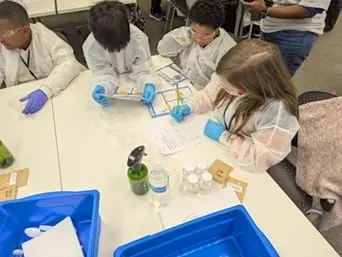 Students work on planning their products.Copyright D. Abascal
Students take on the roles of product designers, chemists, and problem solvers to create an eco-friendly, nontoxic cleaning product for a community co-op. Students investigate how cleaners work, explore the effectiveness of natural ingredients, and examine the health and environmental impacts of traditional chemical-based products. Working collaboratively in teams, they use the engineering design process to research, design, test, and refine their own cleaning formulations using safe, natural materials. To complete the challenge, students design sustainable packaging and develop branding elements, including a product name, logo, and label, to effectively communicate the benefits and environmental responsibility of their cleaner.
Chemical engineers design and improve products that involve chemical processes and formulations, including everyday items such as cleaning products, soaps, detergents, cosmetics, and medicines. They work to select safe and effective ingredients, control chemical reactions, and optimize mixtures to achieve specific product properties such as cleaning power, safety, scent, and environmental impact. In the design of eco-friendly, nontoxic cleaning products, chemical engineers play a critical role by developing formulations that effectively remove dirt and stains while minimizing harm to human health and the environment.
After this activity, students should be able to:
- Describe green chemistry and sustainability principles.
- Demonstrate hands-on skills in product development, testing, and problem solving.
- Practice teamwork, creativity, and communication by presenting the project and working collaboratively.
CCSS.Math.Content.7.EE.B.3 Solve multi-step real-life and mathematical problems posed with positive and negative rational numbers in any form (whole numbers, fractions, and decimals), using tools strategically. Apply properties of operations to calculate with numbers in any form; convert between forms as appropriate; and assess the reasonableness of answers using mental computation and estimation strategies.
Grade 7
Do you agree with this alignment?CCSS.Math.Content.7.RP.A.3 Use proportional relationships to solve multistep ratio and percent problems.
Grade 7
Do you agree with this alignment?
STEL-3G Explain how knowledge gained from other content areas affects the development of technological products and systems.
Grades 6-8
Do you agree with this alignment?STEL-7Q Apply the technology and engineering design process.
Grades 6-8
Do you agree with this alignment?STEL-7T Assess design quality based upon established principles and elements of design.
Grades 6-8
Do you agree with this alignment?
MS-ESS3-3 Apply scientific principles to design a method for monitoring and minimizing a human impact on the environment.
Grades 6-8
This resource focuses on the following Three Dimensional Learning aspects of NGSS:
Science & Engineering Practices- Apply scientific principles to design an object, tool, process or system.Do you agree with this alignment?
Disciplinary Core Ideas- Human activities have significantly altered the biosphere, sometimes damaging or destroying natural habitats and causing the extinction of other species. But changes to Earth's environments can have different impacts (negative and positive) for different living things.Do you agree with this alignment?
Crosscutting Concepts- The uses of technologies and any limitations on their use are driven by individual or societal needs, desires, and values; by the findings of scientific research; and by differences in such factors as climate, natural resources, and economic conditions. Thus technology use varies from region to region and over time.Do you agree with this alignment?
- Relationships can be classified as causal or correlational, and correlation does not necessarily imply causation.Do you agree with this alignment?
Do you agree with this alignment?- Apply scientific principles to design an object, tool, process or system.
MS-ETS1-1 Define the criteria and constraints of a design problem with sufficient precision to ensure a successful solution, taking into account relevant scientific principles and potential impacts on people and the natural environment that may limit possible solutions.
Grades 6-8
This resource focuses on the following Three Dimensional Learning aspects of NGSS:
Science & Engineering Practices- Define a design problem that can be solved through the development of an object, tool, process or system and includes multiple criteria and constraints, including scientific knowledge that may limit possible solutions.Do you agree with this alignment?
Disciplinary Core Ideas- The more precisely a design task's criteria and constraints can be defined, the more likely it is that the designed solution will be successful. Specification of constraints includes consideration of scientific principles and other relevant knowledge that is likely to limit possible solutions.Do you agree with this alignment?
Crosscutting Concepts- The uses of technologies and any limitations on their use are driven by individual or societal needs, desires, and values; by the findings of scientific research; and by differences in such factors as climate, natural resources, and economic conditions.Do you agree with this alignment?
- All human activity draws on natural resources and has both short and long-term consequences, positive as well as negative, for the health of people and the natural environment.Do you agree with this alignment?
Do you agree with this alignment?- Define a design problem that can be solved through the development of an object, tool, process or system and includes multiple criteria and constraints, including scientific knowledge that may limit possible solutions.
MS-ETS1-2 Evaluate competing design solutions using a systematic process to determine how well they meet the criteria and constraints of the problem.
Grades 6-8
This resource focuses on the following Three Dimensional Learning aspects of NGSS:
Science & Engineering Practices- Evaluate competing design solutions based on jointly developed and agreed-upon design criteria.Do you agree with this alignment?
Disciplinary Core Ideas- There are systematic processes for evaluating solutions with respect to how well they meet the criteria and constraints of a problem.Do you agree with this alignment?
Do you agree with this alignment?- Evaluate competing design solutions based on jointly developed and agreed-upon design criteria.
MS-ETS1-3 Analyze data from tests to determine similarities and differences among several design solutions to identify the best characteristics of each that can be combined into a new solution to better meet the criteria for success.
Grades 6-8
This resource focuses on the following Three Dimensional Learning aspects of NGSS:
Science & Engineering Practices- Analyze and interpret data to determine similarities and differences in findings.Do you agree with this alignment?
Disciplinary Core Ideas- There are systematic processes for evaluating solutions with respect to how well they meet the criteria and constraints of a problem.Do you agree with this alignment?
- Sometimes parts of different solutions can be combined to create a solution that is better than any of its predecessors.Do you agree with this alignment?
- Although one design may not perform the best across all tests, identifying the characteristics of the design that performed the best in each test can provide useful information for the redesign process—that is, some of the characteristics may be incorporated into the new design.Do you agree with this alignment?
Do you agree with this alignment?- Analyze and interpret data to determine similarities and differences in findings.
MS-ETS1-4 Develop a model to generate data for iterative testing and modification of a proposed object, tool, or process such that an optimal design can be achieved.
Grades 6-8
This resource focuses on the following Three Dimensional Learning aspects of NGSS:
Science & Engineering Practices- Develop a model to generate data to test ideas about designed systems, including those representing inputs and outputs.Do you agree with this alignment?
Disciplinary Core Ideas- Models of all kinds are important for testing solutions.Do you agree with this alignment?
- The iterative process of testing the most promising solutions and modifying what is proposed on the basis of the test results leads to greater refinement and ultimately to an optimal solution.Do you agree with this alignment?
Do you agree with this alignment?- Develop a model to generate data to test ideas about designed systems, including those representing inputs and outputs.
MS-PS1-3 Gather and make sense of information to describe that synthetic materials come from natural resources and impact society.
Grades 6-8
This resource focuses on the following Three Dimensional Learning aspects of NGSS:
Science & Engineering Practices- Gather, read, and synthesize information from multiple appropriate sources and assess the credibility, accuracy, and possible bias of each publication and methods used, and describe how they are supported or not supported by evidence.Do you agree with this alignment?
Disciplinary Core Ideas- Each pure substance has characteristic physical and chemical properties (for any bulk quantity under given conditions) that can be used to identify it.Do you agree with this alignment?
- Substances react chemically in characteristic ways. In a chemical process, the atoms that make up the original substances are regrouped into different molecules, and these new substances have different properties from those of the reactants.Do you agree with this alignment?
Crosscutting Concepts- Structures can be designed to serve particular functions by taking into account properties of different materials, and how materials can be shaped and used.Do you agree with this alignment?
- Engineering advances have led to important discoveries in virtually every field of science, and scientific discoveries have led to the development of entire industries and engineered systems.Do you agree with this alignment?
- The uses of technologies and any limitations on their use are driven by individual or societal needs, desires, and values; by the findings of scientific research; and by differences in such factors as climate, natural resources, and economic conditions. Thus technology use varies from region to region and over time.Do you agree with this alignment?
Do you agree with this alignment?- Gather, read, and synthesize information from multiple appropriate sources and assess the credibility, accuracy, and possible bias of each publication and methods used, and describe how they are supported or not supported by evidence.
Each group needs:
- (optional) laptop/tablet with internet access (for research)
- 1 Informational Sheets (PPTX) packet
- 1 bottle of water (17 fl. oz or smaller)
- 100 mL graduated cylinder (to measure water, vinegar, and alcohol)
- 100 mL vinegar
- 100 mL isopropyl alcohol (60-70%)
- 2 100 mL plastic bottles with caps
- 1 teaspoon
- 10 tsp baking soda (sodium bicarbonate)
- 10 tsp citric acid
- 2 small paper envelopes or bags (similar to this product: https://www.amazon.com/ESSENTIAL-Envelopes-Gummed-Envelope-Office/dp/B09X194G5G)
- 4-6 250 mL plastic cups or beakers (for mixing mixtures)
- 1 glass stir stick or metal spoon (reusable option) or 3-5 wooden stir sticks (disposable option)
- 1 mL of an essential oil (e.g., orange, lemongrass, rosemary, lavender)
- 1 Eppendorf vial (similar to this product: https://www.amazon.com/Microcentrifuge-Sterilized-Plastic-Storage-Without/dp/B0BBV68SZT)
- paper towels
- 1 white plastic plate (reusable option) or 3-5 white paper plates (disposable option)
- 1 spray bottle (clean and empty)
- 2 adhesive labels
Each student needs:
- 1 Activity Worksheet (PDF)
- 1 lab coat/apron
- 1 pair of safety glasses (goggles)
- 1 pair of latex-free disposable gloves
For the class to share:
- 1 laptop/tablet with projector to show the Make It Clean Presentation (PPTX)
- 1 bottle of ketchup (or another safe stain substance)
- various colored markers
Students should be familiar with metric units.
(Prepare and project the Make It Clean Presentation (PPTX) for the class to view.)
Today, you are not just students: You are product designers, chemists, and problem solvers. You have been hired by a community co-op that wants to stop using harsh chemical cleaners in homes, schools, and small businesses. They are counting on you to research and design a powerful, safe, and eco-friendly cleaning product.
But before we start designing, let’s think about why this matters. (Display Slide 2 of the Make It Clean Presentation (PPTX).) Why do we have to take care of water? (Let students offer answers.) Water is one of the most important resources on Earth. We drink it, cook with it, wash with it, and grow food with it, and ecosystems depend on it.
We know water is essential, but unfortunately human activities can pollute it. How do we pollute water every day? (Let students offer answers. Potential answers include plastics, oil, chemicals from factories and homes. Try to drive the answers toward cleaning supplies.) Those are great answers. What about everyday cleaning, like washing our hands or cleaning the counter? Every time we wash our hands, rinse dishes, or wipe down a counter, that water doesn’t just disappear. It travels through drains, pipes, and treatment systems and eventually returns to rivers, lakes, groundwater, and oceans.
That means whatever goes down the drain can end up in the environment. (Display Slide 3.) Many traditional cleaning products contain chemicals such as ammonia, chlorine bleach, synthetic fragrances, and phosphates. (Display Slide 4.) These ingredients can cause problems such as:
- Polluting rivers and lakes.
- Harming fish and aquatic life.
- Contributing to algae blooms that remove oxygen from water.
- Irritating human skin, lungs, and eyes.
- Triggering asthma or allergies for some people.
Engineers and chemists are working to solve this problem by designing cleaners that work well but are safer for people and the planet. Today, you will take on that challenge. How can we avoid water pollution? (Let students offer answers.)
(Display Slide 5.) Let’s start by thinking about this: What do you use to clean at home? What do you smell when someone sprays a cleaner on the counter? Have you ever gotten a headache, itchy eyes, or a cough after cleaning? Or even just walking into a room that was just cleaned?
Take 30 seconds. Turn to your neighbor and share one cleaning product you’ve seen or used, and how it made you feel—good, bad, or in-between. (Give time for discussion. Walk around and listen to student responses.)
Now let’s bring it back. What did you hear? Did anyone say that the cleaner smelled too strong or caused discomfort? Did anyone mention using homemade products, like vinegar and baking soda? (Take 1–2 student responses.) This is what real science and engineering is about, asking questions that matter to our lives and our communities.
(Display Slide 6.) Today you are going to investigate:
- What makes a cleaner work?
- Can natural ingredients clean just as well as chemicals?
- What’s the impact of those ingredients on our health and the planet?
- How can we design something that is good for both people and the environment?
We will explore natural ingredients such as vinegar, baking soda, and essential oils. You will test how well your products clean real messes. Then, you will design packaging that’s beautiful, biodegradable, and minimal-waste.
(Display Slide 7.) But we are not stopping at the science; you will also brand your product: create a name, logo, and label that explains why your cleaner is safe and effective.
Let’s start by generating some big questions together. I want you to think about your real life, your home, your community, and your environment.
Ask yourself:
- What kinds of cleaners are most used where I live?
- What concerns do people in my home have about cleaning products?
- Do I know anyone who has allergies or asthma?
- What ingredients do I recognize or not recognize on labels?
Let’s take a moment to write down one question or concern you have about cleaners, anything from health to the environment to how to get a stain off your sneakers. This will guide your research and help your team choose a product that really matters. (Let students write for a minute or two. Then invite a few to share.)
Background
Water pollution is a major environmental issue worldwide and affects both ecosystems and human health. Many sources contribute to water pollution, including industrial waste, agricultural runoff, plastics, and chemicals used in homes and businesses. Everyday products such as cleaning supplies, detergents, and disinfectants can contain chemicals that enter waterways when they are rinsed down drains. Even though wastewater treatment plants remove many contaminants, some chemicals can still pass through treatment systems and eventually reach rivers, lakes, and oceans. These substances may harm aquatic organisms, contribute to problems such as harmful algal blooms, and disrupt natural ecosystems. As a result, there is growing global awareness of how the products people use in daily life can affect water quality and environmental sustainability.
In response to these concerns, scientists and engineers are increasingly focused on developing cleaning products that are effective while also being safer for people and the environment. This approach is often connected to the principles of green chemistry, which encourage the design of products and processes that reduce or eliminate hazardous substances. Many eco-friendly cleaners use naturally derived ingredients such as vinegar, citric acid, or baking soda to break down grease, remove stains, or neutralize odors. These alternatives can reduce the environmental impact of household cleaning while still performing essential functions.
In this activity, the ingredients provided to students are safe for classroom use. However, like many substances used in chemistry, their properties can change when two or more materials are combined. For example, mixing certain ingredients can alter acidity, create reactions that release gas, or change the cleaning effectiveness of the solution. It is important that students carefully read the informational materials provided and consider the properties of each ingredient before designing their cleaner. By researching ingredients and making thoughtful decisions about mixtures, students practice the type of investigation and problem solving that engineers and chemists use when developing safer consumer products.
Before the Activity
- Make copies of the:
- Activity Worksheet (PDF) (1 per student).
- Informational Sheets (PPTX) (1 per group).
- Gather and prepare materials
- Measure and put 100 mL vinegar into a 100 mL bottle with cap (1 per group).
- Measure and put 100 mL isopropyl alcohol into a 100 mL bottle with cap (1 per group).
- Measure out 10 tsp baking soda and put into the paper envelope or bag (1 per group).
- Measure out 10 tsp citric acid and put into the paper envelope or bag (1 per group).
- Measure 1 mL of an essential oil) into 1 Eppendorf vial (1 per group).
- (optional) You can offer the students more than one essential oil; dose them into 1mL Eppendorf vials.
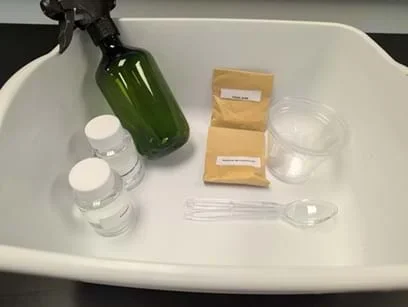 Materials available for student designs.Copyright D. Abascal
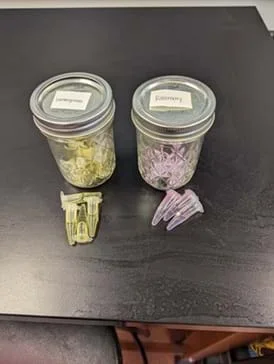 Essential oils available for student designs.Copyright D. Abascal
During the Activity
Ask (~10 minutes)
- Divide the students into groups of 2–3.
- Optional: Review laboratory safety expectations, emphasizing safe handling of all ingredients and proper cleanup procedures.
- Have students put on protective equipment, including goggles, gloves, and lab coats or aprons.
- Optional: Review the steps of the engineering design process.
- Distribute one Activity Worksheet (PDF)to each student.
- Present the design challenge and time constraints:
- Design, create, and test an eco-friendly, nontoxic cleaning product that effectively cleans surfaces while being safe for people and the environment.
- Remind students that this is a timed engineering design challenge, organized into research, planning, testing, and product development phases.
Research (~20 minutes)
- Optional: Give students time to use the internet to research the principles of green chemistry and the harmful effects of traditional chemical-based cleaners.
- Step 1: Understand and Test Materials
- Provide each group with the Informational Sheets (PPTX) packet.
- Allow students to read the informational sheets and discuss:
- Environmental and health impacts of traditional cleaners.
- Properties of natural cleaning ingredients such as baking soda, vinegar, citric acid, and essential oils.
- Instruct students to complete Step 1 of their Activity Worksheet (PDF) based on the Informational Sheets (PPTX) packet.
- Step 2: Experiment with Mixtures
- Have each group collect the materials for Step 2 of their Activity Worksheet (PDF).
- Remind students to handle all materials responsibly and return unused supplies.
- Give each group time to complete Step 2 and record their observations.
- Conduct an activity checkpoint:
- When finished with Steps 1 and 2 of the Activity Worksheet (PDF), have each group raise their hand or come to the front of the classroom to be checked.
- If each team member has correctly completed Steps 1 and 2, allow the students to move on to Part 3.
- If one or more group members have not yet completed their Steps 1 and 2, send the group back to finish.
Imagine and Plan (~10 minutes)
- Encourage teams to identify which ingredients may be most effective for their intended type of cleaner (e.g., all-purpose, glass, bathroom).
Students work on planning their products.Copyright D. Abascal
- Instruct students to brainstorm and plan their cleaning solution in Step 3 of their worksheet. Teams should:
- Decide on the type of cleaner they will design.
- Select natural, nontoxic ingredients based on their research.
- Predict how their formula will work and justify their ingredient choices.
- Direct students to document their initial plan and rationale on the Activity Worksheet (PDF) in Step 3.
Create and Test (~20 minutes)
- Have each group collect materials for their product, including measuring tools, ingredients, and cups.
- Remind students to handle all materials responsibly and return unused supplies.
- Direct each group to use one cup to test their chosen formulation.
- Give students 10 minutes to complete Step 4:
- Mix small test batches.
- Evaluate cleaning effectiveness by removing stains or residue from a test surface (e.g., ketchup on trays or plates). Note: To record the cleaning power of the cleaning mixtures, provide a disposable plate or a white plastic plate and smear ketchup on it. Students can test how effective the mixtures are in removing the stains from the plate. Reference the following Cleaning Power Reference Chart:
4
Completely Clean (No ketchup left)
3
Mostly Clean (Very small smudges left)
2
Somewhat Clean (Visible streaks/spots remain)
1
Barely Clean (A lot of ketchup still there)
0
No Change (Looks the same as before cleaning)
- Observe results such as stain removal, scent, residue, and ease of use.
- Have students reflect on their results by answering the questions in Step 4.
(Optional; if time allows) Improve
- Based on their results, have each group decide how to improve their product in Step 5.
- Monitor groups as they test, revise, and improve their formulas. Encourage teams to:
- Record observations and results in their worksheets.
- Adjust ingredient ratios to improve performance.
- Justify any design changes based on test data.
- Provide additional ingredients if needed and support student troubleshooting.
Final Product Marketing and Documentation (~30 minutes)
- Once each group has a formula they think works, have them work through Step 6 of the Activity Worksheet (PDF) to test their final cleaner on their worktable surface, or you may provide trays or plates with ketchup to ensure consistent testing conditions. Students should evaluate:
- Cleaning ability.
- Scent.
- Residue.
- Ease of application.
- Once teams finalize their formulation, instruct them to name their product and record the final recipe with its costs in Step 7 on their Activity Worksheet (PDF).
- Have each group then prepare a full batch in the spray bottle, labeling it temporarily with their group name and cleaner type.
- Instruct students to start Step 8 and begin working on their product labels.
- Remind students to create a slogan.
- Provide white labels and markers.
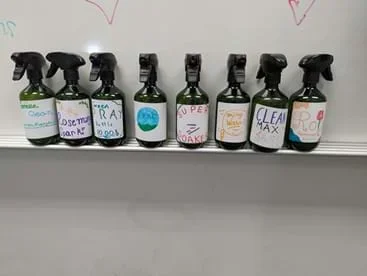 Students’ final products.Copyright D. Abascal
- Ask students to stop working and prepare their three-minute team presentations (Step 9). Each group should present:
- Their final formula and why they selected specific ingredients.
- How their product performed during testing.
- Why their cleaner is safe and environmentally friendly.
- Their packaging and branding strategy.
- Encourage clear communication, teamwork, and creative marketing approaches.
- Have each group give their presentation.
- Have students individually answer the reflection questions in Step 10 of the worksheet.
- Conclude the activity with a class discussion about the reflection questions.
- Optional: Have teams write a report detailing their formulation process, the testing results, and their approach to sustainability.
- acid
- A substance that can donate a hydrogen ion (H⁺) in a chemical reaction; often has a sour taste (e.g., vinegar, lemon juice).
- alkaline / base
- A substance that can accept a hydrogen ion (H⁺) in a chemical reaction; often has a bitter taste and slippery feel (e.g., baking soda).
- biodegradable
- A material that can be broken down naturally by bacteria or other living organisms, returning to the environment safely.
- chemical reaction
- A process in which substances (reactants) change into new substances (products) with different properties.
- citric acid
- A natural acid found in citrus fruits; often used in cleaning to help remove stains and mineral deposits.
- eco-friendly / green
- Products or practices that are safe for the environment and reduce harm to people and nature.
- environmental impact
- The effect a substance, activity, or product has on the natural environment, including air, water, and soil.
- essential oil
- A concentrated plant extract that gives fragrance and sometimes cleaning properties; used in small amounts.
- green chemistry
- The design of chemical products and processes that reduce or eliminate hazardous substances.
- innocuous
- Causing no injury or damage.
- mixture
- A combination of two or more substances that are not chemically bonded and can usually be separated.
- natural ingredient
- A substance that comes from plants, minerals, or animals rather than being made synthetically.
- nontoxic
- Safe for humans and animals; does not cause harmful health effects under normal use.
- ph
- A scale (0–14) that measures how acidic or basic a substance is.
- reaction rate
- The speed at which a chemical reaction occurs; can be influenced by temperature, concentration, or mixing.
- soluble
- Susceptible of being dissolved in or as if in a liquid, especially water.
- solution
- A mixture in which one substance (solute) is completely dissolved in another (solvent), such as sugar in water.
- toxicity
- The degree to which a substance can harm humans, animals, or the environment.
- volatile
- A substance that easily evaporates at room temperature, sometimes giving off strong odors (e.g., alcohol).
- waste reduction
- Actions taken to minimize the amount of material thrown away, especially harmful chemicals.
Pre-Activity Assessment
Probing Questions: Show the students the Make It Clean! Presentation (PPTX). Introduce the topic of water pollution and the importance of taking care of water in the Introduction and Motivation section. Ask students questions like:
- Why do we have to take care of water? (Potential answers: Water is one of the most important resources on Earth. We drink it, cook with it, wash with it, and grow food with it, and ecosystems depend on it.)
- How do we pollute water every day? (Potential answers include plastics, oil, chemicals from factories and homes.)
- How can we avoid water pollution? (Potential answers: Use eco-friendly or biodegradable cleaning products, reduce harmful chemicals in homes and businesses, properly dispose of chemicals instead of pouring them down drains, use natural cleaning ingredients, use smaller amounts of cleaning products, avoid dumping oil, paint, or chemicals into sinks or storm drains, recycle and properly dispose of plastics, reduce fertilizer and pesticide use, support environmentally friendly products and companies, educate others about protecting water systems.)
Wonder Question: Students write down one question or concern they have about cleaners, anything from health to the environment to how to get a stain off their sneakers. This will help guide student research and help students choose a product that really matters.
Activity Embedded (Formative) Assessment
Activity Checkpoint: Students pause to have pages 1 and 2 of their Activity Worksheet (PDF)reviewed. Each group shows their work to you so you can quickly check for required elements using a short checklist. If the pages are complete, approve them and immediately hand over labels and markers. If something is missing, give a brief corrective prompt so students can make the fix and return for a quick second check. This process ensures that students stay on track and have all the necessary information before moving on to designing and labeling their product.
Observation of Teamwork and Investigation: As students work through testing and improving their formulas, circulate around the room and observe group discussions, testing procedures, and data recording. Look for evidence that students are applying scientific reasoning, collaborating with teammates, and adjusting their designs based on results.
Post-Activity (Summative) Assessment
Product Presentations: Each group presents their cleaning product. As they present, collect their completed worksheet. If you choose to evaluate the presentation, add brief notes directly on the worksheet. If not, simply review the completed worksheet as a summative assessment. You can use the Summative Assessment Rubric (PDF)to assess the students.
- Skin and eye irritation:
- Citric acid, baking soda, and vinegar can cause mild irritation.
- Require goggles and gloves at all times when handling ingredients.
- Have students wash hands immediately after the activity.
- Inhalation or sensitivity to fumes:
- Vinegar and essential oils produce odors that can irritate some students.
- Ensure good ventilation or open windows if indoors.
- Isopropyl alcohol hazards (if used):
- Highly flammable → keep away from heat or open flames.
- Do not let students ingest it.
- Have students handle in small, measured amounts, under your supervision.
- Mislabeling or accidental ingestion:
- Clearly label all spray bottles as “Do Not Drink / Cleaning Solution.”
- Emphasize that these are not for consumption.
- Slips and falls:
- Clean up any spilled liquids immediately.
- Keep floor areas around workstations dry.
- Allergies or sensitivities:
- Ask students ahead of time if they are sensitive to fragrances, vinegar, or essential oils.
- Have alternative stations or allow omission of essential oils for sensitive students.
- Mixture doesn’t react as expected (e.g., fizzing, cleaning ability):
- Check ingredient ratios; too much water can dilute the reaction.
- Ensure that citric acid and baking soda are measured correctly so small amounts produce a noticeable reaction.
- Stir thoroughly; some ingredients may settle if not mixed well.
- Cleaner is too thick or too runny:
- Too thick → add small amounts of water gradually.
- Too runny → add more solid ingredient (baking soda or citric acid) carefully.
- Scent is too strong or weak:
- Adjust essential oil drops gradually; some oils are very concentrated.
- Remember: Less is safer, especially for students sensitive to fragrances.
- Stains not removed effectively:
- Ensure that the correct type of cleaner is being tested (all-purpose, glass, bathroom).
- Encourage students to adjust ingredient ratios based on observations.
- Test on the designated plate or tray; consistency matters for accurate evaluation.
- Messy or spilled mixtures:
- Use paper towels or spill trays immediately.
- Encourage students to clean up small spills as they occur to avoid cross-contamination.
Extensions (Deeper Learning Opportunities)
- User Testing
- Have students share their product with classmates or family members for feedback on its performance, scent, and ease of use. Record feedback to improve the final formula and design.
- Compare effectiveness:
- Have students compare their eco-cleaner against a small amount of a traditional chemical cleaner to measure performance differences.
- Quantitative analysis:
- Record data numerically and graph results (e.g., % of ketchup removed, scent rating, residue amount).
- Environmental impact study:
- Research environmental effects of the ingredients in traditional vs. natural cleaners.
- Discuss water pollution, biodegradability, and sustainability.
- Chemistry connections:
- Explore the chemical reaction between citric acid and baking soda.
- Investigate pH levels of mixtures and how acidity affects cleaning power.
- Engineering design iteration:
- Challenge students to design a “next-generation” cleaner based on test results.
- Encourage alternative formulations or packaging innovations.
Enrichment (For Advanced Students or Cross-Curricular Links)
- Marketing and business skills:
- Develop a full brand identity, including logo, slogan, and environmental messaging.
- Calculate the cost per batch of ingredients and discuss pricing strategy.
- STEM integration:
- Measure cleaning efficacy with more precise instruments (pH strips, conductivity meters, weight of removed residue).
- Use statistics to compare group results and determine “best formula” scientifically.
- Community impact project:
- Have students present their cleaner to another class, a school club, or a local community group.
- Discuss ways to implement eco-friendly cleaning in homes or businesses.
- Research extension:
- Investigate other natural cleaning agents (e.g., castile soap, hydrogen peroxide) and how they interact with baking soda or citric acid.
- Explore historical or cultural approaches to eco-cleaning.
- Smaller or larger groups:
- Reduce group size to 2 students for more hands-on experience per student.
- Increase group size to 3–4 for faster prep and fewer materials needed.
- Shorter sessions:
- Focus only on Steps 1–4 (research, test, improve) for a 45–60-minute lesson.
- Skip marketing and labeling if time is tight.
- Larger sessions:
- Include multiple test surfaces (glass, counters, mirrors) for more data collection.
- Allow groups to iterate formulas more than once to refine performance.
Contributors
Dulce Abascal
Supporting Program
Research Experience for Teachers (RET), Rice University Office of STEM Engagement
Acknowledgements
This curriculum was developed under National Science Foundation RET grant NSF EEC-2302127. Any opinions, findings, and conclusions or recommendations expressed in this material are those of the authors and do not necessarily reflect the views of the National Science Foundation.
Copyright
2026 by Regents of the University of Colorado; original © 2025 Rice University