
Unbeweavably Strong! Creating Strong Structures from Weak Materials
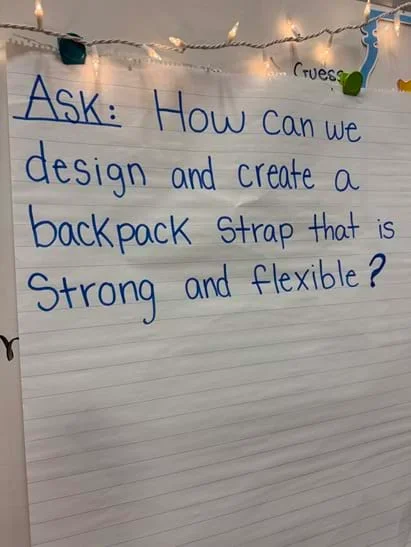 Design challengeCopyright Brennan Cruser
Students are introduced to the real-world problem of backpack straps breaking and the challenge of developing an eco-friendly strap to replace a broken strap. The goal is to use the engineering design process to develop a replacement strap using paper (a weak material) by changing its structure to make it strong enough to hold up to 7 kilograms, the recommended maximum mass for a fifth grader’s backpack. Students work through the design process to explore how structure affects strength while also considering eco-friendly solutions. Instead of throwing away a backpack and contributing to landfill waste, students focus on creative, sustainable ways to repair and reuse materials.
Engineers change the structure of materials to improve how they perform. Structural engineers design and test materials like metal cables to make bridges and buildings stronger and safer. Materials engineers work on a much smaller scale, changing the internal structure of material, even down to the arrangement of atoms, to improve properties such as strength, flexibility, and durability. When solving real-world problems, engineers think carefully about how structure affects function. They test different arrangements, patterns, and treatments to find the best combination. By changing a material’s structure, they can create solutions that meet the exact needs of a specific challenge or environment.
At the end of this activity, students should be able to:
- Describe how a change in the physical structure of a material can alter its physical properties.
- Design a simple experiment to test the effects of force on an object (in this case a strap made of paper).
- Develop a hypothesis.
- Identify and change the variables in an experiment.
- Graph the data from an experiment.
- CCSS.Math.Content.5.MD.B.2 Make a line plot to display a data set of measurements in fractions of a unit (1/2, 1/4, 1/8). Use operations on fractions for this grade to solve problems involving information presented in line plots.
Grade 5
Do you agree with this alignment?
- STEL-7I Apply the technology and engineering design process.
Grades 3-5
Do you agree with this alignment? - STEL-7J Evaluate designs based on criteria, constraints, and standards.
Grades 3-5
Do you agree with this alignment?
- 3-5-ETS1-1 Define a simple design problem reflecting a need or a want that includes specified criteria for success and constraints on materials, time, or cost.
Grades 3-5
This resource focuses on the following Three Dimensional Learning aspects of NGSS:
Science & Engineering Practices- Define a simple design problem that can be solved through the development of an object, tool, process, or system and includes several criteria for success and constraints on materials, time, or cost.Do you agree with this alignment?
Disciplinary Core Ideas- Possible solutions to a problem are limited by available materials and resources (constraints). The success of a designed solution is determined by considering the desired features of a solution (criteria). Different proposals for solutions can be compared on the basis of how well each one meets the specified criteria for success or how well each takes the constraints into account.Do you agree with this alignment?
Crosscutting Concepts- People's needs and wants change over time, as do their demands for new and improved technologies.Do you agree with this alignment?
Do you agree with this alignment? - Define a simple design problem that can be solved through the development of an object, tool, process, or system and includes several criteria for success and constraints on materials, time, or cost.
- 3-5-ETS1-2 Generate and compare multiple possible solutions to a problem based on how well each is likely to meet the criteria and constraints of the problem.
Grades 3-5
This resource focuses on the following Three Dimensional Learning aspects of NGSS:
Science & Engineering Practices- Generate and compare multiple solutions to a problem based on how well they meet the criteria and constraints of the design problem.Do you agree with this alignment?
Disciplinary Core Ideas- Research on a problem should be carried out before beginning to design a solution. Testing a solution involves investigating how well it performs under a range of likely conditions.Do you agree with this alignment?
- At whatever stage, communicating with peers about proposed solutions is an important part of the design process, and shared ideas can lead to improved designs.Do you agree with this alignment?
Crosscutting Concepts- Engineers improve existing technologies or develop new ones to increase their benefits, to decrease known risks, and to meet societal demands.Do you agree with this alignment?
Do you agree with this alignment? - Generate and compare multiple solutions to a problem based on how well they meet the criteria and constraints of the design problem.
- 3-5-ETS1-3 Plan and carry out fair tests in which variables are controlled and failure points are considered to identify aspects of a model or prototype that can be improved.
Grades 3-5
This resource focuses on the following Three Dimensional Learning aspects of NGSS:
Science & Engineering Practices- Plan and conduct an investigation collaboratively to produce data to serve as the basis for evidence, using fair tests in which variables are controlled and the number of trials considered.Do you agree with this alignment?
Disciplinary Core Ideas- Tests are often designed to identify failure points or difficulties, which suggest the elements of the design that need to be improved.Do you agree with this alignment?
- Different solutions need to be tested in order to determine which of them best solves the problem, given the criteria and the constraints.Do you agree with this alignment?
Do you agree with this alignment? - Plan and conduct an investigation collaboratively to produce data to serve as the basis for evidence, using fair tests in which variables are controlled and the number of trials considered.
- 5.7.B design a simple experimental investigation that tests the effect of force on an object in a system such as a car on a ramp or a balloon rocket on a string.
Grade 5
Do you agree with this alignment?
Each group needs:
- 1 laptop computer
- 1 pair of scissors
- Unbeweavably Strong Activity Packet (PDF) (1 per group or per student)
- Design Worksheet (PDF) (1 per student)
- Decision Matrix (PDF)(1 per group)
For the entire class to share:
- 1 scale
- 1 backpack or bag filled to a weight of 7 kg
- variety of paper (e.g., tissue, notebook, napkins, etc.)
- Product Pitch Instructions (docx)
- Product Pitch Instructions (pdf)
- Product Pitch Rubric (docx)
- Product Pitch Rubric (pdf)
- Unbeweavably Strong Activity Packet (docx)
- Unbeweavably Strong Activity Packet (pdf)
- Design Worksheet (docx)
- Design Worksheet (pdf)
- Needs and Constraints Exit Ticket (docx)
- Needs and Constraints Exit Ticket (pdf)
- Unbeweavably Strong Presentation (pptx)
- Unbeweavably Strong Presentation (pdf)
- Decision Matrix (docx)
- Decision Matrix (pdf)
- STEM Station 2nd and 3rd Grade (docx)
- STEM Station 2nd and 3rd Grade (pdf)
Students should have a basic understanding of the following:
- Experimental procedure (specifically variables and hypotheses)
- Measurement of mass
- Force
Think about how you got ready for school this morning. What did you need to remember to bring with you as you headed out for school? (Possible answers: I brought my binder; I had to remember to bring my homework.)
How did you bring those things to school? (Guide students to answer that they brought those items in their backpack.)
We all remembered to bring our backpacks to school with us. Did anyone have any problems with their backpacks this morning? Have you ever had problems in the past with your backpacks? (Possible answers: My problem is my backpack is too bulky and heavy; the zippers don’t work and get stuck.”)
How many of you have had your backpack strap break? What if you had problems with your backpack because the strap broke? Would you still use it? Could you still use it? (Possible answer: No, I can’t use it because it broke.)
If your strap broke, what would you do? (Student responses will vary, but some students may say that they would use the backpack with just one strap or take the items out of the backpack and carry them and throw the backpack away or just buy a new one).
What if it was your favorite Hello Kitty or Spider-Man backpack and you just couldn’t bear to throw it in the trash? Could we try to repair the strap? What would you repair it with? (Student responses will vary, but you may hear things like cloth, leather, etc.)
What would happen to your backpack if you simply threw it away and bought a new one? (Student responses will vary, but someone may bring up landfills.) Every year, 93 million tons of textiles (cloth items like backpacks) end up in landfills. The average person in the United States throws about 37 kg (81.5 lbs) of waste into landfills every year—about the mass of a 5th grader! Textiles take more than 200 years to decompose in landfills. How can we prevent your broken backpack from ending up in a landfill? (Answers will vary; students will likely begin discussing how they can possibly fix the strap instead of throwing it away.)
Here is our challenge today: You’ve been hired by an eco-conscious company to design a low-cost, recyclable strap that could replace broken backpack straps and help reduce waste in landfills. We need to use a sustainable/recyclable material and find a way to make it strong enough to hold the weight of a backpack. You are going to do the work of engineers.
Does anyone know what an engineer does? (Student answers will vary depending on their background knowledge but may include building bridges, designing buildings, etc.) Let’s jump in and learn more!
Background
To support students in this activity, you should understand the fundamental relationship between structure and function in engineering and materials science. A key concept is that altering the structure of a material can significantly change its properties, even if the material itself remains the same. For example, a single sheet of paper is weak and tears easily, but when woven, rolled, braided, or folded, it becomes much stronger and more durable. This is because changing the structure can redistribute forces and increase surface area, rigidity, or tension resistance.
An everyday phenomenon that connects directly to this investigation is a steel cable or a piece of rope. While each individual strand of wire or fiber is relatively weak on its own, when many strands are twisted, braided, or woven together, they form a much stronger and more durable structure. This is because the new structure allows the material to distribute weight and tension more evenly, resist stretching or snapping, and provide greater overall strength and flexibility. In this investigation, students explore this same principle using paper, a weak material on its own, and apply engineering strategies such as twisting, folding, and weaving to improve its strength. This mirrors the real-world process engineers use when designing materials and structures to meet specific needs. By modifying the structure of a material, students see firsthand how engineers solve problems through careful design and testing. This is a great opportunity to learn about key components of both materials science and the engineering design process.
Before the Activity
- Access the Unbeweavably Strong Presentation (PPTX).
- Print copies of the Unbeweavably Strong Activity Packet (PDF)(1 per group or 1 per student)
- Print copies of the Design Worksheet (PDF)(1 per student) to create their designs
- Print copies of the Decision Matrix (PDF) (1 per group)
- Gather the materials needed for each group, including
- Scissors, facial tissue, paper napkins, tissue paper, or other types of paper that you have access to in your classroom.
- Backpack or container capable of holding 7 kg of mass
- Scale to measure the backpack mass
During the Activity
Day 1: Pre-Assessment and Ask
Exploding Atom Activity
- Have students engage in an “Exploding Atom” activity to activate background knowledge and build interest and buy-in.
- Explain that students will stand in a circle and, in response to the statements, they will move toward the center of the circle (agree) or outward from the circle (disagree), creating a "spectrum" of viewpoints.
- If a student strongly agrees with a statement, the student will move to the center of the room (nucleus of the atom).
- If a student strongly disagrees with a statement, the student will move far away from the center of the room (the shell of the atom).
- The students who do not feel as if they strongly agree or disagree will position themselves on a spectrum between the center of the room and edge of the activity area.
- Make the following statements:
- I know what an engineer is.
- I could see myself being an engineer in the future.
- I could see myself as a scientist in the future.
- I can name something an engineer might work on.
- I feel confident solving problems.
- I feel confident creating new technologies.
- I can name at least three properties of matter.
- I know how to form a hypothesis.
- I prefer working in groups.
- I like when I can choose my own team.
- I prefer when the teacher chooses our groups.
- I can get more accomplished working alone.
- I can identify and change the variable in an experiment or investigation.
- I know what an independent variable is.
- I know what a force is.
- I understand how to change the structure of a material in order to change the properties.
Group Setup & Packet Distribution:
- Divide students into groups of 3–4.
- Display the Unbeweavably Strong Presentation (PPTX).
- Distribute an Unbeweavably Strong Activity Packet (PDF)to each student.
- Review the challenge from the introduction: Students will be working together to develop an eco-friendly backpack strap to prevent broken backpacks from entering landfills. “You’ve been hired by an eco-conscious company to design a low-cost, recyclable strap that could replace broken backpack straps and help reduce waste in landfills.”
Everyday Phenomenon
- Choose one of the following to introduce the phenomenon:
- Option 1 (upper grades): Show a picture of the everyday phenomenon of a wire cable (Slide 2 in the Unbeweavably Strong Presentation (PPTX).) Give students one minute to observe and write their observations in their Unbeweavably Strong Activity Packet. (PDF)) What do you notice? (Possible answers: It is metal. The wires are all tangled/in circles. I have seen one of those when they were building something near my house.) This is a steel cable. Engineers develop materials like this steel cable. They work with a variety of materials/types of matter and make changes to the structure in order to change the properties. In this case, they changed the structure to increase strength and flexibility (also called durability or ductility). Now it is time to be an engineer and design a stronger backpack strap using only recyclable materials we have in the classroom right now.
 Golden Gate Bridge steel suspender ropesCopyright Golden Gate Bridge, Highway and Transportation District. (n.d.). What suspends a suspension bridge? Suspender ropes. Retrieved June 28, 2025, from https://www.goldengate.org/assets/1/6/what-suspends-a-suspension-bridge-suspender-ropes.jpg
- Option 2 (lower grades): Show a single picture of a bridge that has wire cables (Slide 3 in the Unbeweavably Strong Presentation (PPTX)). Give students one minute to identify nouns for what they see in the picture. (Possible answers: cables, wires, metal.) Write these down on the board in a specific color. Then give students one minute to identify what verbs (actions) they see in the picture. (Possible answers: holding, supporting.) Write the verbs in a different color to differentiate the nouns from the verbs. Optional: Give one more minute to identify adjectives and record those in a third color. Finally, give students one minute to think about what they can infer from the picture using the nouns and verbs they’ve identified (Possible answer: I think the cables are holding up the bridge). *Note: As students answer for each round, they may name something that is the incorrect part of speech (i.e., an adjective when you are naming nouns). Simply write those down in the appropriate color as you record and note the part of speech as you record it.
Ask
Problem Framing Discussion:
- Ask groups to brainstorm and write down several “How can we…” questions that could help solve the broken strap problem (e.g., "How can we make paper stronger?") in their Unbeweavably Strong Activity Packet (PDF).
- Encourage students to think creatively and consider multiple solutions.
- Emphasize that one key consideration should be the amount of weight the strap can hold. This activity is developed based on the maximum recommended backpack weight for a 5th grader, 7 kg (about 15 lbs).
- Encourage students to include this requirement in their discussions and planning.
Class Guiding Question:
- Have each group share one of their “How can we…” questions with the class.
- As a class, combine ideas and agree on one guiding question for the challenge.
Design challengeCopyright Brennan Cruser
- Instruct students to record the final guiding question in their packets.
- Explain that engineers often define a clear problem before designing solutions. An example would be “How can we use paper from our classroom to create an eco-friendly backpack strap that holds at least 7 kg?”
Needs/Constraints Discussion:
- Discuss the parameters of this design challenge:
- “What do our prototypes need to be successful?” (Possible answers: They need to be able to hold 7 kg. They need to be flexible enough to be attached to the backpack.)
- “What are our constraints in this challenge?” (Possible answers: We only have one piece of paper. It has to be eco-friendly.)
- Give students a minute or two to discuss in pairs or smaller groups.
- Explain: “What we just did is something engineers do before they design their prototype. Engineers identify the needs their design must meet and the constraints they must work within. The goal is to design a prototype that meets the need while staying within the constraints of the challenge.”
Exit Ticket:
- Distribute one Needs and Constraints Exit Ticket (PDF) to each student near the end of the class period.
- Give students time to complete the exit ticket.
- After students complete their exit tickets, collect them and identify common themes related to the project’s needs (such as supporting 7 kg) and the constraints (such as limited materials or eco-friendly requirements).
- Create an anchor chart for the class, listing at least three needs and three constraints that come from the exit tickets. This chart will be a reference as students work through the next stages of the design process.
Day 2: Research, Imagine, Plan
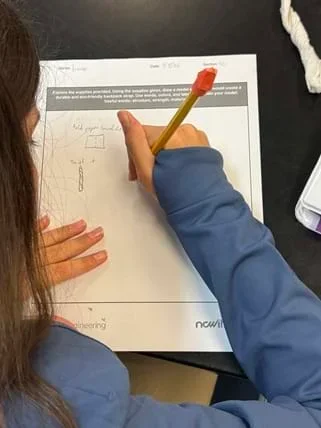 Students brainstorm prototype ideas.Copyright Larry McKenzie
Research
Divide and Research:
- In their groups, have students divide up the research questions from their packets.
- Give students 15 minutes to research their assigned question using approved classroom resources or teacher-provided materials. Students can complete the “Step #2: Research” section of their Unbeweavably Strong Activity Packet (PDF).
Share Findings:
- After individual research time, have students share their findings within their own group for five minutes.
- Then match each team with another and have the two teams compare and discuss ideas.
Facilitate Class Discussion:
- Lead a whole-class discussion to summarize key findings. Encourage students to connect their observations to material properties and structural design by asking:
- “What patterns are we noticing?"
- “Which structures seem strongest, and why?”
Imagine
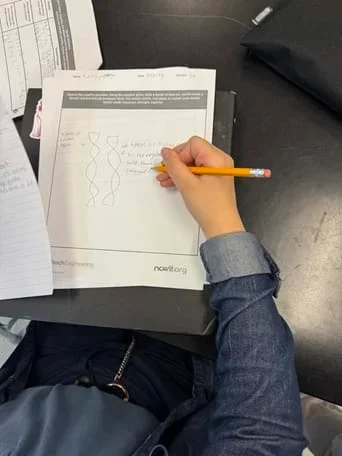 Students draw their prototypes.Copyright Larry McKenzie
Explore Materials & Constraints:
- Show students the available building materials and explain any limitations on the types or amounts of paper they may use.
- Direct them to review the criteria and constraints in their packet (e.g., weight goal, material limits, cost).
- As a group, have them brainstorm additional criteria for success (such as comfort, flexibility, or appearance) and discuss how these will affect their design decisions.
Brainstorm Ideas:
- In the "Imagine" section of their Unbeweavably Strong Activity Packet (PDF), have each student individually sketch and label a model for a paper backpack strap design. Their sketches should reflect both their research findings and the material limitations of the challenge. Give students 5–10 minutes for this.
Plan
Decision Matrix:
- Hand out a Decision Matrix (PDF)to each group.
- Walk through how to use it to compare their individual ideas (e.g., strength, cost, flexibility, and difficulty of construction).
- Give groups time to discuss and then select one design to move forward with. Student can sketch their team’s final design in their activity packet in the “Step #4: Plan” section.
Design Planning:
- Distribute one Unbeweavably Strong Design Worksheet (PDF) to each group.
- In their groups, have students begin finalizing a detailed plan for their strap design using the Unbeweavably Strong Design Worksheet (PDF). Their goal is to create a strap that can hold at least 7 kg using only the paper and tools provided.
- Have students develop a hypothesis about their design (e.g., “We think the braided design will be the strongest because…”)
Day 3: Create and Test
Create
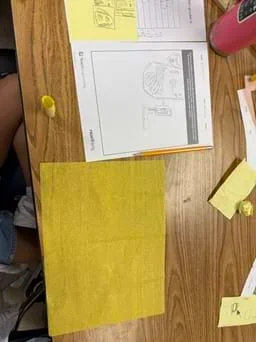 Student planning sheet and tissue paper for the designCopyright Brennan Cruser
Team Roles and Build Start:
- Review the criteria and constraints again.
- Have students assign roles in their groups (e.g., project manager, builder, recorder, materials lead) and record these roles in their activity packet.
- Instruct students to begin building their strap based on their team-chosen design.
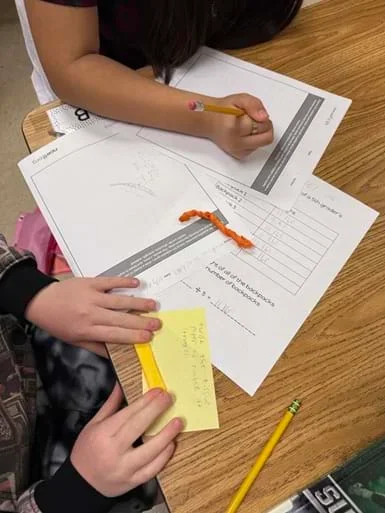 Students create their prototypesCopyright Brennan Cruser
Build Completion Time:
- Allow students 10-20 minutes to complete their strap builds.
- Remind them to test as they go and make minor adjustments if needed.
Test
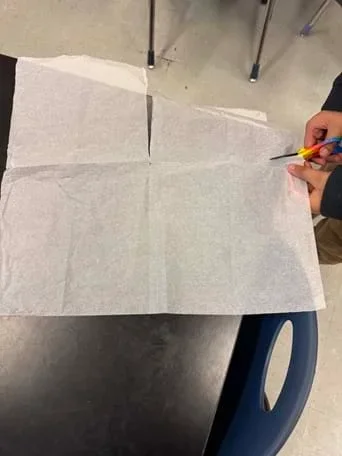 Students build their prototypes.Copyright Larry McKenzie
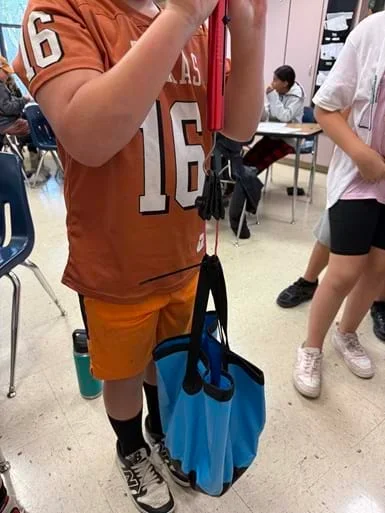 Students test their prototypes.Copyright Brennan Cruser
Testing Station:
- Set up a testing area.
- Have students line up by group to test their straps on the 7 kg backpack.
Prototype Testing:
- Have each group take a turn setting up their tests and determining the strength of their designs.
- Decide exactly how you want students to test their straps and model the procedure (i.e., slide strap through the backpack top handle, hold each end in a tight grip, carefully lift the backpack using only the strap).
Prepare to Record Data:
- Instruct students to open to the "Step #6: Test" section of their packet.
- Discuss the results and observations they will record.
- Have students record their data in their activity packets.
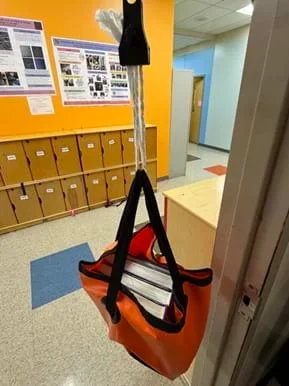 Students test their prototypes.Copyright Larry McKenzie
Calculate Strap Cost:
- Provide students with the cost of paper (e.g., $5.79 per package with 120 sheets in a package).
- Have students calculate the total cost of materials used in their design and record it in their packet.
Peer Feedback:
- As each group tests, assign other students to observe and provide constructive feedback.
- Use the "2 Stars and 1 Wish" method: Identify two things that worked well, and one suggestion for improvement.
Day 4: Improve, Reflect, and Prepare to Share
Improve
Revise the Design:
- In their groups, have students turn to the "Improve" section of the packet.
- Instruct students to choose 1–2 features to redesign or strengthen based on feedback and test results.
Rebuild (Optional):
- If materials and time allow, have students revise and rebuild their straps, then re-test them using the same procedures.
Wrap-Up, Reflection, and Sharing:
- Direct students to the “Final Reflection” section in their packets.
- Prompt them to write about what they learned from the design process, what challenges they faced, and how their understanding of materials and structure changed through the activity.
(optional) Final Product Pitch:
- Distribute a copy of the Product Pitch Instructions (PDF) and the Product Pitch Rubric (PDF) to each group.
- Have each group complete the Final Product Pitch. Note: For the final product pitch, students will share their design, their results (including graphs), and an explanation of how their design has modified the properties of the material. They will create a “pitch” for their eco-friendly strap.
- Have students share their pitches. (Note: These pitches can be shared a variety of ways, but one option would be to have a gallery walk and invite scientists or engineers from the community, students from other classrooms, or teachers/administrators from around the school. Students might also create a video and share it digitally with classmates to conduct the gallery walk virtually and allow all students to hear each other’s pitches and give feedback. A digital gallery walk could also easily be shared with community members.)
- pattern
- Something designed or used as a model for making things.
- mass
- The property of a body that is a measure of its inertia and is commonly taken as a measure of the amount of material it contains and causes it to have weight in a gravitational field.
- observe
- To watch carefully, especially with attention to details or behavior for the purpose of arriving at a judgment.
- measure
- To find out or learn with certainty the dimensions, capacity, or amount of something.
- test
- A critical examination, observation, or evaluation.
- variable
- Something that can change or be changed in an experiment.
- hypothesis
- An initial, proposed explanation made before extensive testing; the starting point for experimentation.
- force
- Cause of motion or change.
- durability
- How well a material can last under stress or over time.
- flexibility
- How easily a material bends without breaking.
- material
- What something is made of.
- property
- A feature of a material, such as strength or flexibility.
- strength
- How much force a material can take before breaking.
- structure
- How something is put together.
- prototype
- A first version of something you build to test your idea.
Pre-Activity Assessment
Exploding Atom activity: Students engage in an “Exploding Atom” activity to activate background knowledge and build interest and buy-in. Many of these questions relate to the science, math, and engineering aspects of the activity, and some of the questions relate to student identity (as an engineer/scientist) and how students feel working in groups and independently.
Activity Embedded (Formative) Assessment
Activity Packet: During the activity, students will have recorded on the included worksheets or in their lab notebooks. See possible example responses included with the sheets. Use these responses to formatively assess throughout the activity.
Teacher Questions: Questioning during the procedure will also allow you to formatively assess student progress and understanding. Here are some questions to ask students and possible responses:
- Explain your design. How will it change the properties of the paper? (Possible student answers include descriptions of the changes they made to their straps and naming properties such as strength and flexibility.)
- What patterns are you noticing?
- What structures seem strongest, and why?
- What is your hypothesis? (Students should be able to explain what they think will happen based on their designs.)
- What are the variables? What is the independent variable? What are the controlled variables?
Post-Activity (Summative) Assessment
Reflection Questions: An end-of-project reflection is included in the activity packet.
Final Product Pitch: Optionally, students may complete the Final Product Pitch as the post-activity assessment. Students will share their design, their results (including graphs), and an explanation of how their design has modified the properties of the material. They will create a “pitch” for their eco-friendly strap. Detailed Product Pitch Instructions (PDF) and a Product Pitch Rubric (PDF) are included. These pitches can be shared a variety of ways, but one option (and the option that is outlined in the student directions page) would be to have a gallery walk and invite scientists or engineers from the community, students from other classrooms, or teachers/administrators from around the school. Students might also create a video and share it digitally with classmates to conduct the gallery walk virtually and allow all students to hear each other’s pitches and give feedback. A digital gallery walk could also easily be shared with community members.
The main safety concern in this activity involves testing the strength of the paper straps using weight. It’s important to remind students never to place their hands, feet, or heads directly under the weight during testing in case the strap fails unexpectedly. Emphasize safe lifting techniques and consider using a partner system for lifting and testing to reduce strain or sudden drops. If suspending the strap from a classroom hook or piece of furniture, test the structure beforehand to ensure it can support the maximum potential weight. If this is not possible, consider using a tabletop edge or a secure chair setup instead.
Common snags may include straps slipping from the hook or a student’s grip, inconsistencies in how weight is applied, or confusion around what counts as a “fair test.” To troubleshoot these issues, model a few trials for the class and discuss how to maintain consistent testing conditions—same attachment method, even weight increments, and clear failure points. If a strap breaks too quickly or doesn’t break at all, guide students to revisit their design and reflect on structural changes they could make—tighter braiding, more folds, or a wider base. Encourage iteration and let students know that failure is a normal part of the engineering design process. Last, have extra paper available so students can revise and retry their designs.
- Investigate the everyday phenomenon of bending a paperclip. While students may assume this makes the material weaker, it actually makes the material stronger and more difficult to bend by changing the microstructure of the material through a process called work hardening. This will also increase the brittleness, so it will eventually break.
- For lower grades: There is a modified version of this activity available for grades 2-3. The STEM Station 2nd and 3rd Grade (PDF)gives directions for a Backpack Strap STEM Station. For younger students, the everyday phenomenon of a shoelace could replace the steel cable as a more relatable example of changing structure to increase strength and durability.
- For older/advanced students: Students in grades 6-8 can extend further by calculating and graphing the forces involved in the challenge. You might also want to try this activity with slinky scales as an extension for middle schoolers: Teach Engineering Activity- Hanging Around: Gravity and Slinky Spring Scales.
- “Scale Up” by having students use a fishing scale or other spring scale to see the maximum mass their prototypes are able to support without breaking. Have students make three prototypes of the same design and then have them test each strap’s maximum mass and then calculate the average of the three tests. Be sure to have students hang the scale on a strong hook in order to prevent them from attempting to lift too much weight at one time.
American Occupational Therapy Association. (2008). Backpacks: Keeping your kids safe [PDF]. Journal of the
Canadian Chiropractic Protective Association. https://jccponline.com/backpacks.pdf
Chaplin, Christopher. The Fatigue and Degradation Mechanisms of Hoisting Ropes. n.d.
Golden Gate Bridge, Highway and Transportation District. “Steel Suspender Rope Exhibit.” Golden Gate Bridge History & Exhibits, Golden Gate Bridge, Highway and Transportation District. www.goldengate.org/exhibits/steel-suspender-rope-exhibit
Igini, M. (2022, July 24). 10 concerning fast fashion waste statistics. Earth.Org. https://earth.org/statistics-about-fast-fashion-waste
National Academies of Sciences, Engineering, and Medicine. 2012. A Framework for K-12 Science Education: Practices, Crosscutting Concepts, and Core Ideas. Washington, DC: The National Academies Press. https://doi.org/10.17226/13165.
U.S. Environmental Protection Agency. (2023). Facts and figures about materials, waste and recycling. EPA. https://www.epa.gov/facts-and-figures-about-materials-waste-and-recycling
Contributors
Brennan Cruser, Kocurek Elementary in Austin, TX; Larry McKenzie, Harmony School of Innovation in Austin, TX; Zach Wilborn, Connally High School International Newcomer Academy in Austin, TX; Dr. Eric Taleff (University of Texas at Austin); Sucharita Banerjee (University of Texas at Austin)
Supporting Program
Research Experience for Teachers (RET), University of Texas at Austin
Acknowledgements
This curriculum was developed under National Science Foundation through the Center for Dynamics and Control of Materials: an NSF MRSEC under Cooperative Agreement number DMR-2308817. Any opinions, findings, and conclusions or recommendations expressed in this material are those of the authors and do not necessarily reflect the views of the National Science Foundation.
Copyright
2026 by Regents of the University of Colorado; original © 2025 University of Texas at Austin