
Dam Impacts
While the creation of a dam provides many benefits, it can have negative impacts on local ecosystems. Using the associated activity students learn about the major environmental impacts of dams and the engineering solutions used to address them.
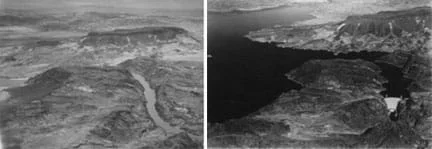 Landscape views before and after the Hoover Dam was constructed.Copyright University of Nevada, Las Vegas Libraries, Special Collections. Used with permission. http://digital.library.unlv.edu/cdm4/item_viewer.php?CISOROOT=/lv_water&CISOPTR=174&CISOBOX=1&REC=3 http://digital.library.unlv.edu/cdm4/item_viewer.php?CISOROOT=/lv_water&CISOPTR=952&CISOBOX=1&REC=15
Biology and nature's cycles have traditionally been considered the domain of biologists and other scientists. However, with the rise of environmental awareness in engineering, engineers are increasingly interested in understanding these traditionally scientific realms. With some knowledge of ecosystems, engineers can more readily understand the environmental impacts of dams and devise solutions to mitigate ecological damage.
After this lesson, students should be able to:
- List the major environmental impacts of dams.
- List the engineering solutions to decrease these impacts.
- Interpret and analyze data about changes in environmental conditions – such as climate change – and populations that support a claim describing why a specific population might be increasing or decreasing
Grade 6
Do you agree with this alignment? - Analyze and interpret data identifying ways Earth's surface is constantly changing through a variety of processes and forces such as plate tectonics, erosion, deposition, solar influences, climate, and human activity
Grade 5
Do you agree with this alignment?
- The use of technology affects the environment in good and bad ways.
Grades 3-5
Do you agree with this alignment? - STEL-5D Determine factors that influence changes in a society's technological systems or infrastructure.
Grades 3-5
Do you agree with this alignment?
- 3-LS4-4 Make a claim about the merit of a solution to a problem caused when the environment changes and the types of plants and animals that live there may change.
Grade 3
This resource focuses on the following Three Dimensional Learning aspects of NGSS:
Science & Engineering Practices- Make a claim about the merit of a solution to a problem by citing relevant evidence about how it meets the criteria and constraints of the problem.Do you agree with this alignment?
Disciplinary Core Ideas- When the environment changes in ways that affect a place's physical characteristics, temperature, or availability of resources, some organisms survive and reproduce, others move to new locations, yet others move into the transformed environment, and some die.Do you agree with this alignment?
- Populations live in a variety of habitats, and change in those habitats affects the organisms living there.Do you agree with this alignment?
Crosscutting Concepts- A system can be described in terms of its components and their interactions.Do you agree with this alignment?
Do you agree with this alignment? - Make a claim about the merit of a solution to a problem by citing relevant evidence about how it meets the criteria and constraints of the problem.
- 5-ESS3-1 Obtain and combine information about ways individual communities use science ideas to protect the Earth's resources and environment.
Grade 5
This resource focuses on the following Three Dimensional Learning aspects of NGSS:
Science & Engineering Practices- Obtain and combine information from books and/or other reliable media to explain phenomena or solutions to a design problem.Do you agree with this alignment?
Disciplinary Core Ideas- Human activities in agriculture, industry, and everyday life have had major effects on the land, vegetation, streams, ocean, air, and even outer space. But individuals and communities are doing things to help protect Earth's resources and environments.Do you agree with this alignment?
Crosscutting Concepts- A system can be described in terms of its components and their interactions.Do you agree with this alignment?
- Science findings are limited to questions that can be answered with empirical evidence.Do you agree with this alignment?
Do you agree with this alignment? - Obtain and combine information from books and/or other reliable media to explain phenomena or solutions to a design problem.
The plant and animal communities in and around a river have unique characteristics that allow them to flourish in that context. Dams disrupt this ecology by altering the flooding pattern and temperature of a river, as well as by inhibiting the free passage of fish.
Many aquatic animals coordinate their reproductive cycles with annual flood seasons. Every flood is valuable in that it deposits nutrients from the land in the river, providing food for the stream's residents. Floods also provide shallow backwater areas in the floodplain where immature organisms are protected from predators. For example, a certain fish may only reproduce during April when its offspring will have abundant food and places to hide. If a dam prevents the usual April flood, the offspring may hatch at a different time of year. If offspring hatch in autumn, when water temperature and food supply are low, the offspring have a reduced chance of survival. In turn, the loss or reduction of one species can have widespread effects throughout the aquatic food web.
Water temperature is also affected by dams. Rivers tend to be fairly homogenous in temperature. Reservoirs, on the other hand, are layered; they are warm at the top and cold at the bottom. Dams usually release water downstream from the bottom of the reservoir, which is often much colder than the usual river temperature. Imagine if the average air temperature of our planet were suddenly altered by 20 degrees! An altered temperature regime can negatively impact all levels of the aquatic ecosystem — from tiny macroinvertebrates to large trout.
Decreased fish passage is yet another impact of dams. Many fish must move upstream and downstream to complete their lifecycles. Dams often create a complete barrier to fish passage. This problem is especially apparent in the Northwest, where the natural cycle of salmon runs has been almost completely eliminated by large dams.
Engineers study and try to mitigate the negative environmental impacts of dams. Intakes at different layers of the reservoir enable the control of outflow temperature. Fish ladders allow fish to climb over dams and complete their migration. Large releases can be timed to simulate natural flooding. Refer to the Your River's Health activity to have students act as environmental engineers by performing a macroinvertebrate (insect) survey to gauge the health of a local river.
Who has been to a river that has been dammed? What kind of impacts can a dam have on a river? Two major impacts are (write on board):
- The water temperature changes
- Flooding no longer occurs
Why does it matter what temperature the water is? Who can think of how changing the water temperature could have a negative effect on a river's ecosystem? If you are not sure, let's brainstorm as a class. Here is a hint: How would it affect you if somebody changed how hot or cold it was inside your house? If your house was too cold or too warm, might it make you sick? For all the animals that live in the river, the water is like their house. If their house is not comfortable for them, they might get sick and suffer or die.
Why might flooding be so important? A flood takes nutrients from the land and deposits them in the river, providing food for the stream's residents. Floods also provide shallow backwater areas in the floodplain when some of the receding floodwater gets trapped in small pools away from the main river. These small pools provide a safe, warm and nutrient-rich environment where young fish and other organisms are protected from predators that are found in the main river. In addition, certain fish may only reproduce during a flood when abundant food and places to hide are available for their offspring.
A dam design can be changed so it is friendlier to the local ecosystem. What possible strategies might reduce environmental impacts? In the case of water temperature, think about the temperature of water in a lake or reservoir. The deeper you go down, the colder it gets. Water is typically released from the bottom level of a reservoir. So, one way to make at least the downstream temperature warmer is to release water from the upper lake levels. The benefits of flooding can also be preserved by releasing large amounts of water at one time to simulate natural flooding.
Let's think back about all we know about dams. What are some of the positive impacts of dams and reservoirs? (Possible answers: Dams help ensure a water supply for domestic and irrigation use. Dams produce hydroelectricity. Dams enable us to control a rivers water so as to prevent flooding.)
Is there a downside? What might be the environmental costs of these benefits? (Possible answers: Lowered water temperatures, altered time of year for river high/low flows, and elimination of floods, which disturbs the ecosystems and natural processes that are essential for animals and plants
How can engineers design better dams? (Answer: Engineers can design water intakes that are not in the coldest layer of the reservoir water. They can arrange for the dam to release large amounts of water during the times that flooding would naturally occur.)
- ecosystem
- A group of organisms interacting with one another and their environment.
- engineer
- A person who applies her/his understanding of science and mathematics to creating things for the benefit of humanity and our world.
Pre-Lesson Assessment
Think-Pair-Share: Students think about a question on their own, pair with another student to talk about it, and then share their ideas with the whole group. Allow two minutes for the first two steps (think and pair), and then call on students. Ask the students:
- Do you think damming up a river has any negative ecological impacts on the river? If yes, what might they be? If no, why not?
Post-Introduction Assessment
Team Discussion: Have students discuss with others around them the environmental impacts of dams. Pose this question:
- Do you think that building a dam on a river is worth the negative environmental impacts to the river's ecosystem?
Lesson Summary Assessment
Voting: Assess student attitudes towards the environment and dams. Label one side of the room YES and the opposite side NO. Gather students into the middle of the room. Tell them you will give them several statements pertaining to the lesson. If they agree with the statement, they must walk to the YES side of the room and vice versa. Once students separate, invite discussion by asking students on opposite sides of the room why they answered the way they did. Use the following statements:
- Yes or No: Flooding provides nutrients to organisms in streams.
- Yes or No: Dams have no influence on the reproduction of organisms.
- Yes or No: The water temperature of a stream can be changed by a dam.
- Yes or No: Engineers can design dams to have less environmental impact.
Kagen, S. Cooperative Learning. San Juan Capistrano, CA: Kagan Cooperative Learning, 1994. (Source for Think-Pair-Share small group assessment tool.)
Webb, Rick. The Stream Study. March 1, 1999. Department of Environmental Sciences, University of Virginia, Charlottesville, VA. Accessed July 14, 2009. http://people.virginia.edu/~sos-iwla/Stream-Study/StreamStudyHomePage/StreamStudy.HTML
Contributors
Sara Born; Kristin Field; Denali Lander; Michael Bendewald; Denise W. Carlson
Supporting Program
Integrated Teaching and Learning Program, College of Engineering, University of Colorado Boulder
Acknowledgements
The contents of this digital library curriculum were developed under a grant from the Fund for the Improvement of Postsecondary Education (FIPSE), U.S. Department of Education and National Science Foundation GK-12 grant no. 0338326. However, these contents do not necessarily represent the policies of the Department of Education or National Science Foundation, and you should not assume endorsement by the federal government.
Copyright
2008 by Regents of the University of Colorado.