
Locks and Dams
Students are introduced to the structure, function and purpose of locks and dams, which involves an introduction to Pascal's law, water pressure and gravity.
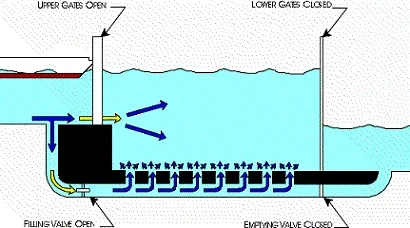 Figure 1. A lock and dam system enables a large ship to move from a body of water at one level to another body of water at another level.Copyright US Army Corps of Engineers http://www.mvp.usace.army.mil/navigation/default.asp?pageid=166
The design of lock and dam structures by civil and mechanical engineers has significantly improved river navigation and, consequently, riverside economies. These engineers must thoroughly understand the fundamental concepts of Pascal's law, water pressure and gravity in order to design functional and reliable systems.
After this lesson, students should be able to:
- Explain the basic operation of a lock and dam system.
- Know that lock and dam system are used to aid in river navigation.
- Know that engineers use Pascal's law when designing lock and dam systems.
- Changes in speed or direction of motion are caused by forces such as pushes and pulls
Grade 2
Do you agree with this alignment?
- CCSS.Math.Content.6.EE.A.2 Write, read, and evaluate expressions in which letters stand for numbers.
Grade 6
Do you agree with this alignment? - CCSS.Math.Content.6.NS.B.3 Fluently add, subtract, multiply, and divide multi-digit decimals using the standard algorithm for each operation.
Grade 6
Do you agree with this alignment?
- STEL-3G Explain how knowledge gained from other content areas affects the development of technological products and systems.
Grades 6-8
Do you agree with this alignment? - STEL-6D Engage in a research and development process to simulate how inventions and innovations have evolved through systematic tests and refinements.
Grades 6-8
Do you agree with this alignment?
- MS-ETS1-1 Define the criteria and constraints of a design problem with sufficient precision to ensure a successful solution, taking into account relevant scientific principles and potential impacts on people and the natural environment that may limit possible solutions.
Grades 6-8
This resource focuses on the following Three Dimensional Learning aspects of NGSS:
Science & Engineering Practices- Define a design problem that can be solved through the development of an object, tool, process or system and includes multiple criteria and constraints, including scientific knowledge that may limit possible solutions.Do you agree with this alignment?
Disciplinary Core Ideas- The more precisely a design task's criteria and constraints can be defined, the more likely it is that the designed solution will be successful. Specification of constraints includes consideration of scientific principles and other relevant knowledge that is likely to limit possible solutions.Do you agree with this alignment?
Crosscutting Concepts- The uses of technologies and any limitations on their use are driven by individual or societal needs, desires, and values; by the findings of scientific research; and by differences in such factors as climate, natural resources, and economic conditions.Do you agree with this alignment?
- All human activity draws on natural resources and has both short and long-term consequences, positive as well as negative, for the health of people and the natural environment.Do you agree with this alignment?
Do you agree with this alignment? - Define a design problem that can be solved through the development of an object, tool, process or system and includes multiple criteria and constraints, including scientific knowledge that may limit possible solutions.
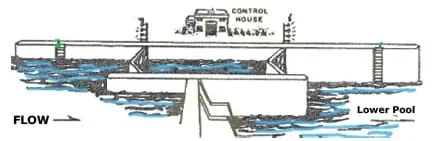 Side view of a lock. Notice the moveable gates and different water levels.Copyright US Army Corps of Engineers http://www.mvp.usace.army.mil/docs/nav/locking.pdf
Locks enable water vessels to move from one section or body of water at one level to another section of water at another level through river and canal waterways. How does it work? A lock might be described as a huge enclosure set in a water channel with watertight and moveable doors (gates) on the front and back. At the point where bodies of water at different levels meet, a lock and dam system bridges the gap by creating a contained area that can individually raise or lower its own water level to step a boat up or down the waterway. See Figure 1 (animation), Figure 2 (three-part diagram) or the attached Dam and Lock Visual Aid (DOC) for a description of the basic steps to move a ship through a lock.
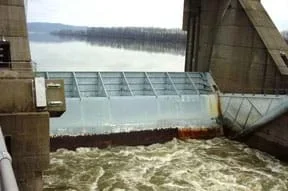 A gate at one end of the Cannelton Lock and Dam in Tell City, IN.Copyright US Army Corps of Engineers, Louisville District http://www.crh.noaa.gov/images/ahps2/lmk/cnni3/tainter_closeup.jpg
The principle behind locks is straightforward: The river is an inclined plane whose water moves in and out of locks by gravity. Think of locks as a flight of "water stairs" going up and down a hill. Water is drained from the first lock (using gravity) until the water level is even with the second one. The downstream gate is opened so the vessel can move into the lower lock, and the process may be repeated numerous times. The lifting and lowering of vessels, some weighing up to 60 tons, is done without a great use of energy.
Raise your hand if you've heard of the Panama Canal. What about the Mississippi River? Did you know that both of these major water transportation routes—and many others!---use a special type of dam system to help boats, ships and barges move from one section of water to another when they are at various water levels? It's called a lock and dam system. Boats and ships get through a waterway by going into a lock, which is a big chamber in the water with moveable gates at each end, then waiting as a valve is opened and the water from that lock flows into the next lock (or next body of water if just one lock), raising or lowering the boat automatically. The boats continue into the next lock, and so on, until they reach the end of the lock and dam system. A series of locks enable river vessels to "step" up or down a river or canal from one water level to another.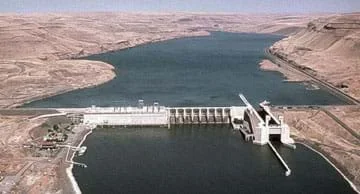 The multipurpose Lower Monumental Dam and Lock on the Snake River in Washington includes a concrete gravity-type dam with short earthfill abutment embankments, an eight-bay spillway, a single-lift type lock (far right structure) and two fish ladders.Copyright 1995 U.S. Army Corps of Engineers Photo Library, Photograph #3996-13, January 1995 http://vulcan.wr.usgs.gov/LivingWith/Historical/LewisClark/Historical/corps-engineers-archives_lower_monumental_dam_1995.jpg
Let's look at this graphic. (Show students Figure 1 [animation], Figure 2 [three-part diagram] or the attached Dam and Lock Visual Aid (DOC). The animation may also be found online at http://www.mvp.usace.army.mil/navigation/default.asp?pageid=166) For a ship going downstream, the lock is filled with water by opening the filling valve. Then the drain valve and upstream and downstream gates are closed so the chamber water level rises to the upstream level. Then the upstream gate opens and the boat moves in. To lower the boat, the gates are closed behind it, the filling valve is closed, and the drain valve is opened. The higher water in the lock chamber drains to the downstream level in a few minutes. Then, the downstream gate is opened and the boat moves out on the lower water level. The process is reversed for a boat going upstream. You can think of locks as a step-by-step way to move water vessels through bodies of water that are at different water heights.
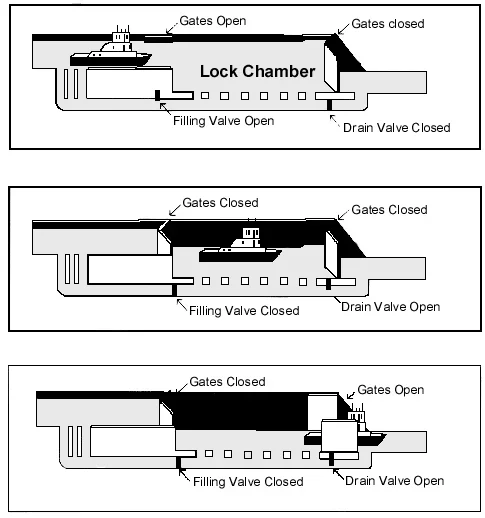 Figure 2. Diagram of a lock and dam system shows the steps of "locking through" to move a ship downstream to a lower-water level.Copyright US Environmental Protection Agency, Gulf of Mexico Program http://www.epa.gov/gmpo/edresources/locks.html
Why would engineers go to all this trouble? Why wouldn't they just let boats travel waterways on their own? In what situations would boats need locks? Let's brainstorm ideas and write them on the board. (Write student suggestions on the board.) One of the main reasons engineers design and build lock and dam systems is to help big and heavy boats get through shallow or steep river areas. Using dams and locks, massive ships can navigate through shallow or steep sections of river, traveling up and down rivers much further than natural terrain would allow, which helps to increase trade and commerce on waterways. We also know that putting a dam in a river causes a change in the water level on each side of the dam (the reservoir is higher than the river below the dam), so how do boats get through once a dam is in place? Locks create ways for boats to get past large dams as well as other naturally-occurring obstacles such as waterfalls, rapids or sandbars. In the case of the Panama Canal, people dug canals across a continent to create a shorter water transportation route between oceans, and they incorporated locks to adjust for the terrain variations. Locks help to improve river and waterway navigation.
A system of locks and dams on the Upper Mississippi River makes it possible for large barges to travel as far north as St. Paul, Minnesota. (Show the Mississippi River on a map of the central US states.) Along the Upper Mississippi River between St. Louis, Missouri, and St. Paul, Minnesota are 29 locks and dams that divide the river into 29 flat pools designed to hold water back to maintain a nine-foot deep shipping channel. That's a lot of locks! Imagine how difficult it would be trying to transport something by boat without the locks. Some boats need the water to be nine-feet deep, and if it got shallower in the summer, they would not be able to pass. Imagine that you were waiting for delivery of something by boat along this river. If that boat ran into shallow waters it might just be stuck, unable to travel any further, without a lock and dam system.
An important consideration when engineers design and create lock and dam systems is that the structures must be designed to withstand the forces of water pushing on them. Pascal's law describes how water at a given depth exerts the same (equal) pressure in all directions. Something else we know about water pressure — the deeper the water, the greater the water pressure. For example, at a depth of five meters from the surface, the water pressure is half as great as it is at a depth of 10 meters from the surface. Refer to the associated activity Under Pressure to illustrate Pascal's law and water pressure with a fun and hands-on experiment!
Pascals Law:
P= ρgh
P = Pressure (Pa = N/m2)
ρ = Density of Fluid (Water = 1000 kg/m3)
g = Gravity (9.81 m/s2)
h = Depth (m)
The deeper you go beneath the water's surface, the more water pressure you'll find. Have you ever dived deep into a pool and thought about the pressure you feel in your ears? The deeper you go, the more pressure you feel. A lot of people do not realize how strong water can be! Imagine how much water pressure is at the bottom of the ocean. Water pressure is something that scuba divers think about — and engineers. Imagine how strong a structure must be to hold back the force of all the water in a reservoir (a dam), or to keep water from going where you do not want it (a lock)!
Who can explain to me how a lock and dam system works? (Let a few students explain.) How do locks help improve river navigation? (Let a few students explain.) How are gravity and water pressure involved in how locks work? (See additional discussion questions and answers in the post-lesson Assessment section.)
- dam
- A barrier to obstruct the flow of water, especially one made of earth, rock, masonry and/or concrete, built across a stream or river.
- engineer
- A person who applies her/his understanding of science and mathematics to creating things for the benefit of humanity and our world.
- gravity
- An invisible force of a mass being attracted to another mass. For example, the Earth's mass pulls you down so you stay on the ground instead of flying away.
- lock
- An enclosed chamber in a waterway with watertight gates at each end, for raising or lowering vessels from one water level to another by admitting or releasing water.
- pascal's law
- A hydrostatics principle that says that for all points at the same absolute height in a body of a fluid, the pressure is the same, even if additional pressure is applied on the fluid at some place.
- pressure
- The exertion of force upon a surface by an object, fluid, etc., in contact with it. Expressed as force per unit area.
Pre-Lesson Assessment
Think-Pair-Share: Ask students to think about the following questions and then share their responses with a neighbor. Review as a class.
- How does it feel to dive to the bottom of a swimming pool?
- Does the water feel "heavier"?
- Do your ears sometimes hurt when you dive down too deep?
- What if you dive even deeper into a lake or an ocean?
(Points to make: What you are feeling at the bottom of the swimming pool is the water's pressure. The deeper we dive, the more pressure we feel from the weight of more water being above us. Sometimes our ears hurt because of the pressure on our eardrums.)
Post-Introduction Assessment
Toss-a-Ball: Ask the following questions to the class and have each student catch and toss a ball while answering.
- Why is the water pressure 5 meters beneath the surface half as great as it is 10 meters beneath the surface? (Answer: Water pressure comes from the weight of the water above, so at 10 meters, twice as much water is above than at five meters. Height, not length or width, is what matters for determining water pressure. Use Pascal's Law with the h = 5 m and h=10m to obtain pressures of 49,050 N/m^2 and 98,100N/m^2 , respectively. Have students note that the pressure for 10 meters is twice that for 5 meters.)
- How does gravity help a boat get across a lock and dam system? (Answer: Gravity "moves" river water in and out of the locks. Water is drained [by gravity] from the first lock until it is even with the second lock. When the water levels are even, the vessel can move into the lower lock).
- Why are lock and dam systems important for our economy? (Answer: Locks enable large boats to travel up and down rivers much further than they could travel naturally. They also enable boats to navigate through shallow or steep sections of river. With this travel improvement, merchants can ship products and good longer distances, increasing the global market.)
Lesson Summary Assessment
Class Discussion: Ask students the following questions. Listen to their answers. Discuss as a class:
- What is the purpose of a lock and dam system? (Answer: To raise and lower boats between stretches of water of different levels on waterways.)
- How is gravity involved in lock and dam systems? (Answer: Gravity is a factor in how boats move through lock and dam systems by how it moves and drains water, which raises and lowers the boats in the locks.)
- In what situations might construction of a lock improve river or canal navigation? (Possible answers: Locks help commercial boats and barges navigate past sandbars, rapids, waterfalls, temporarily low water, changing riverbed elevations and dams.)
- If we didn't have lock and dam systems, how might we move boats through these waterway obstacles? (Possible answer: We could design and build boat lifts, and some places have boat lifts. But, locks make more sense for big ships [imagine cruise ships, ocean tankers, cargo ships] and barges; locks let water and gravity do the heavy work of moving the vessels.)
- What must engineers consider about water pressure so the lock and dam systems they design are safe, strong and reliable? (Answer: As the elevation of water behind a dam increases, its height and density causes increasingly high pressure at the bottom of the dam. Water pressure also affects the walls and gates of locks. Engineers must estimate and take this pressure under consideration in order to make lock and dam structures watertight and strong enough to stand up to the water pressure forces.)
Engineering Drawings: Once students understand how lock and dam systems work, ask them to create preliminary drawings as if they were engineers (from Splash Engineering) designing a system for their municipality client (Thirsty County). Require that the drawings illustrate where along a river (Birdseye River) the lock and dam structure will be built, the dimensions of the structure (how long, wide and deep), and the number of locks in the structure. For an added challenge of constraining the students' designs, tell them that the river is 50m wide and 8m deep, and the largest vessel permitted to pass through is 10m long.
As a short homework assignment, have students make a list of 10 products found in their homes, noting their place of origin. Possible items include clothing, shoes, gadgets, small appliances and toys. Students will probably discover that many of their products came from other countries! With the class, discuss how many of these products traveled on ocean-going vessels or barges. Ask students to talk about how their lives would be different if engineers had not designed lock and dam systems to enable water vessels to travel long distances.
Assign students to research and report back on the amazing boat lifts in use in different countries. Many are modern day marvels of engineering.
See the US Army Corps of Engineers' website for animations of barges, waterways and dam systems: http://www.mvp.usace.army.mil/
Adler, Jerry "Troubled Waters. The Great Flood of '93 Rolled Inexorably Down the Mississippi, Teaching Everyone—Even Television Anchormen—Never to Underestimate Nature." Newsweek. Published July 26, 1993, pp. 66-80.
Ardley, Neil. How "We Build Dams." Ada, OK: Garrett Educational Corporation, 1990.
Cannelton Locks and Dams. Perry County, Indiana, http://www.perrycountyindiana.org/attractions/canneltonlocks.cfm, accessed July 14, 2009.
Dictionary.com. Lexico Publishing Group, LLC., http://www.dictionary.com, accessed July 14, 2009. (Source of some vocabulary definitions, with some adaptation)
Kagan, Spencer. Cooperative Learning. Capistrano, CA: Kagan Cooperative Learning, 1994.
Lock and Dam 6, Trempealeau, WI. Updated September 26, 2007. US Army Corps of Engineers. Accessed July 14, 2009. http://www.mvp.usace.army.mil/
Locks and Dams. 2006. Newton's Apple Teacher Guides. KTCA Twin Cities Public Television, http://www.newtonsapple.tv/TeacherGuide.php?id=1041, accessed July 14, 2009.
Locks and Dams: How do locks and dams work? How does a lock and dam make an unnavigable part of a waterway navigable? Newton's Apple Insights. KTCA Twin Cities Public Television, http://www.darylscience.com/Demos/Lock-Dams.html, accessed July 28, 2009.
Nelson, S.B. "Water engineering." In Standard Handbook for Civil Engineers. Edited by F.S. Merritt. New York: McGraw-Hill Companies, 1983.
Old Man River. St. Paul, MN: U.S. Army Corps of Engineers, 1988.
Skorupa, Joe. "The Problem with Dams." Popular Mechanics. Published December 1991, pp. 106-107.
Contributors
Jeff Lyng; Kristin Field; Denali Lander; Lauren Cooper; Denise W. Carlson
Supporting Program
Integrated Teaching and Learning Program, College of Engineering, University of Colorado Boulder
Acknowledgements
The contents of this digital library curriculum were developed under a grant from the Fund for the Improvement of Postsecondary Education (FIPSE), U.S. Department of Education and National Science Foundation GK-12 grant no. 0338326. However, these contents do not necessarily represent the policies of the Department of Education or National Science Foundation, and you should not assume endorsement by the federal government.
Copyright
2008 by Regents of the University of Colorado.