

Quick Look
- Grade Level:
- 6 (5 – 7)
- Time Required:
- 4 hours
(six 40-minute sessions)
- Group Size:
- 2
- Subject Areas:
-
Biology Chemistry Measurement Number and Operations -
NGSS Performance Expectations:

MS-ETS1-1 MS-ETS1-2 MS-ETS1-3 MS-ETS1-4
Summary
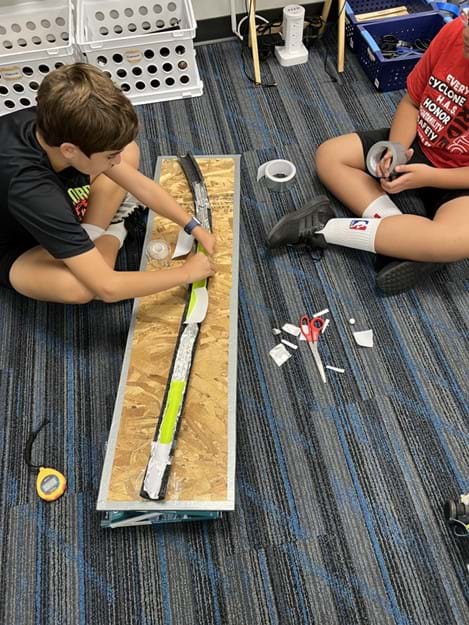
Students explore myelination, demyelination, and remyelination through a hands-on simulation. They design a model of a myelinated nerve by lining a tube with a material that helps a marble travel through quickly and smoothly. After measuring the marble’s speed through this “healthy” tube, students then simulate demyelination by damaging or removing part of the lining and measuring the slower speed. Finally, they attempt to “repair” the tube, test the marble’s speed again, and compare results.Engineering Connection
Biomedical engineers are studying myelin with a focus on repairing, regenerating, and preventing degradation of the myelin sheath, especially in neurological disorders such as multiple sclerosis (MS). Biomedical and bioengineers develop cell therapies and design experimental models to test how different treatments can promote remyelination. Their design solutions address both the mechanics of treatment and the biochemical delivery of cell-based therapies. Current research includes developing new cell therapies, exploring electrical stimulation techniques, creating computer models to simulate disease and treatment, designing new therapeutic approaches, and investigating the mechanical properties of myelin.
Learning Objectives
After this activity, students should be able to:
- Describe the function of myelin and the effects of degraded myelin on nerve signals.
- Differentiate between myelin, demyelination, and remyelination.
- Apply engineering design practices on the creation and repair of myelin models.
Educational Standards
Each Teach Engineering lesson or activity is correlated to one or more K-12 science,
technology, engineering or math (STEM) educational standards.
All 100,000+ K-12 STEM standards covered in Teach Engineering are collected, maintained and packaged by the Achievement Standards Network (ASN),
a project of D2L (www.achievementstandards.org).
In the ASN, standards are hierarchically structured: first by source; e.g., by state; within source by type; e.g., science or mathematics;
within type by subtype, then by grade, etc.
Each Teach Engineering lesson or activity is correlated to one or more K-12 science, technology, engineering or math (STEM) educational standards.
All 100,000+ K-12 STEM standards covered in Teach Engineering are collected, maintained and packaged by the Achievement Standards Network (ASN), a project of D2L (www.achievementstandards.org).
In the ASN, standards are hierarchically structured: first by source; e.g., by state; within source by type; e.g., science or mathematics; within type by subtype, then by grade, etc.
NGSS: Next Generation Science Standards - Science
| NGSS Performance Expectation | ||
|---|---|---|
|
MS-ETS1-1. Define the criteria and constraints of a design problem with sufficient precision to ensure a successful solution, taking into account relevant scientific principles and potential impacts on people and the natural environment that may limit possible solutions. (Grades 6 - 8) Do you agree with this alignment? |
||
| Click to view other curriculum aligned to this Performance Expectation | ||
| This activity focuses on the following Three Dimensional Learning aspects of NGSS: | ||
| Science & Engineering Practices | Disciplinary Core Ideas | Crosscutting Concepts |
| Define a design problem that can be solved through the development of an object, tool, process or system and includes multiple criteria and constraints, including scientific knowledge that may limit possible solutions. Alignment agreement: | The more precisely a design task's criteria and constraints can be defined, the more likely it is that the designed solution will be successful. Specification of constraints includes consideration of scientific principles and other relevant knowledge that is likely to limit possible solutions. Alignment agreement: | All human activity draws on natural resources and has both short and long-term consequences, positive as well as negative, for the health of people and the natural environment. Alignment agreement: The uses of technologies and any limitations on their use are driven by individual or societal needs, desires, and values; by the findings of scientific research; and by differences in such factors as climate, natural resources, and economic conditions.Alignment agreement: |
| NGSS Performance Expectation | ||
|---|---|---|
|
MS-ETS1-2. Evaluate competing design solutions using a systematic process to determine how well they meet the criteria and constraints of the problem. (Grades 6 - 8) Do you agree with this alignment? |
||
| Click to view other curriculum aligned to this Performance Expectation | ||
| This activity focuses on the following Three Dimensional Learning aspects of NGSS: | ||
| Science & Engineering Practices | Disciplinary Core Ideas | Crosscutting Concepts |
| Evaluate competing design solutions based on jointly developed and agreed-upon design criteria. Alignment agreement: | There are systematic processes for evaluating solutions with respect to how well they meet the criteria and constraints of a problem. Alignment agreement: | |
| NGSS Performance Expectation | ||
|---|---|---|
|
MS-ETS1-3. Analyze data from tests to determine similarities and differences among several design solutions to identify the best characteristics of each that can be combined into a new solution to better meet the criteria for success. (Grades 6 - 8) Do you agree with this alignment? |
||
| Click to view other curriculum aligned to this Performance Expectation | ||
| This activity focuses on the following Three Dimensional Learning aspects of NGSS: | ||
| Science & Engineering Practices | Disciplinary Core Ideas | Crosscutting Concepts |
| Analyze and interpret data to determine similarities and differences in findings. Alignment agreement: | There are systematic processes for evaluating solutions with respect to how well they meet the criteria and constraints of a problem. Alignment agreement: Sometimes parts of different solutions can be combined to create a solution that is better than any of its predecessors.Alignment agreement: Although one design may not perform the best across all tests, identifying the characteristics of the design that performed the best in each test can provide useful information for the redesign process—that is, some of the characteristics may be incorporated into the new design.Alignment agreement: | |
| NGSS Performance Expectation | ||
|---|---|---|
|
MS-ETS1-4. Develop a model to generate data for iterative testing and modification of a proposed object, tool, or process such that an optimal design can be achieved. (Grades 6 - 8) Do you agree with this alignment? |
||
| Click to view other curriculum aligned to this Performance Expectation | ||
| This activity focuses on the following Three Dimensional Learning aspects of NGSS: | ||
| Science & Engineering Practices | Disciplinary Core Ideas | Crosscutting Concepts |
| Develop a model to generate data to test ideas about designed systems, including those representing inputs and outputs. Alignment agreement: | Models of all kinds are important for testing solutions. Alignment agreement: The iterative process of testing the most promising solutions and modifying what is proposed on the basis of the test results leads to greater refinement and ultimately to an optimal solution.Alignment agreement: | |
Common Core State Standards - Math
-
Fluently add, subtract, multiply, and divide multi-digit decimals using the standard algorithm for each operation.
(Grade
6)
More Details
Do you agree with this alignment?
-
Giving quantitative measures of center (median and/or mean) and variability (interquartile range and/or mean absolute deviation), as well as describing any overall pattern and any striking deviations from the overall pattern with reference to the context in which the data were gathered.
(Grade
6)
More Details
Do you agree with this alignment?
International Technology and Engineering Educators Association - Technology
-
Refine design solutions to address criteria and constraints.
(Grades
6 -
8)
More Details
Do you agree with this alignment?
-
Create solutions to problems by identifying and applying human factors in design.
(Grades
6 -
8)
More Details
Do you agree with this alignment?
-
Assess design quality based upon established principles and elements of design.
(Grades
6 -
8)
More Details
Do you agree with this alignment?
State Standards
Kansas - Math
-
Fluently (efficiently, accurately, and flexibly) add, subtract, multiply, and divide multi-digit decimals using an efficient algorithm for each operation.
(Grade
6)
More Details
Do you agree with this alignment?
-
Giving quantitative measures of center (mean, median and/or mode) and variability (range and/or interquartile range), as well as describing any overall pattern and any striking deviations from the overall pattern with reference to the context in which the data were gathered.
(Grade
6)
More Details
Do you agree with this alignment?
Kansas - Science
-
Define the criteria and constraints of a design problem with sufficient precision to ensure a successful solution, taking into account relevant scientific principles and potential impacts on people and the natural environment that may limit possible solutions.
(Grades
6 -
8)
More Details
Do you agree with this alignment?
-
Evaluate competing design solutions using a systematic process to determine how well they meet the criteria and constraints of the problem.
(Grades
6 -
8)
More Details
Do you agree with this alignment?
-
Analyze data from tests to determine similarities and differences among several design solutions to identify the best characteristics of each that can be combined into a new solution to better meet the criteria for success.
(Grades
6 -
8)
More Details
Do you agree with this alignment?
-
Develop a model to generate data for iterative testing and modification of a proposed object, tool, or process such that an optimal design can be achieved.
(Grades
6 -
8)
More Details
Do you agree with this alignment?
Materials List
Each group needs:
- 1 3-foot section of foam insulation tube cut in half (6’ with 1” inner diameter opening cut into 4 pieces; paper towel or toilet paper tubes cut in half and connected could be substituted)
- 1 stopwatch (a smart phone app could be substituted)
- 1 calculator (a smart phone app could be substituted)
- 1 marble (any ball with a diameter less than 1 inch could be substituted)
- 1 ramp (a ramp made of any material such as books, chairs, or cardboard could be substituted; ramps must be set to the same height and slope for all groups)
- various high and low friction materials to line the tubing
- various types of tapes/adhesives
- a pair of scissors
- a pencil
- 1 Mission Myelin: Model Sheet
- 1 Mission Myelin: Damage Sheet
- 1 Mission Myelin: Repair Sheet
- 1 Mission Myelin: Results Sheet
Each student in the class will need:
- a paper with silly sentence printed on it (from Telephone Game Ideas Sheet)
- a paper with pre-made “disruptive” direction (from Telephone Game Ideas Sheet)
- 1 Neuron Diagram
Worksheets and Attachments
Visit [www.teachengineering.org/activities/view/uok-3020-mission-myelin-model-damage-repair-activity] to print or download.Pre-Req Knowledge
Students should have:
- A basic understanding that nerve cells in the brain send messages to the body.
- The ability to use and read a stopwatch.
- The ability to round (if needed) and record a stopwatch time to the nearest tenth of a second.
- The ability to calculate mean (average).
Introduction/Motivation
We are going to play a game you may have heard of, called “Telephone.”
(Telephone is a simple game where a message is passed from person to person, usually by whispering, and the final message is compared to the original. The goal is to see how much the message changes as it is relayed through the group. You choose the message and share it by whispering the message to only the student at the beginning of each line. The first student whispers the message to the next group member in the line. Each person then whispers the message to the next person. No one is allowed to repeat, clarify, or explain the message. The last person in the line shares the message they heard aloud. Share the original message and compare how the message changed and/or was different from group to group.)
We are going to divide the class into groups of 5 or 6, and each group will stand in their own line. Each group member will be spaced about two feet apart within the line.
How could the game of Telephone be made easier to play? (Listen to students’ responses.)
We are going to play the game again, but this time we will make it easier to pass the message along.
(Choose a new message. For this round, do something to make relaying the message easier. Some ideas: allow students to write it down, say it at a normal volume, repeat it, explain it, etc. Again, the last person in the line shares the message they heard aloud.)
How does the second version of the game compare to the first version? (Listen to students’ responses.)
We are going to play Telephone one more time. This time you will pass the message along similarly to how you just did, but there will now be some challenges along the way.
(Choose a new message. For this round, do something that complicates or disrupts relaying the message. Hand every student a written direction on a piece of paper. They will need to perform the direction while relaying the message. Some ideas for verbal or physical disruptions: say every other word of the message only, perform jumping jacks while reading the message, read the message in another language or backwards, repeat each word of the message five times, etc. Again, the last person in the line shares the message they heard aloud.)
How does this version of the game compare to the second version? (Listen to students’ responses.)
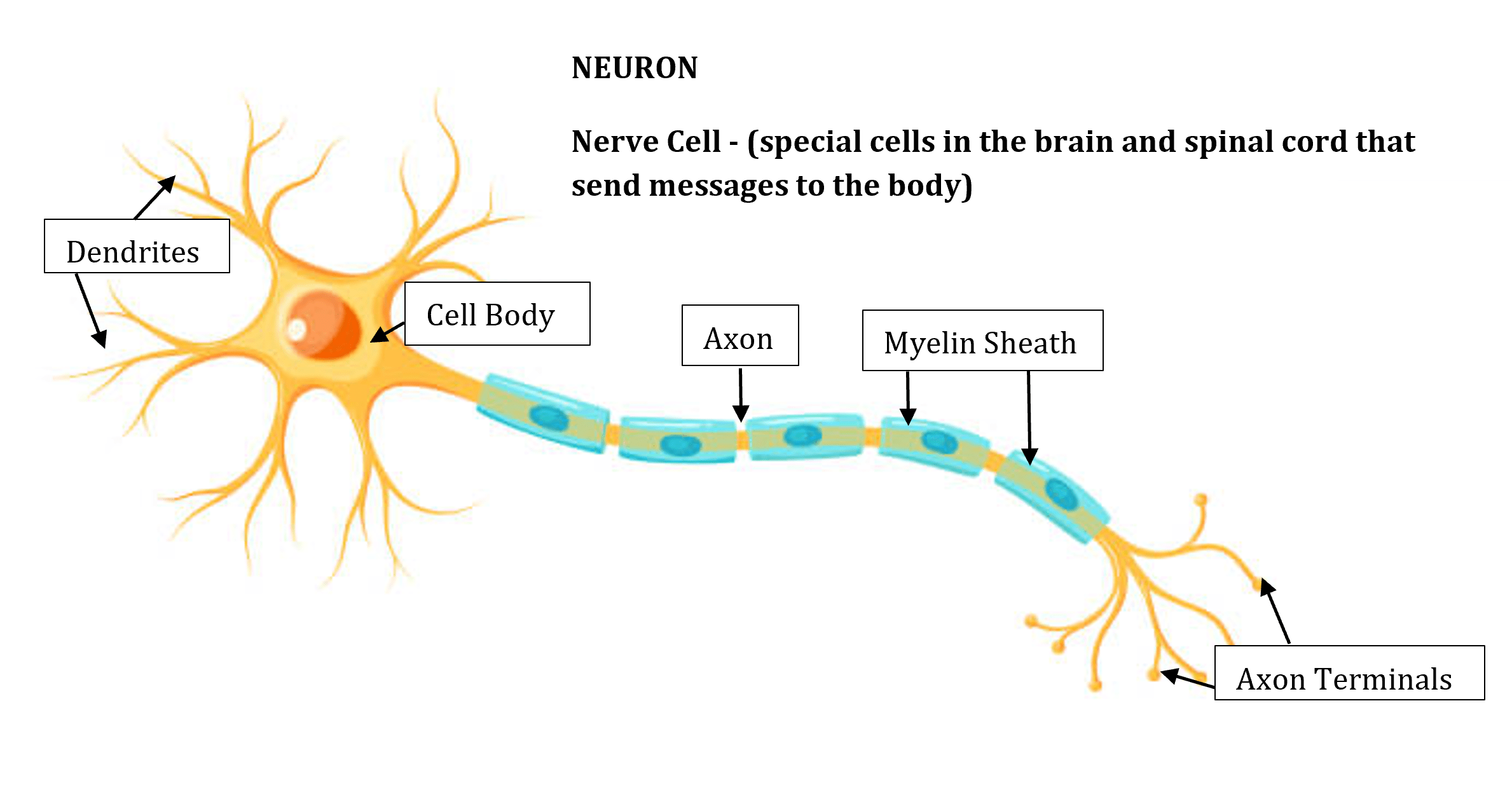
The game of Telephone works sort of like how messages get sent in the brain. Messages in the brain are sent through a network of specialized nerve cells called neurons, using a combination of electrical and chemical signals. Neurons are made up of the dendrites, the cell body, and the axon. The signals are like messages. Dendrites are the main pathway of a signal in a neuron; they receive signals. The axon is a long fiber in the cell body along which the signal is passed. It is covered by a myelin sheath, which helps speed up the signal, and the axon terminal is where the signal is passed along to the next neuron.
(Show students the diagram of a neuron below in Figure 1.) Point out the main parts and their functions. Have students fill out the unlabeled version [Neuron Diagram] for their reference.)
In the Telephone game, each of you acted as a neuron: you received a message and passed it on. Sometimes it was difficult to pass the message along, and sometimes it was easy. The myelin sheath is found in certain neurons. Myelin is a fatty, protective layer wrapped around the axon, allowing signals to travel quickly and easily. Damage to the myelin can slow down, disrupt, or block the signal being sent in the brain. When the myelin is lost or damaged, it is called demyelination. This can cause health issues such as vision problems, muscle weakness, difficulty with coordination and balance, memory problems, difficulty concentrating and thinking, and others. A commonly known demyelinating disease is multiple sclerosis (MS). There is no known cure for MS, but scientists are studying myelin to try to figure out how to protect it from damage and how to remyelinate the cells.
Remyelination is the process of repairing or replacing damaged or missing myelin. Some of the scientists who are studying this are biochemical engineers, who use science (biology and chemistry) and math to design, build, or improve things that solve problems and make life better.
Which version of the Telephone game represented a normally functioning myelinated brain, where the message or signal was easily, quickly, and correctly passed along? (Answer: Version 2)
Which version of the Telephone game represented demyelination, with damage to the myelin, and the message or signal was difficult, slow, and incorrectly passed along? (Answer: Versions 1 and 3)
We will explore an engineering activity where you will use knowledge of myelin to figure out how long it takes a signal to travel from neuron to neuron through myelinated, demyelinated, and remyelinated pathways. You will use engineering, math skills, and teamwork to complete the activity.
Procedure
Background
Neurons (nerve cells) are the basic units of the nervous system. They are responsible for transmitting information throughout the body. The three main types of neurons are sensory neurons, motor neurons, and interneurons. Sensory neurons receive information from the senses (e.g., light, sound, touch, smell, and taste). Motor neurons carry signals from the brain and spinal cord to the muscles and glands. Interneurons connect sensory and motor neurons and help process information within the nervous system.
The basic anatomy of a neuron includes the dendrites, the cell body, and the axon. The basic pathway of a signal in a neuron is as follows: dendrites receive the signal, and the signal passes through the cell body, travels along the axon, and then is passed to the next neuron via axon terminals (see Figure 1). Neurons in the white matter portions of the brain (not gray matter) have a myelin sheath, a fatty, segmented, protective layer wrapped around the axon. Myelin allows signals to travel faster and more efficiently.
Damage to the myelin can slow down, disrupt, or block signals being sent in the brain and spinal cord. When the myelin is lost or damaged, it is called demyelination. This can cause health issues such as vision problems, muscle weakness, difficulty with coordination and balance, memory problems, difficulty concentrating and thinking, and others. A commonly known demyelinating disease is multiple sclerosis (MS). There is no known cure for MS, but scientists are studying myelin to try to figure out how to protect it from damage and also how to remyelinate the cells. Remyelination is the process of repairing or replacing damaged or missing myelin.
MS is a chronic disease of the central nervous system in which the immune system mistakenly attacks the myelin sheath surrounding neurons. This immune response causes inflammation and damage that leads to areas of demyelination, disrupting the normal flow of electrical signals in the brain and spinal cord. Because different nerve pathways can be affected, people with MS may experience a wide range of symptoms, including fatigue, numbness or tingling, muscle weakness, vision problems, balance and coordination difficulties, and changes in memory or thinking. Symptoms can vary in severity and may come and go or progressively worsen over time. Ongoing research focuses on understanding MS and developing treatments that reduce immune attacks and promote remyelination to restore normal nerve signaling.
Before the Activity
- Gather all listed materials.
- Prepare slips of paper (one per student) that are one-sentence directions to disrupt/complicate Round 3 of Telephone game. (Suggested sentences and disruptions can be found in the Telephone Game Ideas Sheet.)
- Prepare ramps; they must be set to the same height and slope for all groups.
- Prepare short-length sample tubes, each lined with small portions of the myelin materials.
- Conduct 5 timed tests of the time (seconds to the nearest tenth) it takes a marble to travel the length of the tube without any material lining (foam surface only); calculate the average time.
- Between Day 3 and Day 4, “demyelinate” the tubes—purposely cause damage by cutting and removing parts of the myelin material.
- Have the Neuron Diagram Answer Key ready to display.
- Make copies of Neuron Diagram (1 per student).
- Make copies of Mission Myelin: Model Sheet (1 per group).
- Make copies of Mission Myelin: Damage Sheet (1 per group).
- Make copies of Mission Myelin: Repair Sheet (1 per group).
- Make copies of Mission Myelin: Results Sheet (1 per group).
During the Activity
Day 1
- Play “Telephone” game(s) as outlined in the Introduction and Motivation.
- Display Figure 1 for students to view.
- Point out the main parts of the neuron and explain their functions using the diagram.
- Give each student a Neuron Diagram worksheet.
- Have students complete the unlabeled Neuron Diagram worksheet for their reference.
- Explain and discuss the science connection between the Telephone game and how neurons transmit signals.
Day 2
- Show the class the materials available.
- Explain the design challenge. Students will add myelin to an axon model with the following constraints:
- A foam tube represents the axon.
- Various materials represent myelin.
- Instead of wrapping the material around the tube, students will line the inside of the tube and secure it with tape.
- A marble represents the signal/message being sent.
- The goal is to choose a material that allows the marble to travel as quickly and smoothly as possible through the tube, modeling how myelin helps signals move rapidly along an axon.
- Show students short, prepared sample tubes, each lined with small sections of different myelin materials.
- Explain that they will explore these samples with a partner.
- Assign partners.
- Arrange the sample tubes around the classroom as stations.
- Have partners rotate through the stations, spending a few minutes at each station. At each station, they should roll the marble through the tube and observe how it moves.
- Have partners discuss their observations and decide which material(s) they think best act like myelin—those that allow the marble to travel quickly and easily down the tube.
- Instruct partners to collect their chosen materials and begin adding the “myelin” to their axon tube.
Day 3
- Distribute copies of the Mission Myelin: Model Sheet.
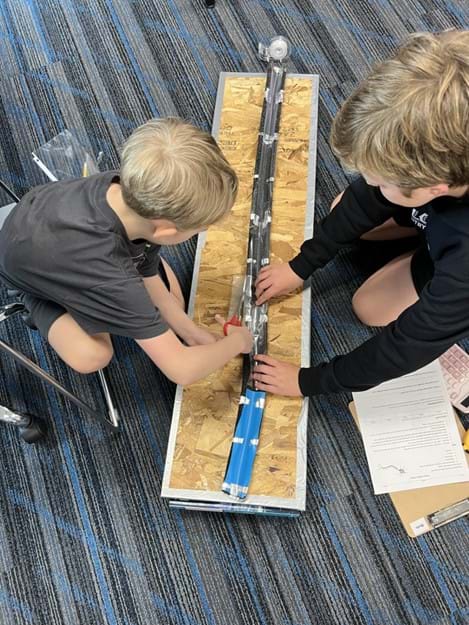
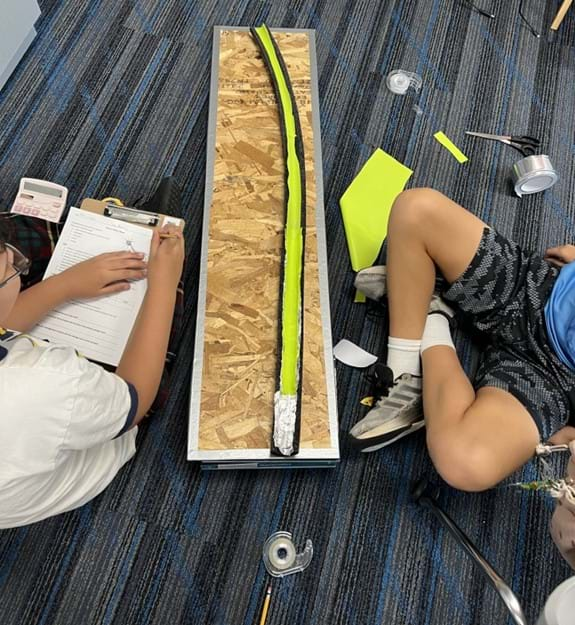
- Have partners finish constructing their myelin tubes. During construction, they should periodically test the tube by allowing the marble to roll through it to check for speed and ease of travel.
- Once construction and practice are complete, have partners collect data using the Mission Myelin: Model Sheet, their tube, a marble, pencil, calculator, stopwatch, and the set-up ramp.
- Ensure each group affixes their tube to the top of the ramp with tape and the bottom of the ramp to the floor with tape. Note: Tape should not be anywhere the marble will touch.
- Instruct one partner to hold the marble at the top of the tube and release it (do not push) on a verbal “Go.” The other partner manages the stopwatch:
- Start timing at “Go.”
- Stop timing when the marble touches the floor at the end of the tube.
- Note: If the marble falls out of the tube and touches the floor before reaching the end, immediately stop the stopwatch and record “N/A” (Not Applicable) for that trial.
- Have each group conduct and record five separate marble roll trials, recording times to the nearest tenth of a second on the Mission Myelin: Model Sheet.
- After completing all trials, have each group calculate the average time of the five marble rolls and record it on their sheet.
- As a class, compare the average times from each group. Record the myelin materials used alongside the average times. (Data may be recorded on a whiteboard, chart paper, or projected on a screen.)
Day 4
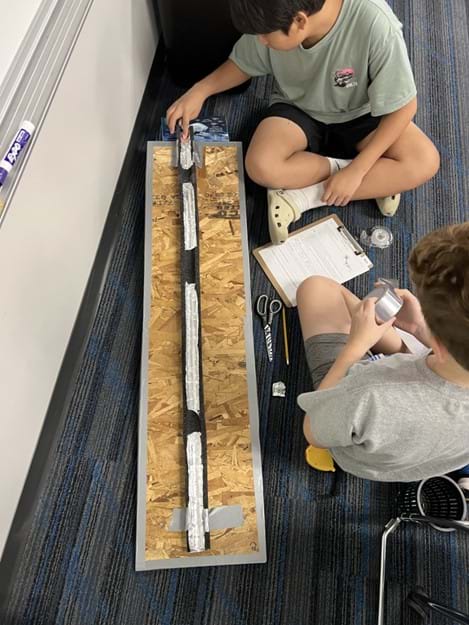
- Reveal to the students that their myelin tubes have been damaged (demyelinated)!
- Distribute copies of the Mission Myelin: Damage Sheet.
- Explain that partners will retest their now demyelinated tubes.
- Have each group gather their Mission Myelin: Damage Sheet, damaged tube, marble, pencil, calculator, stopwatch, and the ramp setup.
- Instruct partners to secure their tube to the top of the ramp with tape and tape the bottom of the ramp to the floor. Tape should not be placed anywhere the marble will touch.
- Assign partner roles for data collection:
- One partner holds the marble at the top of the tube and releases it (do not push) on a verbal “Go.”
- The other partner operates the stopwatch, starting it at “Go” and stopping it when the marble touches the floor at the end of the tube.
- Note: If the marble falls out of the tube and touches the floor before reaching the end, stop the stopwatch immediately and record “N/A” (Not Applicable) for that trial.
- Have each group complete and record five separate marble roll trials. Record times to the nearest tenth of a second on the Mission Myelin: Damage Sheet.
- Have partners calculate the average time of the five trials and record it on their sheet.
- Instruct partners to compare their demyelinated average time to their original myelinated average time.
- As a class, compare demyelinated average times across groups. Record observed damage features alongside the average times. (Data may be recorded on a whiteboard, chart paper, or projected on a screen.)
- Facilitate a whole-class comparison of demyelinated versus myelinated times across all groups.
Day 5
- Explain to students that they will now attempt to repair their damaged myelin tubes (remyelination).
- Distribute copies of the Mission Myelin: Repair Sheet.
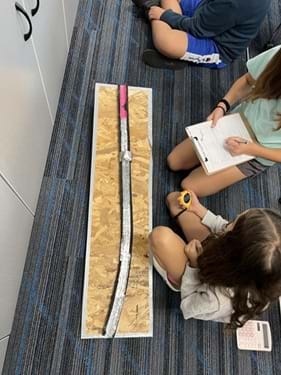
- Instruct partners to plan how they will repair their demyelinated tubes to model remyelination.
- Emphasize the design goal: Repairs should result in a faster marble travel time than the demyelinated tube. (The goal is to have the remyelinated tube allow the marble to travel faster than it did in the demyelinated tube.)
- Ensure partners have access to all materials, including the Mission Myelin: Repair Sheet, damaged tube, marble, pencil, calculator, stopwatch, and ramp setup.
- Have partners discuss, decide, and engineer repairs to their tubes.
- After repairs, instruct partners to secure their tube to the top of the ramp with tape and tape the bottom of the ramp to the floor. Tape should not be placed anywhere the marble will touch.
- Assign partner roles for testing:
- One partner releases the marble (do not push) from the top of the tube on a verbal “Go.”
- The other partner operates the stopwatch, starting at “Go” and stopping when the marble touches the floor at the end of the tube.
- Note: If the marble falls out of the tube and touches the floor before reaching the end, stop timing immediately and record “N/A” (Not Applicable) for that trial.
- Have each group conduct and record five marble roll trials. Record times to the nearest tenth of a second on the Mission Myelin: Repair Sheet.
- Have partners calculate and record the average time of the five trials.
- As a class, compare average remyelinated times across groups. Record the types of repairs made alongside the average times. (Data may be recorded on a whiteboard, chart paper, or projected on a screen.)
- Facilitate a comparison of remyelinated times to demyelinated times across partner groups.
Day 6
- Explain to students that they will display, analyze, and interpret the data they collected throughout the investigation.
- Distribute copies of the Mission Myelin: Results Sheet.
- Have partners work together to complete the sheet using their Mission Myelin: Model Sheet, Mission Myelin: Damage Sheet, and Mission Myelin: Repair Sheet.
- Facilitate a class discussion to compare and interpret results across groups.
- Have students complete the reflection and assessment.
Vocabulary/Definitions
demyelination: Damage to, or loss of, the myelin sheath.
mean (average): The average of a set of numbers, calculated by summing them and dividing by the number of values.
myelin: An insulating layer, or sheath that forms around nerves, including those in the brain and spinal cord.
myelin sheath: A fatty, insulating layer that covers the long, slender projections (axons) of nerve cells (neurons).
neuron: A type of cell that receives and sends messages from the body to the brain and back to the body; a nerve cell.
neuron signal: A brief electrical or chemical change that travels along a neuron, transmitting information throughout the nervous system.
remyelination: The process of repairing or rebuilding the myelin sheath, a protective covering around nerve fibers, after it has been damaged or lost.
Assessment
Pre-Activity Assessment
Telephone Game: Have students share the connections of the versions of the Telephone game to the science concepts presented. Have students first discuss with their Telephone group, then the whole class. Several questions are already included in the activity itself (Introduction and Motivation section). Reinforce which Telephone games connect to myelination and demyelination.
- Which version of the Telephone game represented a normally functioning myelinated brain, where the message or signal was easily, quickly, and correctly passed along? (Answer: Version 2.)
- Which version of the Telephone game represented demyelination, which is damage to the myelin, where the message or signal was difficult, slow, and incorrectly passed along? (Answer: Versions 1 and 3.)
Activity Embedded (Formative) Assessment
Probing Questions: The teacher asks variations on the following questions to each group.
- Justify or explain why you chose XXXX material to act as the myelin in your model. (Example answer: The marble travels very quickly and easily on that material.)
- What do the tube, material, and marble represent in a neuron? (Answer: tube = axon, material = myelin, marble = signal)
- We are representing myelin on the axon (material on a tube) differently than in a real neuron. What is the main difference? (Answer: Our myelin is lined inside the tube. In a real neuron, the myelin is wrapped around the axon and segmented; the myelin and axon are made of different materials than what we used in class.)
- What happened to the marble times in the demyelinated tube compared to the myelinated tube? Why? (Answer: The times were longer because the damage slowed the marble down. A time could not be recorded because the marble could not or did not travel the entire pathway.)
- How would damage to (real) myelin affect signals in the brain? (Answer: The signal or message may not get delivered correctly, quickly, or at all, just like in the Telephone game and just like the marble in the tube. A messed-up myelin means a messed-up message. It could cause problems for someone’s vision, walking, talking, thinking, and more.)
- What happened to the marble times in the remyelinated tube compared to the demyelinated and myelinated tubes? Why? (Answer: The times were the same as the demyelinated tube or longer because the damage could not be fully repaired and slowed the marble down. A time could not be recorded because the marble could not or did not travel the entire pathway. The marble time improved from the demyelinated time and was just as fast as the original myelinated tube. The marble time improved from the demyelinated time but was not as fast as the original myelinated tube.)
Post-Activity (Summative) Assessment
Reflection Questions: Students fill out the Mission Myelin: Results Sheet.
Safety Issues
- Remind students of the appropriate use of materials, especially scissors.
Troubleshooting Tips
- You may need to work individually with students who have trouble using and reading the stopwatch.
Activity Extensions
- Allow students to repeat the engineering process using a different myelin material.
- Increase or decrease constraints on materials (availability, amount, or type).
- Instead of providing initial data, have students conduct five trials and calculate the average time it takes a marble to move through the tube without any myelin material (foam surface only).
Activity Scaling
- Adjust group size to 3–4 students.
- Create groups with mixed ability levels to support peer learning.
- Assign specific roles to students based on their strengths (e.g., recorder, materials manager, timekeeper, presenter).
- Allow students to answer selected questions verbally instead of in writing.
- Have students calculate the mean time without using a calculator.
- Challenge students to compare results across different materials and justify which design best meets the criteria using evidence.
Subscribe
Get the inside scoop on all things Teach Engineering such as new site features, curriculum updates, video releases, and more by signing up for our newsletter!More Curriculum Like This

Students learn about the function and components of the human nervous system, which helps them understand the purpose of our brains, spinal cords, nerves and five senses. In addition, how the nervous system is affected during spaceflight is also discussed.

In this lesson on the brain's neural networks, students investigate the structure and function of the neuron. They discover ways in which engineers apply this knowledge to the development of devices that can activate neurons.

This is the first activity in a unit of four activities. Students are introduced to foundational neuroscience concepts, focusing on motor and sensory neurons and their connections to muscles at the synapse. Through handouts and activities, they explore brain anatomy and construct a basic homunculus ...

Students learn about the first attempts at machine learning and specifically about the perceptron model—a simplified model of a biological neuron.
Copyright
© 2026 by Regents of the University of Colorado; original © 2024 University of KansasContributors
Laura MartzSupporting Program
Inquiry-Driven Engineering Activities using Bioengineering (IDEA-BioE), University of KansasAcknowledgements
This material is based upon work supported by the National Science Foundation under grant no. ECC-2055716 - a Research Experience for Teachers program titled Inquiry-Driven Engineering Activities using Bioengineering (IDEA-BioE) at the University of Kansas. Any opinions, findings and conclusions or recommendations expressed in this material are those of the author(s) and do not necessarily reflect the views of the National Science Foundation.
Last modified: January 10, 2026
User Comments & Tips