
Stay in Shape
Students learn that math is important in navigation and engineering. They learn about triangles and how they can help determine distances. Ancient land and sea navigators started with the most basic of navigation equations (speed x time = distance). Today, navigational satellites use equations that take into account the relative effects of space and time. However, even these high-tech wonders cannot be built without pure and simple math concepts — basic geometry and trigonometry — that have been used for thousands of years.
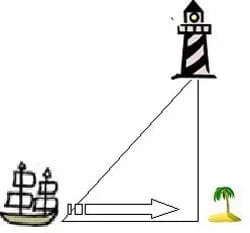 Triangles are helpful in navigation and engineering
Understanding the properties of certain shapes is useful to engineers. For example, to measure extremely long distances, engineers use their understanding of geometry and angles. Civil engineers sometimes design buildings with cross-bracing for added strength. Depending on the type of cross-bracing used, different triangle shapes are formed, which greatly affects the structure quality. Computer engineers who design recordable compact discs to store music calculate the disc's circumference (circle perimeter) to determine its storage capacity.
After this activity, students should be able to:
- Describe how navigation technology is founded on mathematical principles that have been used for thousands of years
- Use geometric relations of triangles and circles to find distances.
- Use the Pythagorean Theorem.
- 7.1.2.c Solve real-world and mathematical problems involving the four operations with rational numbers.
Grade 7
Do you agree with this alignment? - 8.4.2.b Apply the Pythagorean Theorem to determine unknown side lengths in right triangles in real-world and mathematical problems in two and three dimensions.
Grade 8
Do you agree with this alignment?
- Describe methods and equipment used to explore the solar system and beyond
Grade 8
Do you agree with this alignment?
- CCSS.Math.Content.8.G.B.7 Apply the Pythagorean Theorem to determine unknown side lengths in right triangles in real-world and mathematical problems in two and three dimensions.
Grade 8
Do you agree with this alignment? - CCSS.Math.Content.HSG-SRT.C.8 Use trigonometric ratios and the Pythagorean Theorem to solve right triangles in applied problems.
Grades 9-12
Do you agree with this alignment?
- STEL-3G Explain how knowledge gained from other content areas affects the development of technological products and systems.
Grades 6-8
Do you agree with this alignment?
Each student needs:
- pencil
- protractor (can share among students)
- Stay in Shape Worksheet
- Stay in Shape Datasheet
How important is understanding shapes and angles when navigating? (Answer: Very important: being able to determine a position relative to other objects depends on knowing geometric relationships.) As the world grows more complex, we want to navigate faster and know exact distances and times of travel.
How did people first determine distances between cities? Or, how about the size of the Earth? (Answer: They measured the distance between two cities and then used trigonometry to extrapolate that to the size of the earth.) It is all possible using relationships of simple shapes and angles. These principles can be applied to determine almost any distance or height given appropriate reference points. Triangles and their usefulness for measuring distance will be explored in this activity.
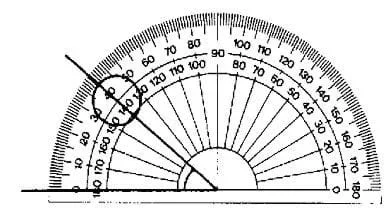 A protractor is used to measure angles.Copyright M. Lippis, University of Colorado at Boulder, 2003.
The sum of the angles in any triangle is 180º.
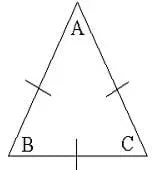 Copyright J. White, University of Colorado at Boulder, 2003.

Types of triangles:
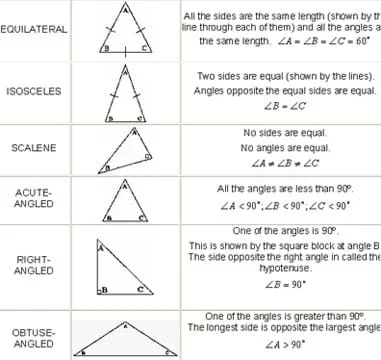
Pythagorean Theorem was an idea discovered by Pythagoras, a Greek mathematician who lived from 569-500 BC. It is said that he discovered the special property of right-angled triangles while looking at the tiles of an Egyptian Palace.
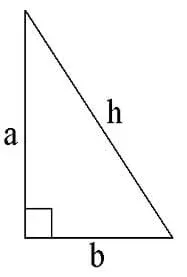 Copyright J. White, University of Colorado at Boulder, 2003.
Pythagoras said, "In a right angled triangle, the area of the square of the hypotenuse equals the sum of the squares of the other two sides."
h is the hypotenuse

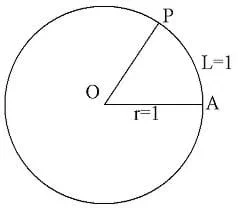
A radian is the angle made when the radius of a circle projects an arc on its perimeter.
One radian is the measure of the angle created at the center of a circle by an arc on the perimeter equal in length to the radius of the circle. A radian is a different way to measure an angle than using degrees.
 Copyright J. White, University of Colorado at Boulder, 2003.
If r = 1 unit
and length, L = 1 unit
then ∠AOP = 1 radian

1 radian = 57.30 degrees
If there are 360º in a circle, then 360º / 57.3º per radian = 6.28 radians on the perimeter of a circle. Notice that number equals 2 x 3.14 (pi or π) radians; therefore, 3.14 radians = 180º.
Before the Activity
- Print out enough copies of the Stay in Shape Worksheet and Stay in Shape Datasheet, one each per student.
- Review the properties of triangles and circles, as described above.
With the Students
Remind students that understanding shapes and angles is important in navigation; being able to determine a position relative to other objects depends on knowing geometric relationships. Explain that the word "geometry" comes from the Latin roots geo (meaning land or Earth) and metry (meaning measure). Geometry, therefore, means measurements of the Earth, which is precisely what is needed in navigation.
- Have students brainstorm in groups what they know about triangles and circles. Clarify the true statements and write them on the board.
- Hand out the worksheets and datasheets
- Do the the Ship #1 problem as a class. Have the students try the second ship problem on their own. Note: It may be helpful to write the following chart on the board for the Ship #2 problem. First write the numbers 1-15 across and then have the students come up with the square values for each.

- Do the third ship problem with the class. (For question #3, the relationship between a circle's radius and its perimeter must be established. Discuss what this relationship is from the background section.)
- Ask the students to add any new properties of triangles and circles learned to the list already on the board.
Pre-Activity Assessment
Brainstorming: In small groups, have students engage in open discussion. Remind students that no idea or suggestion is "silly."
- What are the properties of triangles and circles? Write on board as directed in Step 1 of the "With the Students" section.
Activity Embedded Assessment
Shape Datasheet and Shape Worksheet: Have students complete the attached worksheets.
- Have students do geometry calculations on the data sheet of angles and distances.
Post-Activity Assessment
Debrief: Lead a discussion on the learned subject and ask students to relate their observations of the activity.
- Ask for input from students to add new — or remove any proven false — properties of triangles and circles learned to the list already on the board.
If students get confused when working on the circular question (#3) of the third ship problem, clarify the difference between radians and degrees (that is, what does it mean to be 50 radians away?). Use the worksheet as a teaching tool.
Using the website: http://www.staff.vu.edu.au/mcaonline/units/trig/trigraddegrees.html, either as a group or individually, have students complete some of the sample problems.
- For younger students, work through all the activities together.
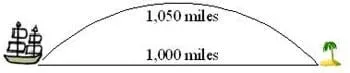
- For older students, discuss why the curve of the Earth was not used in the first and second ship problems. (Answer: Because the distances were very small compared to the curve of the Earth. At small distances the Earth can be considered flat.) At what distance is it necessary to include the curve of the Earth? (Answer: It depends on the application and how accurate the measurement needs to be. But, if you were sailing to an island using a flat Earth map, you would be short of your target by about 5 miles after sailing 100 miles (probably within sight on a clear day). If the island were 1,000 flat miles away, you would end up being 50 miles short.
 Copyright M. Lippis, University of Colorado at Boulder, 2003.
- Plot Your Course - Navigation
- Where Is Here?
- How to be a Great Navigator!
- Navigating by the Numbers
- Stay in Shape
- Trig River
- Accuracy, Precision and Errors in Navigation: Getting It Right!
- Topo Map Mania!
- Getting to the Point
- Navigational Techniques by Land, Sea, Air and Space
- Navigating at the Speed of Satellites
- GPS on the Move
- Not So Lost in Space
Contributors
Jeff White; Matt Lippis; Penny Axelrad; Janet Yowell; Malinda Schaefer Zarske
Supporting Program
Integrated Teaching and Learning Program, College of Engineering, University of Colorado Boulder
Acknowledgements
The contents of this digital library curriculum were developed under a grant from the Satellite Division of the Institute of Navigation (www.ion.org) and National Science Foundation GK-12 grant no. 0338326.
Copyright
2004 by Regents of the University of Colorado.