
How to be a Great Navigator!
In this lesson, students learn how great navigators of the past stayed on course — that is, the historical methods of navigation. The concepts of dead reckoning and celestial navigation are discussed.
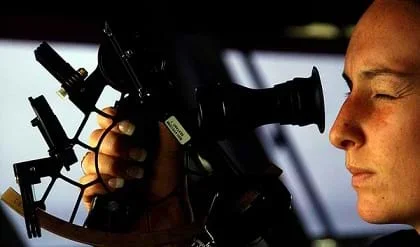 What makes great navigators?Copyright U.S. Navy. Wikimedia Commons https://commons.wikimedia.org/wiki/File:US_Navy_050721-N-5549O-038_Quartermaster_2nd_Class_Stephanie_Hudson_from_Plymouth,_Mass.,_peers_through_a_marine_sextant,_a_navigational_instrument_used_to_determine_celestial_navigation_aboard_USS_Ronald_Reagan_(CVN_76).jpg
Dead reckoning concepts are important for engineers who make predictions and analyze circumstances related to motion; they must understand the relationships between speed, time and distance. Engineering is built upon a network of knowledge extending way back in time. Even though celestial navigation is for the most part historical, the best engineers understand how things used to be done, building on the same mathematics concepts, such as geometry and trigonometry, used by engineers every day.
After this lesson, students should be able to:
- Understand the concept of distance equal to speed multiplied by time
- Interpret altitude data to form conclusions about latitude.
- Understand how a cross staff, sextant, and clock help determine your location
- Understand how modern navigation technology is founded upon a network of knowledge extending way back in time
- 8.4.2 Direct and indirect measurement can be used to describe and make comparisons.
Grade 8
Do you agree with this alignment? - 7.1.2.c Solve real-world and mathematical problems involving the four operations with rational numbers.
Grade 7
Do you agree with this alignment?
- Describe methods and equipment used to explore the solar system and beyond
Grade 8
Do you agree with this alignment?
- CCSS.Math.Content.6.NS.B.3 Fluently add, subtract, multiply, and divide multi-digit decimals using the standard algorithm for each operation.
Grade 6
Do you agree with this alignment?
- STEL-3G Explain how knowledge gained from other content areas affects the development of technological products and systems.
Grades 6-8
Do you agree with this alignment? - STEL-6D Engage in a research and development process to simulate how inventions and innovations have evolved through systematic tests and refinements.
Grades 6-8
Do you agree with this alignment?
The following topics will be discussed: dead reckoning; how early navigators knew their speed, time and direction; and celestial navigation in determining your latitude
Dead reckoning is the process of navigation by advancing a known position using course, speed, time and distance to be traveled. In other words, figuring out where you will be at a certain time if you hold the speed, time and course you plan to travel. Although dead reckoning normally has a 10% error associated with it, sailors relied on this form of navigation — also, called deduced reckoning — to travel the seas until celestial navigation was developed. Refer to the associated activity The North (Wall) Star to have students conduct their own celestial navigation adventure. Columbus — and most other sailors of his era — used this method. With dead reckoning, the navigator finds their position by estimating the course and distance they have sailed from some known point. Starting from a known point, such as a port, the navigator measures out their course and distance from that point on a chart, pricking the chart with a pin to mark the new position. Students can act as sailors in the associated activity Vector Voyage! by determining the location of their landfall during a sailing trip from Europe to North America.
Today, navigators record their speed using a "Ship's Log," but how did early navigators know their speed to even be able to keep track of it? In Columbus' day, the ship's speed was measured by throwing a log over the front side of the ship, or "Heaving the Log." There were two marks on the ship's rail that were a measured distance apart. When the log passed the forward mark, the pilot would start a quick chant; when the log passed the aft mark, the pilot would stop chanting. (The exact words to such a chant are part of a lost history of navigation.) The pilot would then note how much of the chant he recited, which would then enable him to determine the speed of the boat based on the distance traveled. This method would not work when the ship was moving very slowly, since the chant would be over before the log actually reached the aft (last) mark.
Speed x Time = Distance
This makes sense when you look at the units:
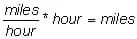
The hours cancel to give your distance in miles.
Many years after the development of the Heaving the Log method, another technique came along, called the Chip Log, to measure a ship's speed. The Chip Log apparatus consisted of a small weighted wood panel that was attached to a reel of rope, which had knots tied at equal distances. Sailors would throw the wood panel into the sea, behind the ship, and the rope would start unwinding from the reel. The faster the ship was moving forward the faster the rope would unwind. Using a 30-second sand glass to time the number of knots that went overboard in a given time interval, the ship's speed could be determined. The Chip Log method is in fact the origin of the nautical speed unit, the knot, and of the Ship's Log, which is currently used by Sailors record their ship's speed.
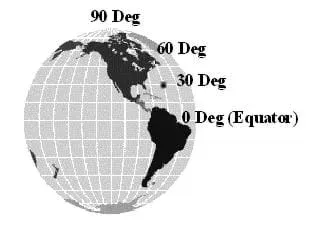 Figure 1. The Earth, measured in degrees.Copyright J. White, University of Colorado at Boulder, 2003.Along with their speed and distance, they needed to know the direction of travel. This was done, logically, using a compass. Since they knew their distance and direction, they could determine their current location based on their previous location.
Celestial navigation is the art and science of finding one's geographic position by means of astronomical observations, particularly by measuring altitudes of celestial objects: sun, moon, planets, or stars. This lesson looks at the basic, but very important and useful, celestial measurement of the elevation of the North Star, also called Polaris.
In ancient times, navigators planning to sail out of sight of land would simply measure the altitude of Polaris — using a cross staff, or sextant — as they left homeport. They were essentially measuring the latitude of their homeport. To return after a long voyage, they needed only to sail north or south, as appropriate, to bring Polaris to the altitude of homeport, then turn west or east as appropriate and "sail down the latitude," keeping Polaris at a constant angle.
The world today is highly organized and in our day-to-day lives, we rarely think of ourselves as navigators. Either taking a hike or simply going to a large park, the thrill of wondering what's around the next corner exists, but we generally know where we are. Today people rely on technological devices and precise maps to stay on track. But, what if the batteries in a high-tech device fail? What if the map falls out of your pocket? What do you do if you do become lost in the wilderness? (Possible answers: Use a compass, look at your map, look for known landmarks, call for help.) Even visiting a city, entering a new building, traveling via subway, or getting separated from someone in a department store, we can become lost. This is when it is beneficial to know some basics of navigation.
If we are ever lost, or even just feel that we are lost, we often say that we need to "get our bearings," a common expression which means to figure out where you are. Before navigation by dead reckoning is possible, you need at least fours pieces of information. Does anyone know what they are?
- Starting Point – where you began.
- Course – what direction you are traveling.
- Speed – how fast you are traveling.
- Time – how long you have been traveling.
Using this information and the principle of dead reckoning, you can figure out where you are. If any of these pieces of information is missing, you will not be able to determine where you will end up.
Celestial navigation requires multiple observations over time to pinpoint a location. By locating the North Star, only two pieces of information are known: the direction North, and that you are somewhere on a latitude circle of the Earth. However, this is better than nothing, for if you know the latitude of your target, you may not know how far away it is, but you know you will reach it if you stay on that latitude and keep going. Use a globe to discuss these concepts with students.
- altitude
- The height of a celestial object above the horizon, measured in degrees.
- course
- The direction you intend to steer a vessel. A vessel's course does not take into account current and drift.
- course made good
- The course that you actually travel, taking into account the wind and ocean currents.
- estimated position (ep)
- A position determined through dead reckoning and may include effects of current and wind.
- landfall
- The land sighted or reached after a voyage.
- polaris
- Another name for the North Star.
- position
- The actual geographic location of a vessel identified by coordinates of latitude and longitude (for example, 040 degrees E and 45 degrees N).
- sextant
- Another name for a cross staff, which is a device used to measure altitude.
- zenith
- A point in the sky directly above a person or location (zenith elevation = 90 degrees).
Pre-Lesson Assessment
Discussion Question: Solicit, integrate, and summarize student responses.
- How did people navigate before navigation instruments were designed? (Answer: natural landmarks, sun, moon, stars, dead reckoning, following animals, etc.)
Post-Introduction Assessment
Voting: Ask a true/false question and have students vote by holding thumbs up for true and thumbs down for false. Count the votes, and write the totals on the board. Give the right answer.
- True or False: If you use dead reckoning, you will never become lost? (Answer: False. Many factors — such as the chant used by sailors — that are involved in dead reckoning are not always precise, throwing off your estimate.)
- True or False: If you find the North Star, you can estimate exactly where you are? (Answer: True if you are in the Northern Hemisphere, but false if you are in the Southern Hemisphere since the North Star cannot be seen from there. In ancient times, the navigators planning to sail out of sight of land would simply measure the altitude of Polaris as they left homeport, essentially measuring the latitude of their homeport. To return after a long voyage, they needed only to sail north or south, as appropriate, to bring Polaris to the altitude of home port, then turn left or right as appropriate and sail down the latitude, keeping Polaris at a constant angle.)
Lesson Summary Assessment
Question/Answer: Solicit, integrate, and summarize student responses.
- If you left your port and sailed southeast for two days but did not record your speed, would you know where you are? (Answer: No. You only know that you are on a line somewhere SE of your port.)
- If you left your port and sailed southeast at 5 miles/hour but did record the time when you left, would you know where you are? (Answer: No. Again, you only know that you are on a line somewhere SE of your port.)
- If you left your port and sailed at 5 miles/hour for two days but did not record the direction, would you know where you are? (Answer: No. You only know that you are somewhere on a circle 240 miles (48 hours x 5 mph = 240) from your port.)
- Which of the above situations is the worst? Why? (Answer: the latter. In the first two scenarios, you do not know how far away you are, but you know the direction. In the last scenario, you know how far you are, but have no idea which way will take you back to homeport.)
Have students research early navigators' methods either on the Internet or at the library. Have them write a short essay on their chosen navigator and his means of navigation and whether or not that method would be effective for today's sea captains.
Beck, Sandi. ST6 - Compass Star Tracker. June 2003. California Institute of Technology. October 16, 2003. http://science.nasa.gov/missions/st6/
"Dometrails." September 2, 2000. Online image. Astronomy Picture of the Day. October 17, 2003. http://antwrp.gsfc.nasa.gov/apod/image/0009/dometrails_cfht_big.jpg>.
Skorucak, Anton, "How do sea navigators measure their ships speed?" Physlink.com. November 1, 2004. http://www.physlink.com/Education/AskExperts/ae400.cfm>.
Woodfill, Jerry. Medieval and Twentieth Century Navigation. August 28, 2002. National Aeronautics and Space Administration. October 16, 2003. http://vesuvius.jsc.nasa.gov/er/seh/navigate.htm
- Plot Your Course - Navigation
Homework
Internet Search: Assign students to research on the Internet some of the concepts explored in this lesson. Lead a brief discussion of student findings during the next class period.
Contributors
Jeff White; Penny Axelrad; Janet Yowell; Malinda Schaefer Zarske
Supporting Program
Integrated Teaching and Learning Program, College of Engineering, University of Colorado Boulder
Acknowledgements
The contents of this digital library curriculum were developed under a grant from the Satellite Division of the Institute of Navigation (www.ion.org) and National Science Foundation GK-12 grant no. 0338326. However, these contents do not necessarily represent the policies of the NSF and you should not assume endorsement by the federal government.
Copyright
2004 by Regents of the University of Colorado.