
GPS Receiver Basics
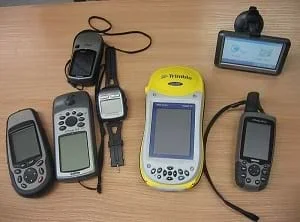 Students work with GPS receiversCopyright Wikipedia http://en.wikipedia.org/wiki/GPS_navigation_device#/media/File:GPS_Receivers_2007.jpg
Students familiarize themselves — through trial and error — with the basics of GPS receiver operation. They view a receiver's satellite visibility screen as they walk in various directions and monitor their progress on the receiver's map. Students may enter waypoints and use the GPS information to guide them back to specific locations.
Some engineers specialize in antenna design and placement for a range of conditions. Antennas are part of every cell phone and tower. In schools, shopping malls, warehouses, hospitals, offices, exhibition halls and airports they enable wireless Internet hot-spot coverage. In a shipping port, antennas collect data on the movement of shipping containers. On helicopters, they provide police, news or sports events with real-time video. Antennas mounted on bicycles or race cars enable continuous high-speed data links. They provide long-distance data transmission from ocean-based oil and gas platforms, buoys, ships, aircraft and spacecraft.
After this activity, students should be able to:
- Understand the core concepts of GPS technology
- Measure and calculate values (i.e distance and speed) from acquired data
- Learn about GPS technology through hands-on experimentation
- HS.1.2.a Reason quantitatively and use units to solve problems.
Grades 9-12
Do you agree with this alignment? - 7.1.2.b.iii Apply properties of operations to divide integers.
Grade 7
Do you agree with this alignment?
- Describe methods and equipment used to explore the solar system and beyond
Grade 8
Do you agree with this alignment?
- CCSS.Math.Content.6.NS.B.2 Fluently divide multi-digit numbers using the standard algorithm.
Grade 6
Do you agree with this alignment? - CCSS.Math.Content.HSN-Q.A.1 Use units as a way to understand problems and to guide the solution of multi-step problems; choose and interpret units consistently in formulas; choose and interpret the scale and the origin in graphs and data displays.
Grades 9-12
Do you agree with this alignment?
- Communication systems are made up of a source, encoder, transmitter, receiver, decoder, and destination.
Grades 6-8
Do you agree with this alignment?
Each group should have:
- GPS Receiver
- Compass (groups may share)
- Small ball for assessment activity
- 2 copies of the worksheet (one for each group member)
It's summer vacation, and Jeremy is already bored with the long, hot days. Fortunately, though, his favorite uncle is visiting for a few days. Jeremy loves it when Uncle Fred comes because he is a mechanical engineer and always has the newest electronic gadgets. Yesterday, when Uncle Fred arrived, he opened his suitcase and began showing Jermey some of his new "toys." In particular, Jeremy's eye caught sight of a small hand-held device called a GPS receiver. Uncle Fred said that the receiver could help you find your way when hiking in the mountains or fishing. Coincidentally, Jeremy is anxious to go fishing in the pond across town; after all, he is 12 years old — old enough, he thinks, to go fishing alone. The problem: he does not know how to get to the pond because he has only been there by car with his mother and father. But, what if he uses Uncle Fred's GPS? He said that it can help you find where you are going, and Jeremy needs to know how to get to the pond. Jeremy heads out on his fishing trip with his "borrowed" GPS receiver.
Should Jeremy use Uncle Fred's GPS receiver? (Answer: No. Aside from the fact that he is using it without his permission, Jeremy does not know HOW to use the device. GPS receivers provide very accurate navigation, but only if you know how to use them properly.)
Lucky for you, this activity will teach you the basics of using a GPS receiver and how to label and use waypoints. Should you stumble across a GPS receiver while on summer break, you will be ready to go (as long as you are accompanied by an adult!).
The Global Positioning System is a constellation (or set) of at least 24 satellites that continuously transmit faint radio signals toward the earth. These radio signals carry information about the location of the satellite and special codes that allow someone with a GPS receiver to measure distance to the satellite. Combining the distances and satellite locations, the receiver can find its latitude, longitude, and height. GPS satellite signals are free and available for anyone to use.
Each GPS manufacturer and model works a little bit differently; but just like a VCR or TV remote control, they all have some common features. The receiver will include a built in antenna, sometimes under a plastic cover and sometimes one that flips up. To work properly, the antenna has to be able to have a clear view of the sky. Almost all GPS receivers will not work indoors. So the first step in using one is to go outside in a relatively clear area and turn on the receiver. They will work fine in any weather conditions (i.e., sunny or overcast skies) and any time of day (night or daytime).
GPS receivers have a permanent memory that remembers its position from the last time that it was turned on, the time, and an almanac of the locations (actually orbits) of the GPS satellites. If your receiver was used relatively recently in a location not too far away, this information will be valid. So, when the receiver is turned on, it will begin looking for the satellites that should be visible at the current time at your location. Once it acquires four satellites, it will begin showing your current location and the current time. At this point, it will show an indication that it is in 3-D navigation mode. The time it takes to get to 3-D navigation will typically be less than one minute, but it can sometimes take a bit longer, especially if you are not out in an open area.
When the receiver is first turned on, it will display some type of satellite visibility page. The Satellite Page shows the satellites that the receiver thinks are currently visible from your location. The GPS constellation of satellites will always have a total of at least 24 satellites; sometimes there are as many as 28 operating at the same time. This means that from any point on earth, there should be at least four available in the sky above you at all times. The GPS satellites travel in orbits around the earth, each with a period of 11 hours and 58 minutes. So depending on the time of day you go outside, your receiver will see different satellites overhead. The same satellites will appear each day but their pattern in the sky will shift four minutes earlier each day. When a new satellite is launched or an old satellite is turned off, the receiver will be notified as soon as it tracks one of the other satellites in the constellation.
Each GPS satellite has a unique number that identifies it, sometimes called a PRN (pseudo random noise code number). The satellite number is shown on the bullseye plot (an actual bullseye-looking diagram in the center of the receiver's screen) and on the bottom of the screen. The bullseye represents the sky above you. Satellites shown in the center are directly overhead, and satellites shown near the outermost ring are near the horizon. North is typically at the top of the screen.
Before the Activity
- Make enough copies of the accompanying worksheet so that each student has one.
- Set up all the GPS receivers to the default or common settings. You will need to:
- Clear the current track
- Set the Units to the factory default or to another common setting that you prefer.
- Set the time on all receivers to show either local time or UTC time (Greenwich).
With the Students
- Start out by asking students how accurate they think the GPS they are using is? (Answer: Very accurate, if you know how to properly use them.) What is the minimum number of satellites needed for the GPS to work? (Answer: Four.) Do GPS receivers work indoors? (Not usually; most require you to be outdoors.)
- Go outside to a large open field or park. Hand out worksheets for students to follow along. Have students turn on their receivers and look at the satellite page. On the Garmin eTrex® receiver, make sure that the satellite page is in "advanced" mode.
- Have students sketch the satellite visibility picture where indicated on the worksheet and point out the directions to the satellites in the sky. Take note of any buildings or trees nearby that might block the students' view.
- Ask students to cover the top of their receiver (specifically the antenna) with their hand and notice that the signal strengths of all the satellites are lost.
- Have students uncover the antenna and move closer to a building or group of trees. Ask them to describe what happens to the satellite signals. Can they predict which satellites will be blocked using the satellite display?
- Ask students to estimate the direction along one edge of the field/park. Have them begin to walk in that direction and monitor their movement on the receiver's map page. Have them check their direction on the compass page. How well does the direction match what they estimated?
- Have students check their speed on the compass page. How fast are they moving? What happens to the compass page if they stop or move slowly?
- Next, ask students to MARK a location and enter a name for the waypoint. They should walk across the field/park and MARK a second waypoint.
- Have them use the GOTO function to tell them how to get from waypoint 2 to waypoint 1. How good (accurate) were the directions?
- Now, ask students to stand still with their receiver. Every once in a while, they should MARK their location (waypoint). Have them look at their marked waypoints. How much are their waypoints changing even though they are not moving?
- While still outside, conduct the "Toss-a-Question" assessment activity described in the Assessment / Evaluation section.
Pre-Activity Assessment
Discussion Questions: Solicit, integrate and summarize student responses.
- How accurate do you think the GPS you are using are? (Answer: Very accurate if you know how to use them properly.)
- What is the minimum number of satellites needed for the GPS to work? (Answer: Four.)
- Do GPS receivers work indoors? (Answer: Not usually; most require you to be outdoors.)
Activity Embedded Assessment
Worksheet: Have the students record their observations on the activity worksheet; review their answers to gauge their mastery of the subject.
Post-Activity Assessment
Toss-a-Question: Provide the students with a list of questions (see below), without answers. Students work in groups and toss a ball or wad of paper back and forth. The student with the ball asks a question and then tosses the ball to someone to answer. If a student does not know the answer, s/he tosses the ball onward until someone gets it. Review the answers at the end. Possible questions/answers include:
- What is the Satellite Page used for? (Answer: In a bullseye diagram, the receiver's current satellites in use are displayed.)
- Why would we want to know which satellites are being used? (Answer: It is helpful information to determine your location in relation to the satellites. The satellites in the center of the bullseye are directly overhead; the satellites in the outermost ring are near the horizon.)
- How good were the directions given by the receiver to get to your waypoint? (Answer: Pretty good if the points are farther apart, but not as reliable if the points are closer together.)
- If time allows, incorporate other questions from Worksheet 1.
Ask students to be very careful with the GPS receivers so as not to cause any damage (especially if they are borrowed!). Remind them to stay in their groups and not to stray too far from their class; they are still novice GPS users!
Make sure to have plenty of spare batteries, as receivers may use them up quickly. If the receiver does not find satellites fairly quickly, make sure that the antenna is not blocked. The antennas are usually located under a plastic shield at the top of the receiver. By holding the receiver flat in your hand, the antenna has a good view of the sky and will likely transmit effectively.
- Plot Your Course - Navigation
- Where Is Here?
- How to be a Great Navigator!
- Navigating by the Numbers
- Accuracy, Precision and Errors in Navigation: Getting It Right!
- Topo Map Mania!
- Getting to the Point
- Navigational Techniques by Land, Sea, Air and Space
- Navigating at the Speed of Satellites
- GPS on the Move
- GPS Receiver Basics
- Making GPS Art: Draw It, Walk It, Log It, Display It!
- GPS Scavenger Hunt
- Not So Lost in Space
Contributors
Matt Lundberg; Penny Axelrad; Janet Yowell; Malinda Schaefer Zarske
Supporting Program
Integrated Teaching and Learning Program, College of Engineering, University of Colorado Boulder
Acknowledgements
The contents of this digital library curriculum were developed under a grant from the Satellite Division of the Institute of Navigation (www.ion.org) and National Science Foundation GK-12 grant no. 0338326.
Copyright
2004 by Regents of the University of Colorado.