

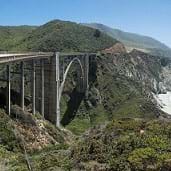
Doing the Math: Analysis of Forces in a Truss Bridge High School Lesson
In this lesson, students learn the basics of the analysis of forces engineers perform at the truss joints to calculate the strength of a truss bridge. This method is known as the “method of joints.” Finding the tensions and compressions using this method will be necessary to solve systems of linear equations where the size depends on the number of elements and nodes in the truss. The method of joints is the core of a graphic interface created by the author in Google Sheets that students can use to estimate the tensions-compressions on the truss elements under given loads, as well as the maximum load a wood truss structure may hold (depending on the specific wood the truss is made of) and the thickness of its elements.

Building a Piezoelectric Generator High School Activity
Students learn how to build simple piezoelectric generators to power LEDs. To do this, they incorporate into a circuit a piezoelectric element that converts movements they make (mechanical energy) into electrical energy, which is stored in a capacitor (short-term battery). Once enough energy is stored, they flip a switch to light up an LED. Students also learn how much (surprisingly little) energy can be converted using the current state of technology for piezoelectric materials.
Arduino Air Quality Monitor High School Activity
Students use the engineering design process to engage in a hands-on investigation of how atmospheric conditions impact learning while connecting their findings to real-world sustainability goals. By constructing and using an Arduino air quality monitor, students collect and analyze data on factors such as temperature, humidity, carbon dioxide levels, and air particulates. Through this process, they explore how these environmental properties influence cognitive function, concentration, and overall well-being. Students then interpret their data, draw evidence-based conclusions, and relate their findings to the United Nations Sustainable Development Goals (SDGs), particularly those related to health, education, and sustainable cities. Finally, they apply their knowledge by proposing actionable improvements to optimize classroom air quality, fostering healthier, more effective learning environments.

Sliders (for High School) High School Activity
In this hands-on activity, students learn about two types of friction — static and kinetic — and the equation that governs them. They also measure the coefficient of static friction and the coefficient of kinetic friction experimentally.

Archimedes' Principle, Pascal's Law and Bernoulli's Principle High School Lesson
Students are introduced to Pascal's law, Archimedes' principle and Bernoulli's principle. Fundamental definitions, equations, practice problems and engineering applications are supplied. Students can use the associated activities to strengthen their understanding of relationships between the previous concepts and real-life examples. A PowerPoint® presentation, practice problems and grading rubric are provided.
Creative Engineering Design: Engineering Design Process & Design Thinking High School Activity
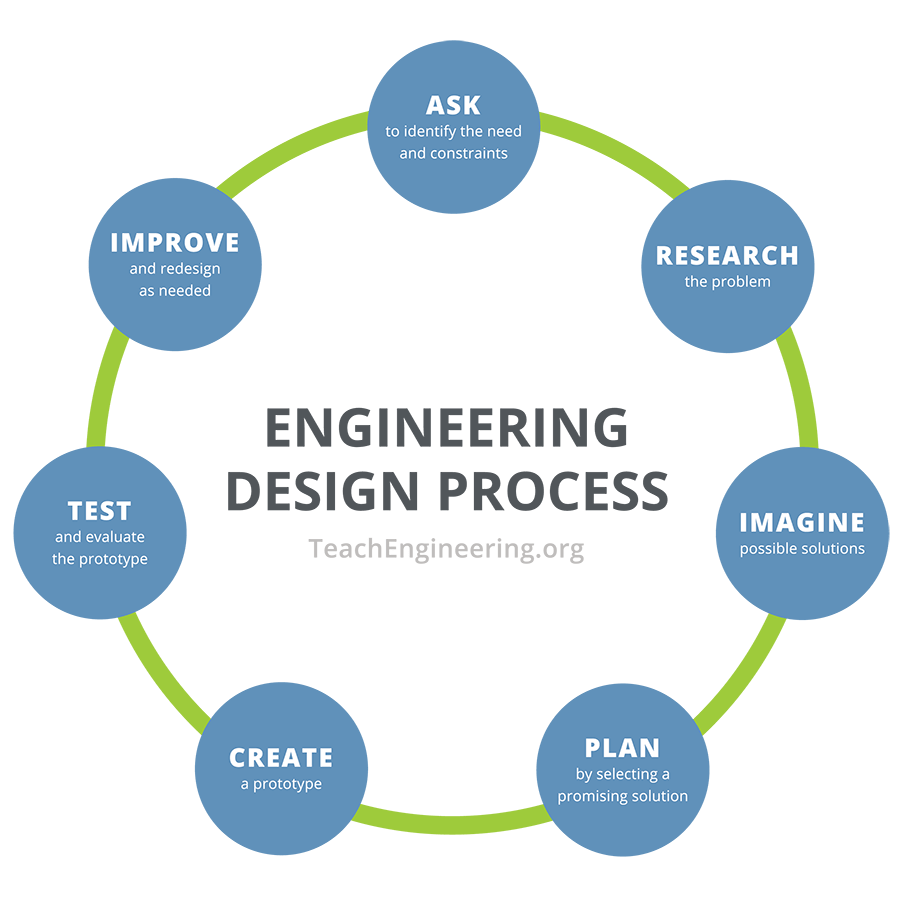
After informally using the various Engineering Design Process (EDP) steps in the previous design challenges, students are formally introduced to the seven-step EDP: Ask, Research, Imagine, Plan, Create, Test, and Improve. Students are also introduced to Design Thinking to help them creatively problem-solve and innovate throughout the Engineering Design Process.
Creative Engineering Design: Paper Tower Design Challenge High School Activity
Students work as civil engineering teams in small groups to design and construct model towers out of paper with minimal teacher guidance on completing the challenge. Each team is given limited supplies (three sheets of paper, tape, and scissors) and limited time (one class period), paralleling the real-world resource/cost limitations faced by engineers. Teams aim to build their towers for maximum height and stability to withstand a simulated lateral "wind" load.
Design Step 1: Identify the Need High School Activity
Students practice the initial steps involved in an engineering design challenge. They begin by reviewing the steps of the engineering design loop and discussing the client need for the project. Next, they identify a relevant context, define the problem within their design teams, and examine the project's requirements and constraints. (Note: Conduct this activity in the context of a design project that students are working on, which could be a challenge determined by the teacher, brainstormed with the class, or the example project challenge provided [to design a prosthetic arm that can perform a mechanical function].)

Reaction Exposed: The Big Chill! High School Activity
In the presence of water, citric acid and sodium bicarbonate (aka baking soda) react to form sodium citrate, water, and carbon dioxide. Students investigate this endothermic reaction. They test a stoichiometric version of the reaction followed by testing various perturbations on the stoichiometric version in which each reactant (citric acid, sodium bicarbonate and water) is strategically doubled or halved to create a matrix of the effect on the reaction. By analyzing the test matrix data, they determine the optimum quantities to use in their own production companies to minimize material cost and maximize carbon dioxide production. They use their test data to "scale-up" the system from a quart-sized ziplock bag to a reaction tank equal to the volume of their classroom. They collect data on reaction temperature and carbon dioxide production. More advanced students are challenged to theoretically predict the results using stoichiometry.
Creating Mini Wastewater Treatment Plants High School Activity
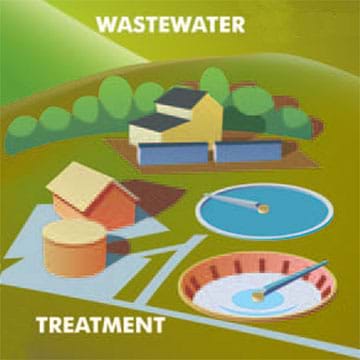
Student teams design and then create small-size models of working filter systems to simulate multi-stage wastewater treatment plants. Drawing from assorted provided materials (gravel, pebbles, sand, activated charcoal, algae, coffee filters, cloth) and staying within a (hypothetical) budget, teams create filter systems within 2-liter plastic bottles to clean the teacher-made simulated wastewater (soap, oil, sand, fertilizer, coffee grounds, beads). They aim to remove the water contaminants while reclaiming the waste material as valuable resources. They design and build the filtering systems, redesigning for improvement, and then measuring and comparing results (across teams): reclaimed quantities, water quality tests, costs, experiences and best practices. They conduct common water quality tests (such as turbidity, pH, etc., as determined by the teacher) to check the water quality before and after treatment.

Creative Engineering Design High School CurricularUnit
Students are introduced to the world of creative engineering product design. Through six activities, teams work through the steps of the engineering design process (or loop) by completing an actual design challenge presented in seven steps. The project challenge is left up to the teacher or class to determine; it might be one decided by the teacher, brainstormed with the class, or the example provided (to design a prosthetic arm that can perform a mechanical function). As students begin by defining the problem, they learn to recognize the need, identify a target population, relate to the project, and identify its requirements and constraints. Then they conduct research, brainstorm alternative solutions, evaluate possible solutions, create and test prototypes, and improve and redesign before manufacturing. See the Unit Schedule section for a list of example design project topics.
Simple Machines and the Rube Goldberg Challenge High School MakerChallenge
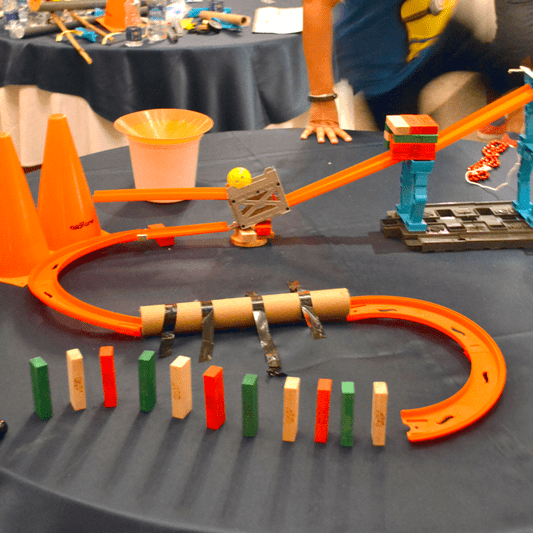
Students research simple machines and other mechanisms as they learn about and make Rube Goldberg machines. Working in teams, students utilize the engineering design process to design and build their own Rube Goldberg devices with 10 separate steps, including at least six simple machines. In addition to the use of readily available classroom craft supplies, 3D printers may be used (if available) to design and print one or more device mechanisms. Students love this open-ended, team-building project with great potential for creativity and humor.

Build and Test a Conductivity Probe with Arduino High School Activity
Student groups construct simple conductivity probes and then integrate them into two different circuits to test the probe behavior in solutions of varying conductivity (salt water, sugar water, distilled water, tap water). The activity culminates with student-designed experiments that utilize the constructed probes. The focus is to introduce students to the fabrication of the probe and expose them to two different ways to integrate the probe to obtain qualitative and quantitative measurements, while considering the application and utility of a conductivity probe within an engineering context. A provided handout guides teams through the process: background reading and questions; probe fabrication including soldering; probe testing and data gathering (including circuit creation on breadboard); probe connection to Arduino (including circuit creation and code entry) and a second round of testing and data gathering; design and conduct their own lab experiments that use the probes; online electrolyte/nonelectrolyte reading, short video, comprehension check and analysis questions.
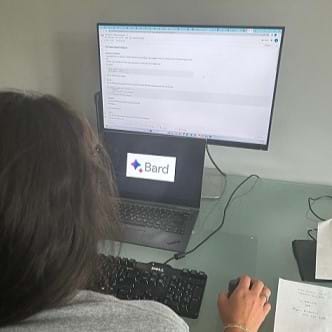
Python Conditionals Using AI Technology High School Activity
One way for engineers to be effective in creating designs is to understand technology tools support their efforts. These technology tools themselves are often designed by engineers! In this activity, students utilize Google's Colab and Google's Bard to master writing “if” statements in Python while also analyzing the effectiveness of an AI tool to define future success criteria for engineers developing tools like Bard. Engaging in various activities, students delve into the significance of conditionals, understanding how they enhance code readability and enable more innovative programming approaches. Moreover, students venture into exploring the effectiveness of AI technologies in programming, providing insightful suggestions for refining and engineering future AI tools.
Creative Engineering Design: Straw Bridge Design Challenge High School Activity
Working as engineering teams, students use the engineering design process to plan, create, and test model bridges using plastic drinking straws and tape as their construction materials. Their goal is to build the strongest bridge with a truss pattern of their design while meeting the design criteria and constraints. They experiment with different geometric shapes and determine how shapes affect the strength of materials.
Last updated 11 hour(s) ago